
Futures
US Midterm Elections 2026: Stock Market Impact on Nasdaq, Bonds & the Dollar
How could the 2026 US midterms affect stocks, Nasdaq futures, Treasury yields and the dollar? Explore three scenarios, history and election-week risks.
On this page+
The US midterm elections take place on Tuesday, November 3, 2026, against a backdrop of volatile AI-related earnings, significant infrastructure investment, bond-market concerns and upcoming economic data. Control of the House and Senate can shape fiscal negotiations and regulation, but it does not mechanically decide whether stocks, Treasury yields or the dollar rise. Prepared on November 2 before the election result is known, this TradeLuma guide compares possible congressional outcomes, historical stock-market patterns and practical risk controls for traders.
US midterm elections 2026: the market quick answer
Control of the US Congress can influence taxation, spending, regulatory priorities and the risk of budget disputes. That matters to businesses, but it does not automatically determine what happens to the S&P 500, Nasdaq or Treasury yields.
A market moves when expectations change. A result largely anticipated by investors may cause only a modest reaction, while a surprise can affect stocks, bond yields and currencies in different directions. This is a scenario guide, not a forecast of the winning party.
When is the US midterm election in 2026?
Election Day is Tuesday, November 3, 2026. All 435 voting House districts and 35 Senate races, including two special elections, are involved. The presidency is not on the ballot in this midterm election.
This article is published on November 2, before the vote. No election outcome is assumed. Close contests could keep control of a chamber unresolved after election night; a news projection is not the same as final certification.
Why does control of Congress affect financial markets?
The House and Senate influence legislation, the federal budget, oversight and appointments through different procedures. Proposed laws also face presidential action, procedural obstacles and implementation delays.
A political headline should therefore be translated into a specific, feasible policy change before assigning a market effect. Broad sector claims can hide major differences between individual companies.
What do markets expect before the vote?
Pre-election forecasts have discussed the possibility of a divided Congress, but polls, prediction markets and portfolios can imply different expectations. None predicts the actual result with certainty.
The right question is whether the reported outcome differs from the expectation already reflected in asset prices. An outcome that appears dramatic politically may have little immediate price impact if it was widely anticipated.
Scenario 1: Republicans retain the House and Senate
Continued Republican control could increase expectations of legislative cooperation with the Republican White House on taxation, deregulation and spending proposals. Investors might reprice particular industries according to the likely details.
That is not automatically positive for the Nasdaq. If fiscal policy raises projected deficits, borrowing or inflation, higher long-term Treasury yields could offset potential benefits for growth stocks.
Scenario 2: Congress is divided between the parties
Split control may reduce the probability of sweeping new laws and lead investors to expect more negotiation. Some may interpret this as policy stability; others may worry about federal budget deadlines and financing disputes.
Executive actions, state-level policies, regulatory decisions and existing legislation still operate under divided government. The possibility of gridlock offers no guaranteed bullish or bearish signal.
Scenario 3: Democrats gain control of both chambers
Democratic control of both chambers could change expectations for oversight, spending negotiations and policy affecting healthcare, finance, energy and technology businesses.
The president's veto and Senate procedures would still constrain legislation, so not every proposal would be enacted. Markets would need to assess what could realistically change rather than treating the outcome as an automatic rally or selloff.
What happens if results are close or delayed?
Competitive races may require more time before a chamber's control is clear. News outlets can project winners using different methods, but a projection is not the final legal result.
Uncertainty can lead to price gaps or reversals, especially outside the main US cash-equity session. However, earnings, inflation news and changes in rates can create similar price action; do not attribute every move to the vote.
Do stocks historically rise after midterm elections?
Several historical studies report relatively soft average returns during midterm election years and stronger average returns in the months after the vote. BlackRock's October 2026 review, for example, reported a roughly 14.1% average S&P 500 gain over six months after elections in its selected historical sample.
These averages are descriptive, not predictive. Results vary by sample period and starting valuation; business cycles, monetary policy and corporate profits can explain part of the historical pattern. A positive average does not preclude a negative election week or year.
Could the S&P 500 or Nasdaq fall after the election?
Yes. A result matching expectations can still coincide with a decline if technology earnings disappoint, bond yields climb or the growth outlook weakens. Broad indexes contain companies with different exposures.
The more useful analysis measures the size and persistence of any change in earnings expectations, discount rates and risk appetite. Avoid extrapolating one overnight futures move into a long-term investment forecast.
Why Nasdaq and AI stocks need a separate lens
The Nasdaq is heavily influenced by large growth and technology companies. AI earnings and the cost of computing infrastructure have become important valuation drivers, including the economics of high-bandwidth memory and data-centre power demand.
An election result may matter less to a chip or cloud stock than its latest capital expenditure guidance, cash-flow prospects or an unexpected supply constraint. Keep company-specific fundamentals separate from congressional scenarios.
How might two-year and ten-year Treasury yields react?
Treasury yields incorporate expectations for interest rates, inflation, growth, budget deficits and government debt issuance. Investors might read a policy outcome as implying tighter fiscal constraints or larger financing needs, but the direction is not fixed by party labels.
Two-year yields are often more sensitive to near-term monetary policy, while ten-year yields include longer-term expectations and term premium. Bond prices and yields move inversely, and the yield curve can change even if stocks barely move.
What might happen to the US dollar?
The dollar reflects relative interest rates, global funding needs, economic expectations and demand for safe assets. During some risk-off episodes it strengthens even as US shares fall.
Comparing the dollar with Treasury yields, oil prices and major currency pairs helps distinguish a rate-driven move from a broader liquidity shock. The yen carry trade provides one possible link between exchange rates and leveraged global exposures.
Sectors to watch: banks, healthcare, defense and energy
Policy debates may affect financial regulation, defense procurement, healthcare reimbursement and infrastructure spending differently. Utilities also face project finance costs and energy-system investment choices.
A sector label is only a starting point: enacted policy, agency discretion, state and local regulation, cash flow and company balance sheets often matter more than a congressional headline.
Why AI data centres and local policy matter
The AI buildout depends on electricity access, transmission lines, site permits, grid connection dates and financing. These constraints can be influenced by state and local policy as well as Washington.
A change in governance may alter a project's timetable without moving the overall Nasdaq much. Track data-centre electricity demand, construction risk and the cost of capital rather than assuming all AI infrastructure companies move together.
Oil, inflation and the Federal Reserve complicate the story
Elevated oil prices and inflation concerns were part of the late-October 2026 market debate. Changes in energy costs can influence rate expectations, Treasury yields and the purchasing-power outlook at the same time as political news.
An election-night rally could reflect falling yields or improved earnings expectations rather than the vote itself. Conversely, an inflation surprise could overwhelm market relief from an outcome that reduces political uncertainty.
What else is scheduled during election week?
The November 2–6 calendar includes additional corporate earnings, labor-market reports and US Treasury financing news. These events can move Nasdaq futures and bonds independently of election outcomes.
Use confirmed event times and compare price action with the actual release sequence. For a disciplined analysis, note whether an earnings update, Fed-related development or data surprise preceded the move.
Nasdaq and S&P 500 futures: what changes overnight?
NQ, MNQ, ES and MES futures trade beyond the regular US stock-market session, subject to exchange schedules. An overnight market is not necessarily a deep market; spreads and available liquidity can change when news breaks.
Check futures margin and tick value for the exact contract. Micro contracts can reduce nominal exposure compared with larger contracts, but stop orders may still fill away from the desired price during a fast market.
Election-week risk management for active traders
Before entering, define the event window, position-size limit, acceptable liquidity and maximum loss. Consider correlated exposure across equity indexes, currencies and interest-rate products instead of treating each trade as isolated.
Test order handling in paper trading, especially where automated alerts, stop orders, duplicate signals or emergency controls are involved. Slippage, gaps and delayed information can make a seemingly small position riskier than its normal-session calculation suggests.
What to monitor after November 3
Track the level of confidence around the House and Senate outcomes, then compare the market's actual response across S&P 500 and Nasdaq futures, two-year and ten-year yields, the dollar and oil.
Watch for cross-asset confirmation over time. A one-minute move can reverse when a headline is corrected, a race is reclassified or an unrelated earnings release changes the picture.
Common mistakes in election-market analysis
Avoid declaring one political party permanently good or bad for stock prices, confusing historical averages with guarantees, and assuming a proposed policy is already law.
Trading errors include overleveraging on poll probabilities, widening stops into a gap, using stale broker orders or ignoring another scheduled catalyst. A strong narrative is not a substitute for a risk-defined plan.
Bottom line: a market framework, not an election prediction
The 2026 US midterms can alter expectations about spending, oversight and regulation, but the effect is conditional and may vary by asset class. Corporate earnings, inflation, the Fed and market positioning remain major drivers.
This guide was prepared before Election Day and does not assert a winner. The practical approach is to plan several outcomes, monitor reliable updates, measure actual market reactions and keep exposure consistent with one's risk tolerance.
Frequently asked questions
When is the 2026 US midterm election?+
Tuesday, November 3, 2026. This article was prepared on November 2, before the results.
Are the 2026 midterm results known?+
Not at this article's November 2 publication date. All potential changes in congressional control discussed here are scenarios.
What is on the ballot in the US midterms?+
The congressional election includes all 435 voting House seats and 35 Senate races, including special elections; it does not elect a new president.
Do midterm elections make stocks go up?+
Not necessarily. Historical averages cannot guarantee short-term or long-term returns. Earnings, valuations, interest rates and policy expectations matter.
Which political party is better for the stock market?+
No party produces a reliably positive market outcome in every economic environment. The surprise relative to expectations and actual policy changes matter more.
What happens to Nasdaq after the midterms?+
Nasdaq may react to policy probabilities, but AI earnings, bond yields and growth expectations can dominate the result.
Is divided government bullish for stocks?+
Not automatically. It can limit rapid legislative changes but can also increase the risk of prolonged budget negotiations.
Can Treasury yields rise after a midterm election?+
Yes. They may rise with higher expected inflation or borrowing, or fall if growth and fiscal expectations weaken.
What happens to the dollar after the US election?+
The dollar depends on relative interest rates, global demand for liquidity, inflation and growth; there is no fixed election rule.
Why can Nasdaq and Dow react differently?+
They have different sector and company exposures. Long-duration technology valuations can be more rate-sensitive.
Will results be final on election night?+
Not necessarily. Some close races may remain undecided; media projections and final official results are distinct.
Can NQ or MNQ futures gap on election news?+
Yes. Rapid changes in expectations and variable liquidity can produce gaps, slippage and reversals.
Are post-midterm rallies historically guaranteed?+
No. Historical averages are specific to the sample and cannot guarantee what happens after November 2026.
Which other events matter in election week?+
Technology earnings, US labor-market data, Treasury financing news and central-bank expectations can also drive prices.
Should I trade larger positions when an election outcome seems certain?+
A perceived probability is not a risk limit. Exposure should account for scenario uncertainty, liquidity, leverage and potential gaps.
How do I manage automated trading alerts during an election?+
Set defined order expiry, maximum loss and exposure controls, test in paper mode and plan for delayed or duplicate signals.
What should I monitor on November 4?+
Congressional control uncertainty, Nasdaq and S&P 500 futures, Treasury yields, the dollar, oil, volatility and scheduled earnings/data.
Does this article predict who wins Congress?+
No. It is a pre-election educational analysis dated November 2, 2026, not a prediction or financial recommendation.
Futures workflows
Explore the strategy side of TradeLuma.
Browse TradeLuma's futures strategy catalogue and the chart, rollover, and reference methodology used for each published strategy.
Explore futures strategies →Continue learning
Related guides.
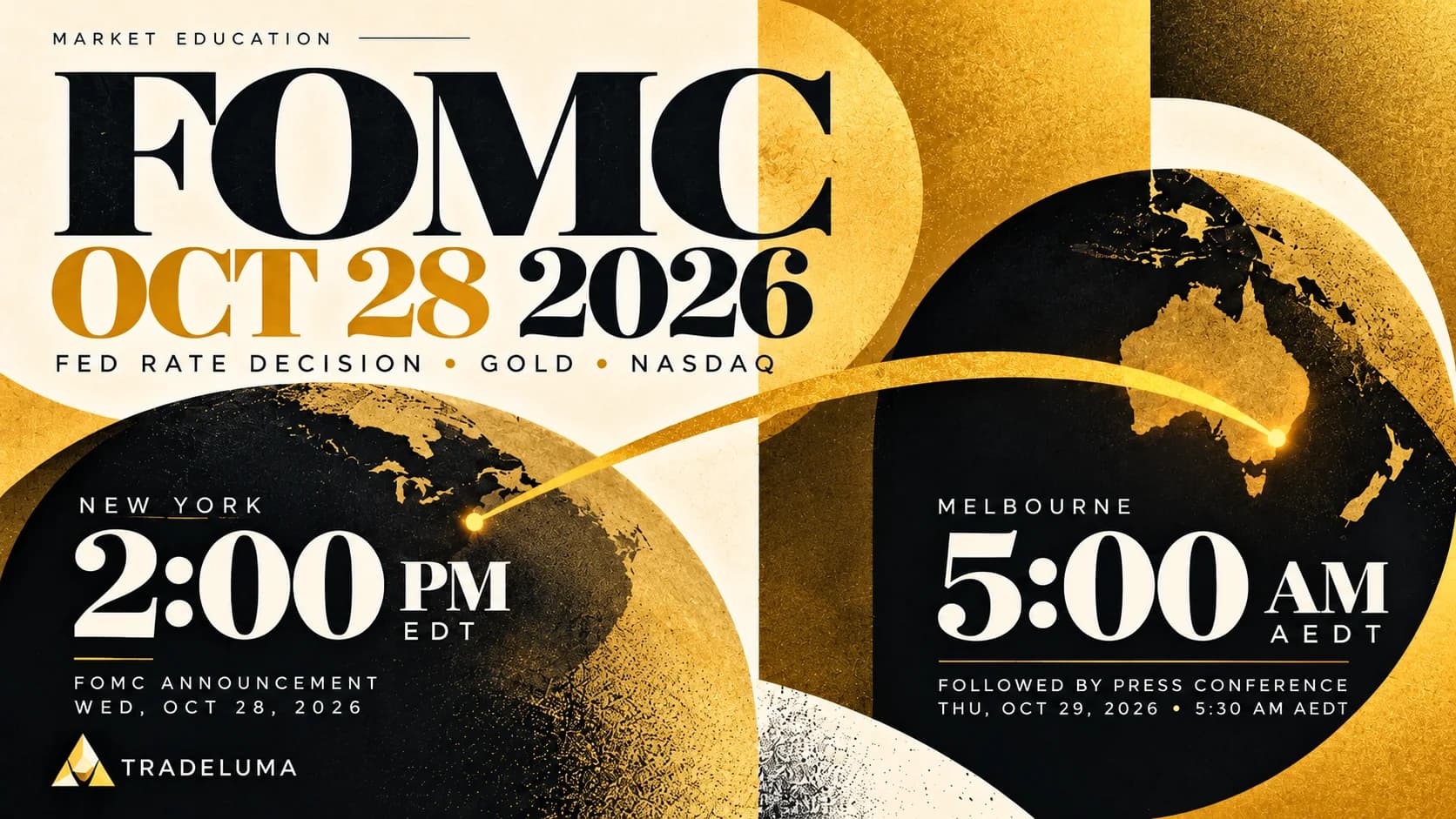
FOMC Meeting October 2026: Fed Rate Decision Time, Expectations & Gold/Nasdaq Impact
October 2026 FOMC decision time in New York and Australia, Fed rate expectations, statement and press conference explained, plus gold and Nasdaq trading risks.
Nonfarm Payrolls (NFP) Explained: Why Jobs Data Moves Gold & Nasdaq
Learn what US nonfarm payrolls, wages, unemployment and revisions mean, and why NFP surprises can move gold, Nasdaq and Treasury futures.
US Midterms 2026: Stock Market Winners, Losers & What Happens Next
Which stocks won and lost after the 2026 US midterms? Explore healthcare, housing, clean energy, defence, AI, Nasdaq, gold and Treasury yields.