
Technical Analysis
ICT Kill Zones: Exact London, New York & Asian Session Times + DST Guide
Learn ICT Kill Zone times for Asia, London, New York and London Close, how daylight saving changes conversions, and how traders test time-based setups.
On this page+

ICT Kill Zones are time windows used by traders who follow Inner Circle Trader-style market concepts. The idea is simple: instead of treating every hour of the trading day as equally important, the trader studies a smaller set of session windows around Asia, London and New York. The difficult part is that different educators publish slightly different Kill Zone schedules, and fixed UTC tables can become wrong when daylight saving changes. This guide separates the commonly cited New York-time convention from broader modern session filters, explains daylight-saving conversion, and shows how to test whether a time window actually improves a setup.
What is an ICT Kill Zone?
An ICT Kill Zone is a defined intraday window used to focus analysis around a major trading session. The concept is associated with Inner Circle Trader-style methods and is often combined with liquidity sweeps, market-structure shifts, displacement, fair value gaps and other price-action rules.
The important distinction is that a Kill Zone describes when a trader is willing to look for a setup. It does not prove that a trade should be taken. A complete plan still needs a directional thesis, a setup definition, an entry trigger, invalidation, position size and exit rules.
ICT Kill Zone times: quick reference
One widely cited four-window convention uses New York local time as the base: Asian Kill Zone 19:00-22:00; London Kill Zone 02:00-05:00; New York Kill Zone 07:00-09:00; London Close Kill Zone 10:00-12:00.
Treat those times as a convention that must be defined inside your own rules rather than as a law of market structure. Other modern guides use expanded windows such as 20:00-00:00 for Asia, 08:30-11:00 for New York AM, or a separate New York PM window. Mixing two schedules inside one backtest makes the result difficult to interpret.
Why different websites show different Kill Zone times
The phrase Kill Zone is used across a large trading community, and the boundaries have not been standardised like exchange trading hours. Some guides preserve narrower legacy windows, while others expand them to cover more of the session open, the US cash-market open, or the afternoon session.
The practical solution is to record the exact schedule beside the strategy version. If a setup was tested using 07:00-09:00 New York time, do not later describe the same results as evidence for an 08:30-11:00 window. Time definitions are part of the strategy.
Asian Kill Zone
The Asian Kill Zone is commonly used to study the overnight range and the highs and lows that form before Europe becomes active. Under the four-window convention used in this guide, the window is 19:00-22:00 New York local time.
Traders often care less about large directional movement during this window and more about the range it creates. The Asian high and Asian low may later become reference levels for London-session liquidity sweeps, breakouts or rejections.
London Kill Zone
The London Kill Zone is commonly placed at 02:00-05:00 New York local time. It overlaps the period when European participation increases and is therefore frequently studied in major FX pairs and other globally traded markets.
A common price-action sequence is an overnight range, a move beyond one side of that range, and then either continuation or rejection. The time window does not tell the trader which outcome will occur. It simply narrows the period in which the strategy is permitted to search for its other conditions.
New York Kill Zone
A commonly cited New York Kill Zone runs from 07:00-09:00 New York local time. Some modern approaches extend the window later to include major US data releases and the cash-market open, so traders should be especially careful about which definition they are using.
For futures, gold and US indices, the New York morning is naturally important because scheduled economic releases and the US market open can change volume and volatility quickly. That market reality does not mean every ICT-labelled setup in the window has an edge; the exact entry model still needs independent testing.
London Close Kill Zone
The London Close Kill Zone is commonly described as 10:00-12:00 New York local time. It captures a period when the European trading day is moving toward its close while North American markets remain active.
Some traders study this window for reversals, profit taking or a transition away from the morning move. Those are hypotheses rather than guarantees. If London Close is part of a strategy, test its behaviour separately instead of assuming that a morning pattern automatically repeats later in the day.
New York local time is the safest anchor
The cleanest way to avoid daylight-saving mistakes is to store Kill Zone rules in New York local time first. New York switches between Eastern Standard Time, UTC-5, and Eastern Daylight Time, UTC-4.
If a platform allows an America/New_York timezone, use it rather than hard-coding UTC. A fixed UTC schedule can drift by one hour when the United States changes daylight saving, which can silently move entries outside the intended session.
How daylight saving changes UTC conversions
When New York is on EST, add five hours to convert New York time to UTC. When New York is on EDT, add four hours. For example, a 02:00-05:00 London Kill Zone converts to 07:00-10:00 UTC in EST and 06:00-09:00 UTC in EDT.
The Kill Zone clock labels do not need to change if the strategy is anchored to New York local time. What changes is the UTC equivalent and therefore the local time seen by traders in Europe, Australia and other regions.
ICT Kill Zones in Melbourne and Australia
Australian conversion is more complicated because Victoria and the United States change daylight saving on different dates. Melbourne can be 14, 15 or 16 hours ahead of New York depending on the time of year and the short transition periods between clock changes.
As an example on 5 October 2026, Melbourne is on AEDT while New York remains on EDT, making Melbourne 15 hours ahead. Under the four-window convention, London 02:00-05:00 New York maps to 17:00-20:00 Melbourne, New York 07:00-09:00 maps to 22:00-00:00, and London Close 10:00-12:00 maps to 01:00-03:00 the following Melbourne day. Recalculate whenever either region changes clocks.
Kill Zones versus normal market sessions
A trading session is a broad market-hours concept. A Kill Zone is a narrower strategy filter inside or around that session. The London forex session lasts much longer than a three-hour London Kill Zone, and the New York trading day lasts much longer than a two-hour New York Kill Zone.
This distinction matters when reviewing performance. A strategy may perform well during the entire London session but poorly inside a narrower Kill Zone, or the opposite. Test the filter that will actually be used in live execution.
Kill Zones versus the ICT Silver Bullet
Kill Zones and Silver Bullet windows are related time-based ideas but they are not the same thing. A Kill Zone is a broader session window. Silver Bullet models are usually described as narrower one-hour periods with additional setup conditions.
Do not treat one label as proof of the other. If a Silver Bullet setup is being tested, record the exact one-hour window and its entry rules rather than inheriting results from a broader Kill Zone backtest.
How traders combine Kill Zones with liquidity and market structure
A structured model might begin by marking a prior session high or low, then waiting for price to trade beyond that level during a chosen Kill Zone. The trader may then require a reclaim, displacement, CHoCH or MSS, followed by a retracement into an FVG or another predefined entry area.
The sequence matters. A time window by itself creates too many signals, while adding every possible SMC label after the move creates hindsight. Write the required order of events before the session starts.
Do Kill Zones work for gold and futures?
Gold futures, US index futures and major FX markets all show strong intraday changes in activity around session opens and scheduled economic events. That makes time-of-day filtering a reasonable research question.
It does not follow that one branded Kill Zone schedule will automatically improve every strategy. Gold can react strongly before, during or after a chosen window depending on data releases, liquidity and the broader market regime. Futures traders should also account for contract-specific trading hours and exchange maintenance periods.
Economic releases can dominate the time window
US employment data, inflation releases, central-bank decisions and other scheduled events can create abrupt volatility inside a New York window. A strategy that ignores the event calendar may appear to have a time-of-day edge when the real driver is a small number of high-impact announcements.
Backtests should therefore tag major news days or test them separately. Traders also need a rule for whether entries are allowed immediately before a scheduled release, after the release, or not at all.
Common Kill Zone mistakes
The most common timing mistake is mixing EST, EDT, UTC and local computer time. Another is changing the Kill Zone definition after seeing where the winning move occurred. Both errors create misleading backtests.
Other problems include treating every liquidity sweep as an entry, assuming volatility equals profitability, ignoring spread and slippage around data releases, and taking a setup simply because it occurred inside the correct time window.
How to backtest an ICT Kill Zone
Start with one market, one timeframe and one exact New York-time window. Define the setup independently of the clock: for example, the swing rule, liquidity level, sweep distance, displacement threshold, FVG definition, entry, stop and target.
Then compare the same strategy with and without the time filter. Measure signal count, win rate, average win and loss, expectancy, profit factor, drawdown, adverse excursion, favourable excursion and transaction costs. A useful time filter should improve the strategy in a way that survives different samples rather than simply removing losing trades from one historical period.
How to test whether the time filter adds value
A strong test asks a counterfactual question: what happens to the exact same setup outside the Kill Zone? If performance is similar across the day, the time label may not be adding much information. If the chosen window consistently changes expectancy or risk characteristics, the filter may be useful.
Also test nearby boundaries. If a strategy appears excellent from 07:00-09:00 but collapses when the start time moves by 15 minutes, the result may be overfitted. Robust timing effects usually tolerate small changes in the window.
A practical Kill Zone checklist
Before the session, confirm the timezone, daylight-saving state, Kill Zone definition, market, scheduled economic releases, higher-timeframe context and the exact setup sequence. During the window, take only signals that satisfy the written rules. After the session, record whether the time filter helped, hurt or had no effect.
The goal is not to trade more because a Kill Zone has opened. The goal is to make time an explicit, testable variable inside a complete trading process.
Frequently asked questions
What are the ICT Kill Zone times?+
A commonly cited New York-time convention uses Asian 19:00-22:00, London 02:00-05:00, New York 07:00-09:00 and London Close 10:00-12:00. Other guides use broader windows, so traders should define the exact schedule they are testing.
What time is the ICT London Kill Zone?+
A commonly cited London Kill Zone is 02:00-05:00 New York local time. Its UTC and local-time conversion changes when daylight saving changes.
What time is the ICT New York Kill Zone?+
A commonly cited New York Kill Zone is 07:00-09:00 New York local time, although some modern approaches use a broader morning window.
What time is the Asian Kill Zone?+
A commonly cited Asian Kill Zone is 19:00-22:00 New York local time. Other schedules use wider Asian-session windows, so use one definition consistently.
Do ICT Kill Zone times change with daylight saving?+
If the strategy is anchored to New York local time, the New York clock labels stay the same. The UTC, London, Melbourne and other local-time conversions change when daylight saving changes.
Are ICT Kill Zones in EST or New York time?+
The safest implementation is New York local time using an America/New_York timezone. That automatically follows EST and EDT rather than hard-coding one fixed UTC offset.
What is the ICT Kill Zone time in Australia?+
It varies during the year because Australian and US daylight-saving transitions occur on different dates. Melbourne may be 14, 15 or 16 hours ahead of New York, so convert from New York local time for the specific date.
Do ICT Kill Zones work for gold?+
Gold has clear intraday changes in liquidity and volatility, especially around London, US data and New York trading. Whether a specific Kill Zone improves a gold strategy must be tested using fixed entry and risk rules.
Is the ICT Silver Bullet the same as a Kill Zone?+
No. Kill Zones are broader session windows. Silver Bullet models are usually narrower one-hour windows with their own setup conditions.
Can ICT Kill Zones be backtested?+
Yes. Keep the setup rules constant, define the time window in New York local time, include transaction costs, and compare results inside and outside the Kill Zone.
Technical analysis
Continue with the topic hub.
Browse the related TradeLuma guides and build the topic from foundations through practical application.
Explore Technical analysis guides →Continue learning
Related guides.

Order Blocks in Trading: How Traders Mark, Validate and Test the Zones
Learn what order blocks mean in technical analysis, how bullish and bearish zones are marked, and how traders test displacement, retests, and invalidation.
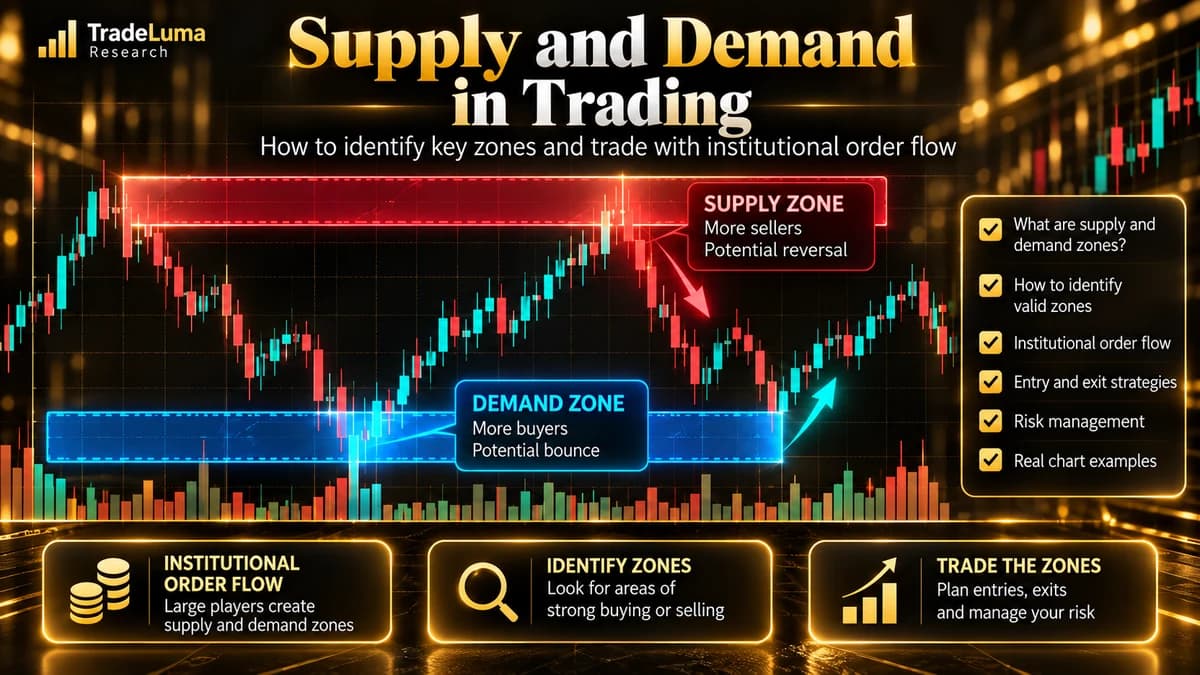
Supply and demand in trading: how traders identify zones of imbalance
Learn what supply and demand zones are, how traders identify them, and how to use them alongside structure, timing, and risk control.
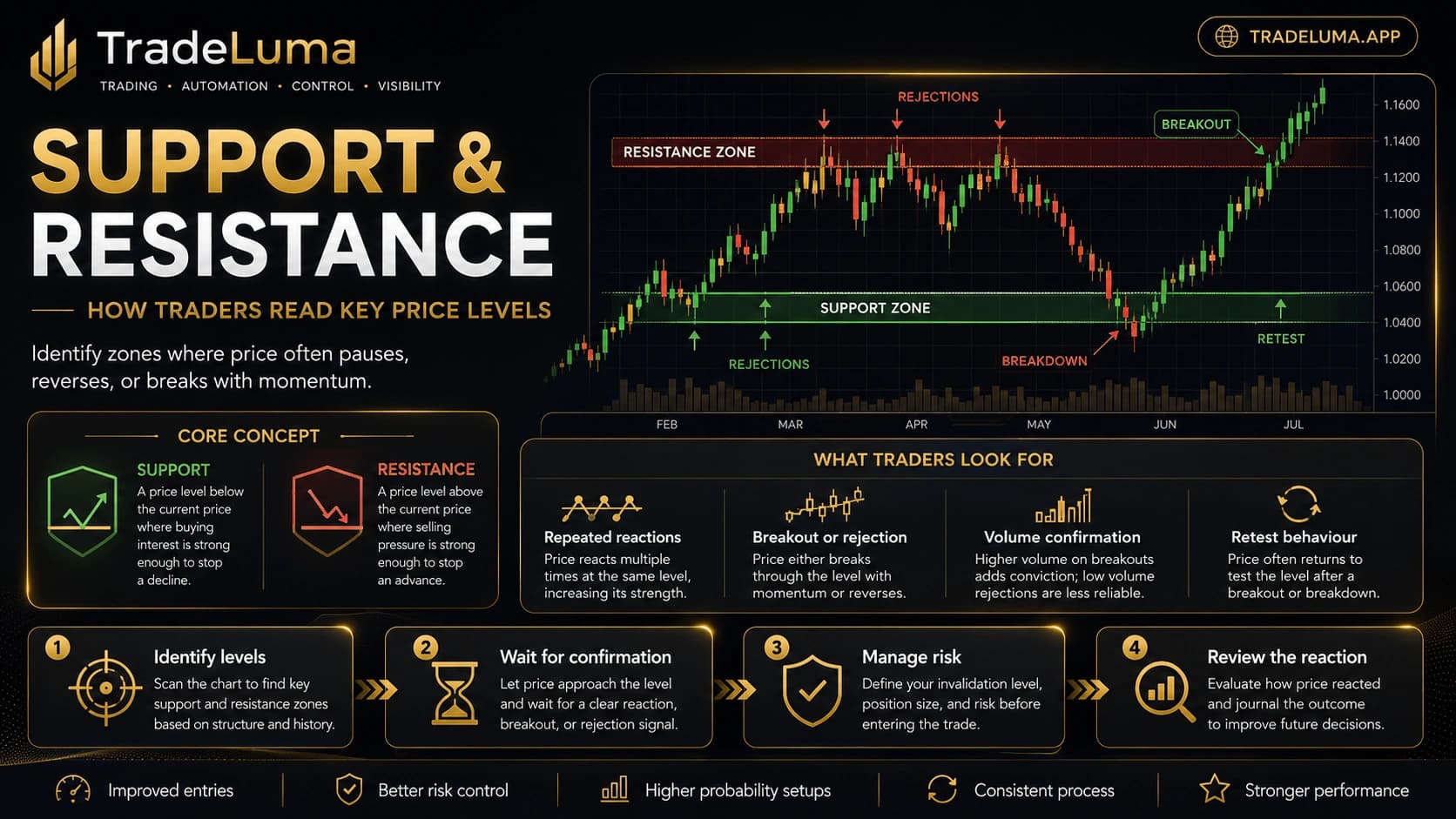
Support and resistance trading: how to identify key price levels
Learn what support and resistance mean, how traders identify key price levels, and how breakouts, rejections, and retests can shape better trade decisions.