
Strategy Research
How to Test a TradingView Strategy During a 24-Hour Trial
Use a 24-hour TradingView strategy trial effectively: verify chart settings, review simulated trades, observe signals and document your decision.
On this page+
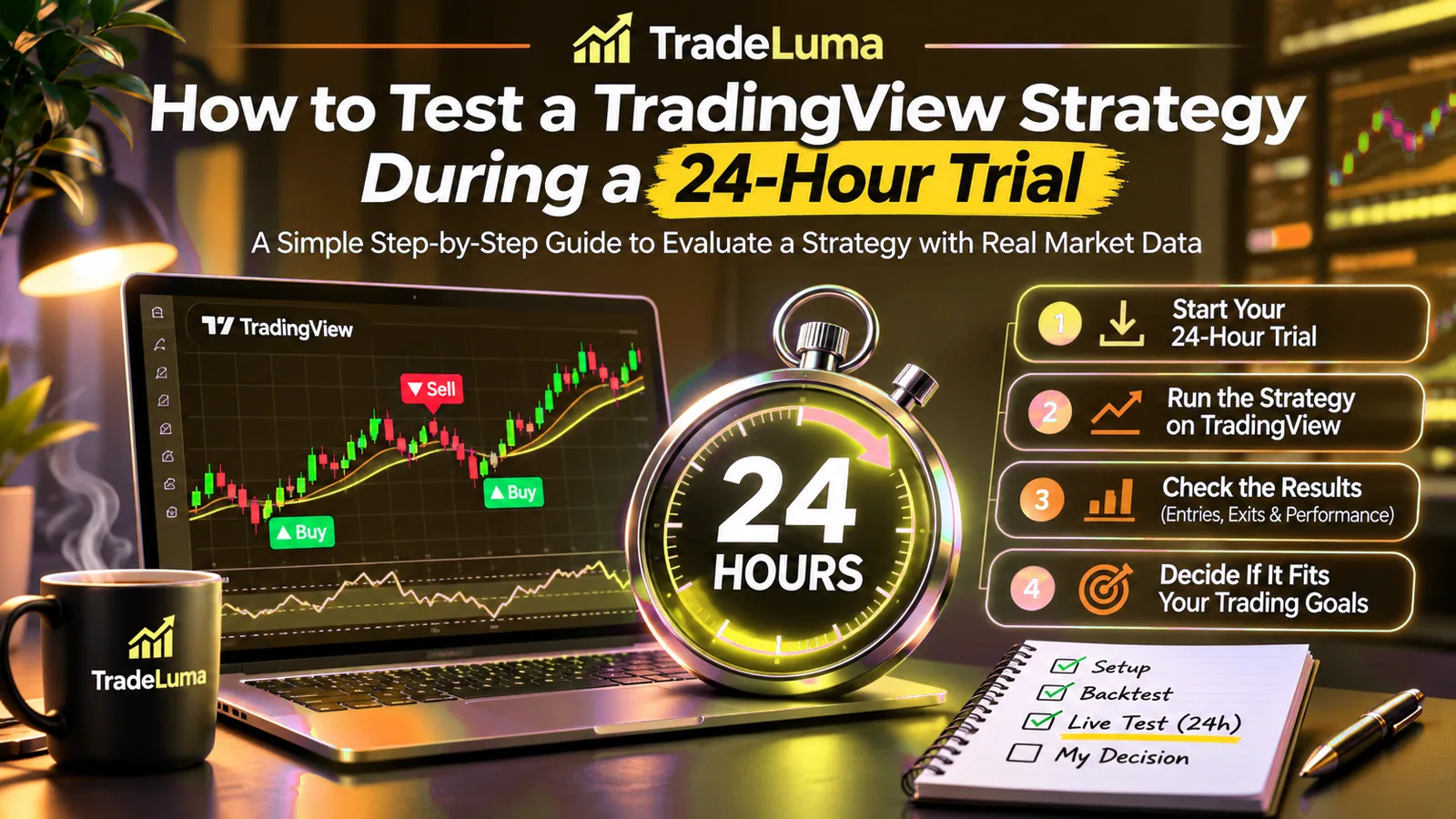
A one-day trial is a useful opportunity to check whether a script is understandable, accessible and compatible with your research workflow. It is not enough time to establish a statistically reliable trading edge. This guide gives a practical sequence for evaluating a protected strategy without needing to place a live order. The cover is a conceptual workflow, not a screenshot of actual signals. TradeLuma has a commercial interest in its own invite-only TradingView strategies. The catalogue is first-party product information, not an independent recommendation. Historical simulated results do not guarantee future performance. Futures are leveraged and losses can exceed initial margin.
Before the trial: define a decision checklist
Record the market, intended timeframe, risk tolerance, desired strategy behaviour and budget. Check the exchange session and whether your data subscription supports the desired observations. For leveraged futures, distinguish margin from capital that could be lost.
Read the product documentation and access terms before requesting a trial. With TradeLuma, eligible first-time customers receive 24 hours from manual access approval. No payment is taken when requesting access. A later paid subscription requires a separate purchase.
First hour: reproduce the reference setup
Use the exact TradingView username for which access was granted. Add the invite-only script using the authorised account, then confirm ticker, timeframe, chart type, continuous-contract settings and any required back adjustment. Save a screenshot of the setup and note the script version if visible.
Check whether your chart has enough loaded history for the stated research period. Differences in data, chart history and settings can explain mismatched simulated results before any conclusion about strategy quality is warranted.
Hours 1–4: examine the simulated trade report
Review the available Strategy Tester results: number of trades, net outcome, drawdown, profit factor and the size of losing trades. Inspect the list of simulated trades rather than focusing on a single headline figure. Record commission, slippage, quantity and fill assumptions.
Look for dependence on a few exceptional outcomes. If a reference period contains very few trades, recognise that apparent consistency may be difficult to assess. If changing assumptions for research, document the change and keep the original settings separately.
During the session: observe signal behaviour
Keep the intended chart open or use permitted alert configurations. Log the time, bar state, symbol and any actual signals. If no valid setup occurs, record that observation rather than forcing a trade or changing conditions to create more activity.
Use paper trading or observation instead of risking capital simply to fit a 24-hour deadline. A four-hour strategy may produce no new entries in a day, particularly around quiet sessions, weekends and holidays. That does not by itself prove success or failure.
Before expiry: investigate differences
Compare your observations with the chart after a reload. A developing candle can change before it closes, and historical fill models differ from broker execution. Check whether signal behaviour is documented and whether any discrepancy needs clarification.
Review the guide to why profitable backtests fail in live trading if you find differences in chart entries, alert timestamps or fill assumptions. A trial cannot establish that a protected script is entirely free from repainting or selection bias.
Make a decision without pressure
Write down what you verified, what remains uncertain and whether the tool fits your workflow. Check subscription currency, initial pricing, renewal terms, support and any other necessary platform or data costs. Do not treat the expiry of a trial as a reason to buy.
For TradeLuma, the published strategy collections explain the intended chart setup, simulated historical metrics and access process. If the trial produces insufficient observations, it is reasonable to defer a purchase. Continuing paid access is a separate decision.
Frequently asked questions
When does the TradeLuma 24-hour trial begin?+
The eligible first-time trial starts when access is manually approved, not when the request is submitted.
Will I see a live trade during a 24-hour trial?+
Not necessarily. Signals depend on market conditions and the strategy's rules.
Do I need to place live orders?+
No. A chart review, simulated results and paper observations can help you evaluate functionality.
Is one day enough to prove a strategy works?+
No. A day can help validate the workflow but cannot establish a durable trading edge.
See the workflow
Follow the signal from TradingView to broker state.
Review how TradeLuma handles webhook intake, execution controls, broker routing, and reconciliation in the TradingView + Interactive Brokers workflow.
Explore TradingView + IBKR →Continue learning
Related guides.

How to Evaluate a TradingView Strategy Before Buying: 10 Things Every Trader Should Check
Ten practical checks before paying for a TradingView strategy: profit factor, drawdown, trade count, realistic costs, repainting, settings, market fit and vendor terms.

Long-Only vs Short-Only Trading Strategies: Why Separate Systems Can Make Sense
Compare directional trading systems, asymmetric market behaviour, combined exposure and separate long/short strategy research for futures traders.
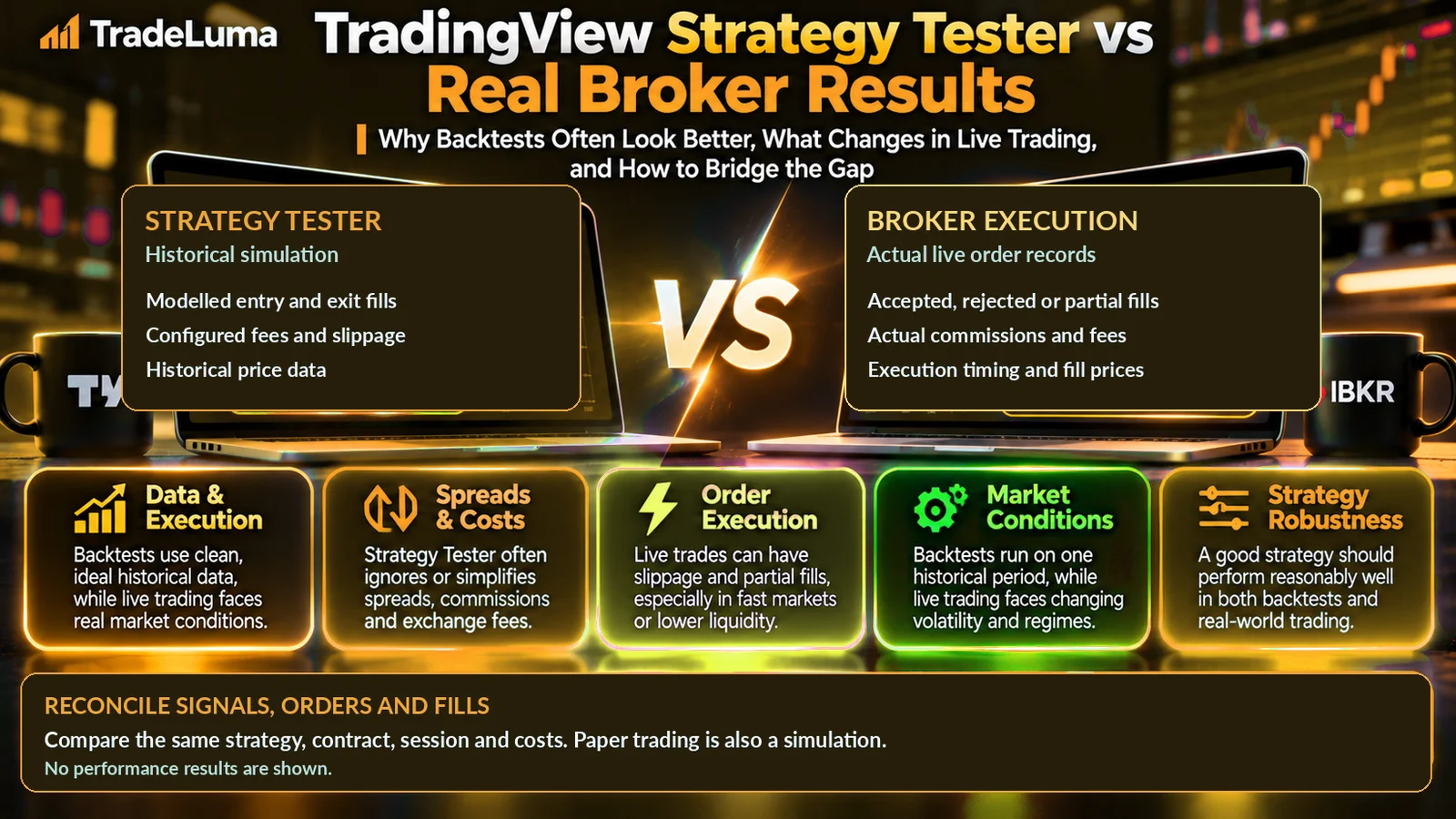
TradingView Strategy Tester vs Real Broker Results: Where Does the Profit Go?
Compare simulated and actual trade records using timestamps, commissions, slippage, missed orders, partial fills and a reconciliation workflow.