
Strategy Research
How to Evaluate a TradingView Strategy Before Buying: 10 Things Every Trader Should Check
Ten practical checks before paying for a TradingView strategy: profit factor, drawdown, trade count, realistic costs, repainting, settings, market fit and vendor terms.
On this page+
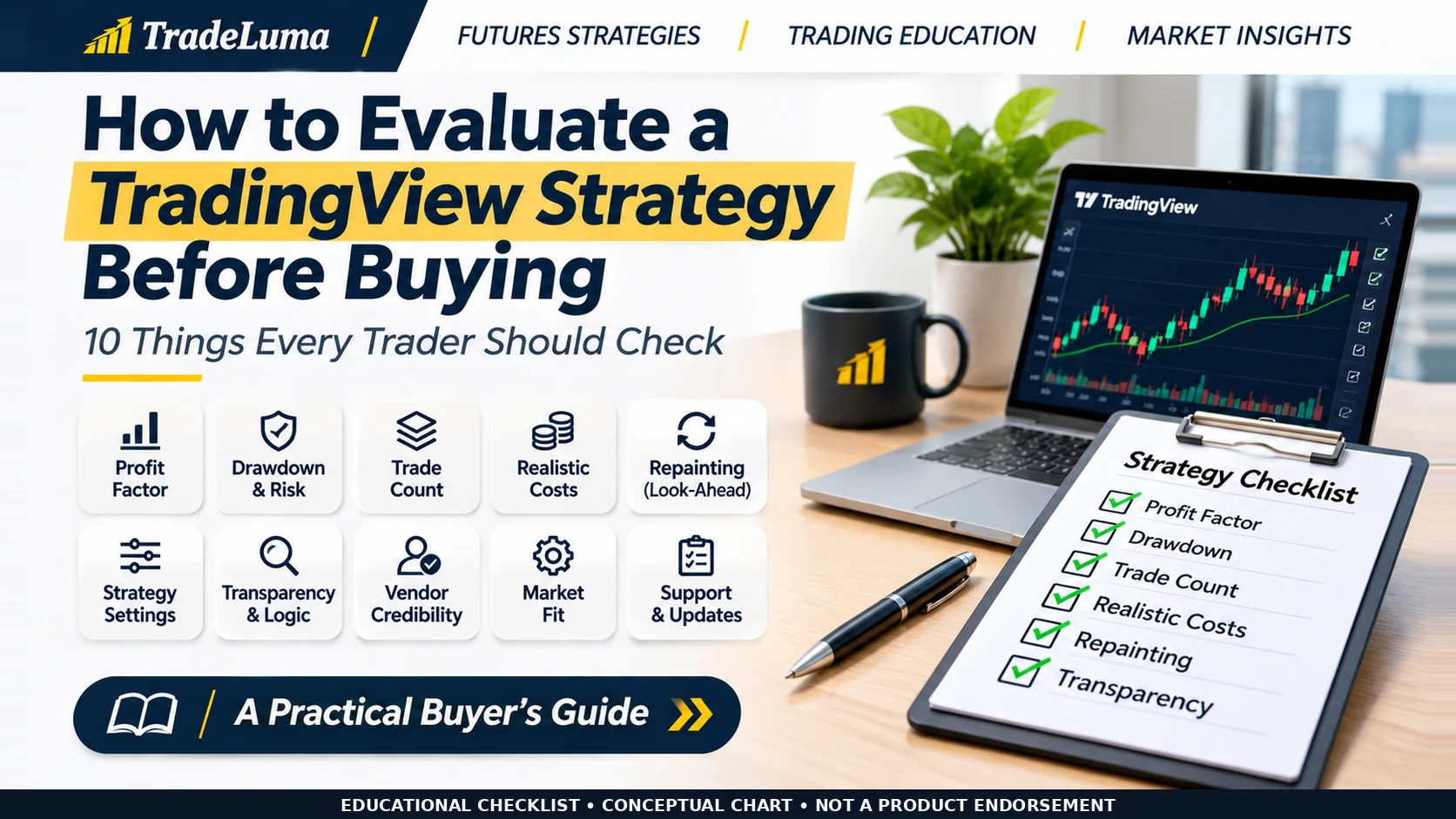
A persuasive equity curve is not enough to establish whether a paid TradingView strategy deserves further investigation. A buyer needs to understand exactly what was tested, how the results were calculated, what the script does and what the subscription or access arrangement includes. This guide offers ten questions that apply to any vendor, including TradeLuma. TradeLuma has a commercial interest in its own protected TradingView strategy scripts. The catalogue below provides first-party product information, not an independent ranking, recommendation or guarantee of returns. Futures are leveraged and losses can exceed initial margin.
1. Identify the market and reference settings
Ask for the exact ticker, contract month or continuous-chart convention, timeframe, chart type, data period and script version. A strategy designed for Micro Gold futures should not be assumed to behave identically on Nasdaq or silver. A chart on a different feed or timeframe may produce different results.
Record those settings before comparing reports. Standard candles and synthetic chart prices, such as Heikin Ashi, can have different implications for simulated fills. Ask which chart type the author actually supports.
2. Understand profit factor and net expectancy
Profit factor divides gross winning-trade amounts by the absolute gross losing-trade amounts. For example, $6,000 in winners and $4,000 in losses gives 1.5 before any costs not already included. Ask whether fees are reflected in each reported measure. If the sample has no losses, the ratio is not a meaningful finite estimate.
Expectancy is the average net outcome per trade under the sample assumptions. Neither figure forecasts the next trade, and a high ratio from a handful of outcomes can be fragile.
3. Review drawdown and capital assumptions
Maximum drawdown describes a decline from a preceding equity peak. If equity moves from $12,000 to $9,000, the decline is $3,000 or 25% of that peak. Confirm how the report measures intratrade and closed-trade drawdowns, and whether the percentage uses a comparable denominator.
Initial capital, leverage and position size influence the report. A small historical drawdown does not set a maximum future loss, particularly with leveraged futures.
4. Inspect the trade count and distribution
Ask for the number of completed trades, date range and distribution of gains and losses. A sample of 20 trades offers limited evidence, especially if one exceptional winner dominates results. More trades can help but correlated observations are not fully independent.
Compare periods of different market behaviour, and consider whether the test includes relevant volatility and liquidity conditions. No universal trade-count threshold proves an edge.
5. Verify commissions, slippage and fill assumptions
TradingView's strategy properties allow simulated costs and execution settings. Ask whether commission is per contract, per order or proportional, whether slippage is included and how limit fills are modelled. For example, an illustrative $5 average round-trip cost across 200 trades subtracts $1,000 if not already included.
A simulation cannot reproduce every queue position or rejected order. Stress-test costs rather than assuming the displayed result can be transferred directly to a broker account.
6. Investigate repainting and signal timing
Ask whether a signal is provisional during an open bar or confirmed at bar close, whether it uses higher-timeframe inputs, and whether historical markers can move after reload. Not all realtime updating is deceptive; the concern is a historical display that suggests a signal was available earlier than it really was.
Keep a timestamped record of actual observed alerts and compare with the same chart after reload using unchanged settings. This can reveal discrepancies but cannot prove that a protected script has no hidden bias.
7. Request evidence beyond the development sample
A developer may tune parameters using a development period. An untouched evaluation period provides a different test of the chosen rules, although any later changes turn that period into another development sample. Ask whether the report separates these stages.
Forward observations and paper orders provide additional evidence about signal timing and execution assumptions. None guarantees that future performance will resemble the sample.
8. Check what the script does and does not provide
A strategy can simulate entries and exits while an indicator may present analysis or alert conditions without a strategy report. Protected source code is not inherently a problem, but the vendor should explain the intended market, behaviour, limitations and supported settings sufficiently for evaluation.
Ask whether the product includes alerts, what changes require recreating them and whether broker connectivity needs another service. Buying access does not necessarily configure automatic execution.
9. Examine access, pricing and vendor credibility
Before payment, confirm the actual seller, billing currency, renewal terms, cancellation or refund policy, platform subscription requirements and support channel. TradingView has separate vendor and publishing rules; a listing or platform presence is not an endorsement of performance.
Be cautious with guaranteed returns, selective screenshots, undisclosed changes to results, pressure to pay and claims that trading is risk-free. Verify current access arrangements directly rather than assuming all invite-only scripts use the same commercial model.
10. Make a documented comparison before committing
Use the same questions for every candidate: market, version, costs, drawdown, sample, independent evaluation, timing, features, support and terms. Record unanswered items rather than giving the product credit for information you do not have.
TradeLuma publishes separate Gold, Nasdaq, Silver and Platinum script collections. Apply this checklist to our products too. The cover depicts a generic evaluation process, not a certified assessment or a TradingView endorsement.
Frequently asked questions
What should I check before buying a TradingView strategy?+
Reference settings, results and assumptions, signal timing, market fit, access terms and support.
Is a profit factor above 2 enough?+
No. Sample size, costs, drawdown and independent testing also matter.
Does a high win rate prove profitability?+
No. The relative size of gains and losses and all costs determine net outcomes.
Is protected source code a warning sign?+
Not on its own. Clear documented behaviour and independently observed signals remain important.
Can I test for repainting without source code?+
Forward logging and reload comparisons can detect some discrepancies but cannot prove its absence.
Is a TradingView strategy the same as automation?+
No. Script access, alerts and broker execution are separate.
Does TradingView endorse paid scripts?+
A listing is not evidence of a performance endorsement.
Can historical results guarantee future profits?+
No.
Put it into practice
Use the risk maths next to the guide.
Open TradeLuma's free position-size, risk/reward, expectancy, and drawdown tools to test the numbers behind a risk-management decision.
Open free trading calculators →Continue learning
Related guides.
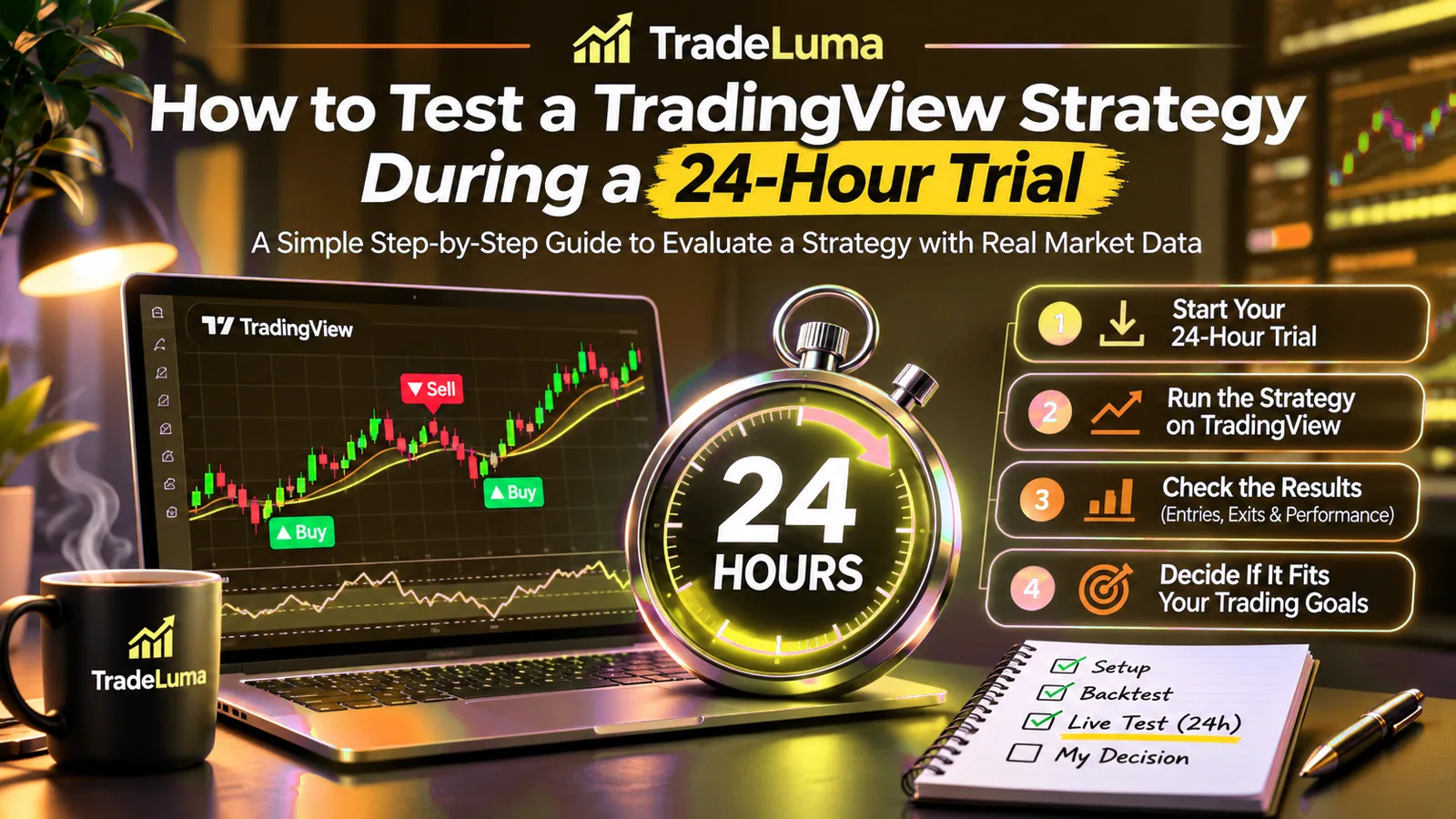
How to Test a TradingView Strategy During a 24-Hour Trial
Use a 24-hour TradingView strategy trial effectively: verify chart settings, review simulated trades, observe signals and document your decision.
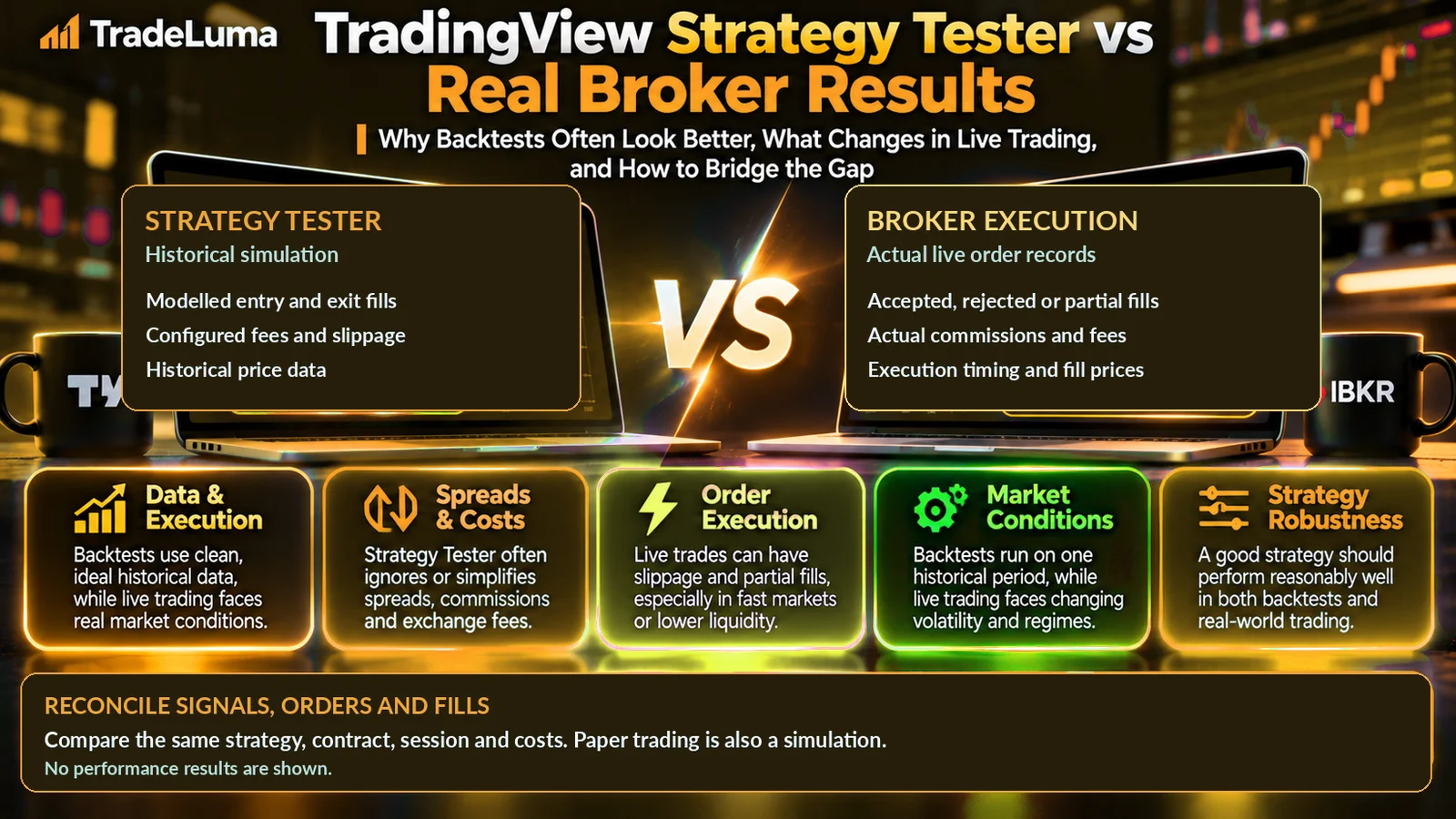
TradingView Strategy Tester vs Real Broker Results: Where Does the Profit Go?
Compare simulated and actual trade records using timestamps, commissions, slippage, missed orders, partial fills and a reconciliation workflow.
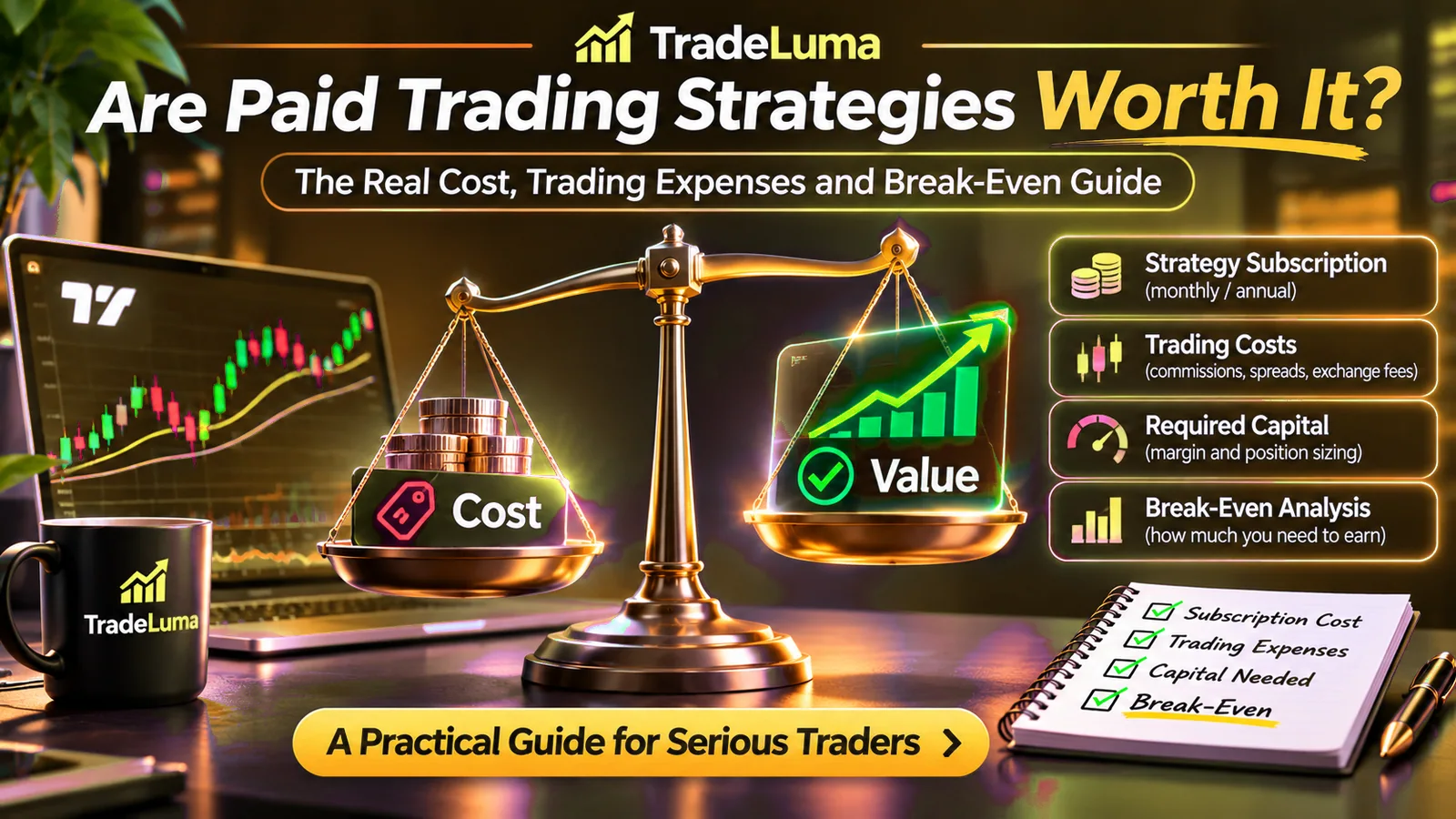
Are Paid Trading Strategies Worth It? The Real Cost of a Subscription
Evaluate a paid trading strategy using subscription fees, commission, slippage, margin risk and a worked break-even calculation before buying.