
Oil & Commodities
Strait of Hormuz Oil Paradox: Tanker Attacks Rise but Brent Falls to $92
Oil slipped to $92.29 Brent early on November 23, 2026 despite Gulf tanker attacks. Understand risk-off selling, shipping premiums, WTI and OPEC+ supply scenarios.
On this page+
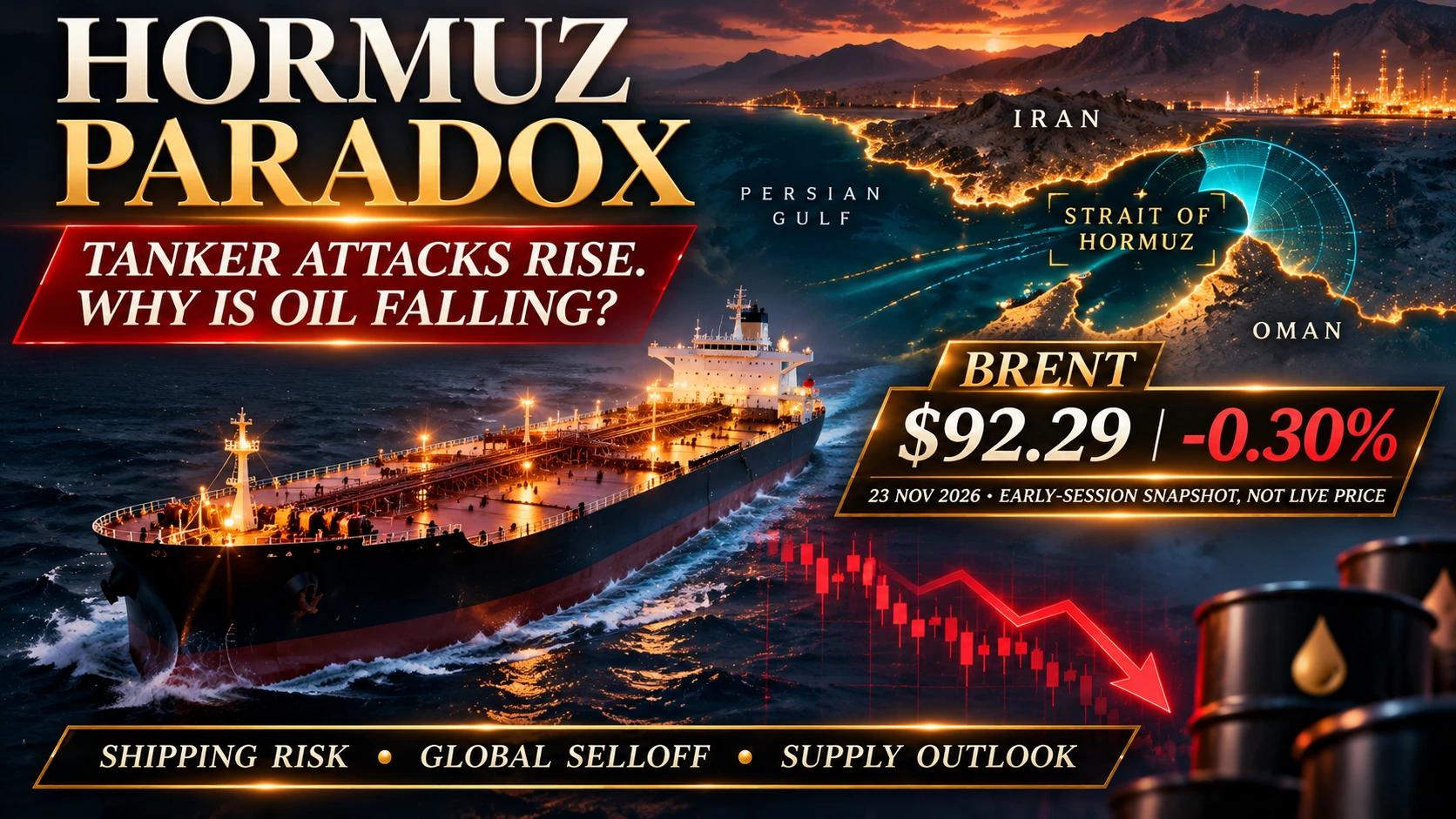
Oil markets opened Monday 23 November 2026 with a paradox: continuing attacks on shipping in the Gulf and near the Strait of Hormuz suggested supply danger, yet Brent crude futures fell 28 cents, or 0.30%, to US$92.29 a barrel by 02:16 GMT, according to Reuters. The number is a precise early-session snapshot, not the current price and not the day's settlement. Reuters attributed the modest decline to the wider equity selloff and concerns that weakening market confidence in AI-driven growth could spill into other assets, while attacks around major energy shipping routes limited oil's losses. This is not proof that geopolitical risks disappeared. It shows that crude futures simultaneously price demand expectations, actual export availability, risk appetite and probabilities of future disruption. Here's how to interpret the tension and what to watch next.
What happened in oil trading on November 23?
Reuters reported that Brent futures dropped US$0.28, or 0.30%, to US$92.29 per barrel by 02:16 GMT on Monday November 23. At the time, crude had already experienced several weeks of pressure as a broader global market selloff affected sentiment toward commodities.
The article linked declining confidence in the potential for AI investment to deliver near-term growth with weakness across equity markets. At the same time, renewed security incidents around oil infrastructure and regional shipping routes provided a countervailing support for prices.
There is no contradiction in those two observations. An oil price is the market-clearing result of buyers and sellers weighing many future scenarios; it does not rise every time a tanker is attacked. A modest intraday fall can coexist with a significant risk premium relative to a hypothetical peaceful market.
What attacks were reported near the Strait of Hormuz?
The November 23 Reuters report described multiple attacks on shipping in the Gulf and near Hormuz over the weekend. It also reported that the Iran-aligned Houthi movement claimed it had attacked a Saudi Arabian refinery on Sunday.
The correct evidentiary distinction is between a reported event, a militant group's claim and independently verified physical damage. A claimed refinery strike does not by itself tell us how many barrels of processing capacity were disrupted, for how long or whether any export terminal stopped loading cargo.
Tanker incidents can affect voyage routing, insurance costs and willingness to transit even without an immediate sustained cut in production. The significance for oil pricing depends on cargo volumes that actually reach global markets.
Why is the Strait of Hormuz so important?
The Strait of Hormuz is the narrow maritime passage between Iran and Oman linking the Persian Gulf to the Gulf of Oman and onward to international sea routes. It is crucial for transporting crude oil and other energy products from Gulf producers to global consumers.
If ships are unable or unwilling to transit, exporters can face delays and buyers may need to draw inventory or source crude elsewhere. Some overland routes can partly bypass the strait, but their capacity and destination options are constrained.
Strategic significance does not mean a complete closure has occurred. Markets distinguish occasional attacks, prolonged transit restrictions, confirmed closure and a lasting reduction in actual shipments. The scope of disruption is as important as the headline.
Why can oil prices fall while shipping risk rises?
Crude prices reflect the balance of physical barrels and anticipated demand. During global equity weakness, investors may expect softer industrial activity, airline demand and transport fuel consumption. Portfolio managers may also cut risk across assets, selling futures or reducing positions independent of immediate physical demand.
Meanwhile, shipping security adds an upside risk premium. The premium may be smaller than the downward influence of demand expectations if cargo is still flowing and stockpiles appear sufficient. Early-November and late-November Reuters reports pointed to relatively strong Middle East export flows despite security incidents.
This is an illustrative causal framework, not a calculation of how many dollars per barrel each force contributed. Price formation also depends on hedging, speculative positioning, currencies, interest rates and futures-curve dynamics.
Why strong oil shipments can suppress prices despite attacks
Physical loading and arrival data are more important than a headline alone. If ports continue loading and buyers are receiving contracted barrels, a market may have less immediate concern about scarcity than the latest attack implies.
Reuters' November 20 reporting described strong Middle East exports as a reason crude was still declining through the week despite attacks and warnings around shipping. That is a different statement from saying the Strait of Hormuz had become risk-free or that all earlier disruptions had been reversed.
To assess the real situation, follow shipping volumes, port line-ups, tanker tracking, destination data and any declared force majeure notices. Separate volumes loaded from vessels merely present near the strait.
How do Brent and WTI differ in this crisis?
Brent is a global seaborne crude benchmark; West Texas Intermediate (WTI) is closely tied to US delivery infrastructure. The two benchmarks can respond differently to regional supply, shipping constraints, refinery demand and storage conditions.
A security event in the Gulf might influence Brent more directly through seaborne market pricing, but WTI also reacts through global arbitrage and changes in US exports. The Brent–WTI spread is affected by transport costs, grade differences and storage dynamics.
On November 23, Reuters described the preceding week's Brent decline as roughly 4% and WTI's as about 5%. Those are historical weekly returns, not a forecast of which contract will outperform next.
What does the OPEC+ meeting on November 29 mean?
Reuters reported that OPEC+ ministers planned a series of November 29 meetings to discuss 2027 output policy. Production targets, compliance and capacity assumptions can influence expectations for future supply independently of any short-term shipping incident.
An announced production adjustment does not translate one-for-one into physically delivered barrels, and the market's reaction depends on how much was already expected. If the group surprises traders with a more restrictive plan, available supply expectations could tighten. If plans are looser than expected, price pressure could increase.
This article does not assert a decision has already been made at a meeting scheduled for a future date. Traders should monitor the actual post-meeting statement and verified production trends.
Why futures curves and roll yield matter
Oil is traded through dated futures contracts rather than one permanent instrument. Contango describes later months priced above near months; backwardation describes the opposite. Storage costs, near-term scarcity, financing and geopolitical delivery risks can influence the curve.
Geopolitical news may strengthen near-month contracts relative to later maturities even when the outright benchmark drops during a risk-off episode. Conversely, softer demand forecasts can pressure multiple contract months.
A trader rolling a WTI futures position should not confuse the change in the quoted front-month contract with their total realised return. TradeLuma has a separate guide to contango, backwardation and roll yield, which is useful alongside this developing news.
Three scenarios for the Hormuz oil market
Scenario one: Shipping incidents continue but physical exports remain broadly available. Geopolitical fear may prevent a deeper selloff without generating an enduring price surge, while the market focuses on demand and OPEC+ decisions.
Scenario two: A serious confirmed disruption cuts sustained flows through the strait or a major terminal. Crude spreads, freight and options volatility could respond quickly, although the magnitude would depend on alternative supplies and the length of disruption.
Scenario three: A broader economic slowdown dominates, with production and inventories adequate despite isolated attacks. In that case prices could continue facing downward pressure. These are possible outcomes for monitoring, not predictions with quantified probabilities.
What to watch next for oil and futures traders
Track verified maritime incident reports, actual exports and refinery operations, not only unverified claims or dramatic video. Shipping insurance, tanker availability, regional crude differentials and delivery delays can show whether risk is reaching the physical market.
Monitor benchmark quotes with precise time zones, inventory reports, future-month spreads, OPEC+ announcements on November 29 and the wider equity-market environment. Holidays and thinner liquidity can exaggerate some intraday moves.
The approved cover's Brent US$92.29, down 0.30%, refers to Reuters' 02:16 GMT November 23 snapshot and is not a live price or settlement. Its map and charts are stylised illustrations. This article is educational market analysis, not individualised trading advice.
Frequently asked questions
Why was Brent falling despite Strait of Hormuz attacks?+
Reuters reported that broader market selling and economic-growth concerns outweighed some immediate supply fears in early trading on November 23, while attacks limited the decline.
What was Brent crude trading at on November 23, 2026?+
Reuters recorded Brent futures at US$92.29 per barrel, down 0.30%, by 02:16 GMT. This is a historic snapshot, not a current quote or settlement.
Was the Strait of Hormuz completely closed?+
The cited November 23 report discussed attacks on regional shipping; it did not establish a complete and sustained closure of the strait.
Did the Houthis attack a Saudi refinery?+
Reuters reported that the Houthi movement claimed responsibility for a refinery attack on Sunday. A claim alone does not establish the amount or duration of physical damage.
Does a tanker attack always increase oil prices?+
No. Futures reflect the balance of real deliveries, demand expectations, inventories, positioning and geopolitical risks.
What is the difference between Brent and WTI?+
Brent is a global seaborne pricing benchmark; WTI is linked closely to US delivery infrastructure. Regional freight and quality factors can cause their prices to diverge.
How much did oil fall the previous week?+
Reuters' November 23 report described Brent down approximately 4% and WTI around 5% during the preceding week.
When is the next OPEC+ meeting?+
Reuters reported OPEC+ meetings scheduled for November 29, 2026 to discuss 2027 oil output policy; this article does not assume what the group will decide.
What is the oil geopolitical risk premium?+
It is the price influence traders may attribute to potential supply interruptions, but it cannot be read precisely as a single directly observable figure.
Are the chart and $92.29 price on the cover live?+
No. The art is illustrative, and the price is explicitly dated to an early-session Reuters observation on November 23.
Put it into practice
Use the risk maths next to the guide.
Open TradeLuma's free position-size, risk/reward, expectancy, and drawdown tools to test the numbers behind a risk-management decision.
Open free trading calculators →Continue learning
Related guides.

Why Are Oil Prices Rising in 2026? Brent vs WTI, Strait of Hormuz & the $100 Oil Shock
Why are oil prices above $100 in October 2026? Understand Brent vs WTI, Strait of Hormuz supply risks, crude inventories, inflation and CL/MCL futures.
Oil Price Crash November 2026: Brent Below $100, Iran Peace Hopes and the Gold Trade
Brent oil plunged around 17% in the week ending Nov 6, 2026. Explore US–Iran diplomacy, Hormuz risk, WTI, gold, inflation and what oil traders should watch.

The Great Everything Sell-Off: Why Gold, Bitcoin and Nasdaq Crashed Together — and What Happens Next
Why did stocks, Bitcoin and gold fall together on November 20, 2026? Understand the Nasdaq plunge, VIX surge, margin calls, liquidity risk and what to watch.