
Strategy Research
Repainting TradingView Strategies: How to Spot Misleading Backtests
Learn why TradingView signals can change, how future-data leakage differs from ordinary intrabar updates, and how to evaluate protected scripts with forward logs.
On this page+

A chart marker that looks perfectly timed in hindsight may not have been available when a trader could actually act. TradingView uses repainting to describe differences between historical and realtime calculations or plots. Some forms are ordinary consequences of an open candle changing; others, such as future-data leakage, can seriously misrepresent a historical test. This guide distinguishes them and explains practical checks even when the script source is protected. TradeLuma has a commercial interest in its own protected TradingView strategy scripts. The catalogue below provides first-party product information, not an independent ranking, recommendation or guarantee of returns. Futures are leveraged and losses can exceed initial margin.
What repainting actually means
TradingView's Pine documentation describes repainting broadly as differences between realtime and historical behaviour. During a developing bar, prices and calculated indicators may update. When the chart is reloaded, previously elapsed bars are evaluated with their historical data.
The critical question is whether the chart accurately represents information available at the time of the signal. An openly documented provisional indicator is different from a historical display that misrepresents when an actionable signal existed.
Ordinary intrabar changes versus misleading historical signals
Imagine an unfinished candle briefly crossing a moving average before closing below it. A condition evaluated on every incoming update can appear and disappear during that candle. A rule evaluated only at close might never trigger. Both can be legitimate if the timing is accurately documented.
Compare the intended calculation schedule with the observed signal. If the author claims a signal is confirmed, ask exactly what confirmation means and whether alerts are generated at that point.
Higher-timeframe information and lookahead bias
A lower-timeframe chart can use information from a developing higher-timeframe candle. Its final high, low or close is not known before the higher-timeframe candle completes. Treating that final value as available earlier in historical data introduces a misleading information advantage.
Pine's documentation discusses confirmed higher-timeframe values and the use of lookahead settings with an appropriate historical offset for strictly higher-timeframe requests. The correct implementation depends on the context. Merely enabling or disabling a single setting does not certify an entire script.
Backdated pivots and chart markers
A swing pivot may require later candles to confirm it. A marker can then be drawn on the earlier pivot candle. That is useful for visual analysis if the confirmation delay is explicit, but it does not imply a trader knew the pivot at the earlier time.
Ask whether displayed entry markers correspond to the event time or to a prior reference bar. A visually attractive retrospective label is not the same thing as a timestamped executable signal.
Strategy calculation settings and order timing
TradingView strategies have settings that affect when calculations occur and when the emulator fills orders. Recalculation on realtime updates or simulated fills can create behaviour that is difficult to reproduce with historical bar data alone.
Inspect strategy properties, chart type and alert configuration. Changing settings, data feeds or script versions can alter results for reasons other than repainting. A simulated marker is not necessarily an actual order fill.
How to investigate a protected script without reading its code
Fix the version, ticker, timeframe and inputs. Observe signals on incoming data, record their timestamps and whether they were confirmed, and retain screenshots or exported alert logs. After bars close, reload the chart and compare the matching markers under the same configuration.
Record differences rather than assuming every discrepancy is malicious. Revisions to data or settings can also change a display. Repeat the observation across different conditions; a clean sample is not proof that no bias can occur.
Questions to ask the vendor
Ask whether confirmed markers change after reload, whether higher-timeframe inputs use developing or completed values, how pivot confirmation is represented, and whether realtime alerts correspond to historical entry markers. Ask whether any known limitations are described in the product documentation.
TradingView's vendor rules call for accurate representations of script behaviour and performance. A protected source is not itself evidence of repainting. Judge the quality of explanations and observed evidence without treating an unverified claim as a certification.
Why non-repainting does not equal profitable
A script that consistently represents available information can still produce losing trades. Costs, exposure, overfitting and changes in market conditions remain separate concerns. Forward observation should be paired with documented research assumptions.
TradeLuma's commercial catalogue is presented for product discovery, not as a blanket certification of non-repainting or profitability. The cover illustrates a potential misleading-versus-realistic chart comparison; it is not evidence that one chart configuration always wins or loses.
Frequently asked questions
What is repainting in TradingView?+
Differences between realtime and historical script calculations or displays.
Is all repainting deceptive?+
No. Normal intrabar updates can be legitimate when their timing is clear.
What is lookahead bias?+
Using information in a historical calculation before it would actually have been available.
Can a pivot marker appear on an earlier candle?+
Yes. It may be plotted retrospectively after later confirmation.
Can I detect repainting without Pine source code?+
Some discrepancies can be detected by forward logging and reload comparison, but this cannot prove absence of all bias.
Does bar-close confirmation fix every repainting problem?+
No. Other data requests, plotting conventions and calculations can still matter.
Does non-repainting guarantee profits?+
No.
Is the cover a real backtest?+
No. It is a conceptual illustration.
See the workflow
Follow the signal from TradingView to broker state.
Review how TradeLuma handles webhook intake, execution controls, broker routing, and reconciliation in the TradingView + Interactive Brokers workflow.
Explore TradingView + IBKR →Continue learning
Related guides.
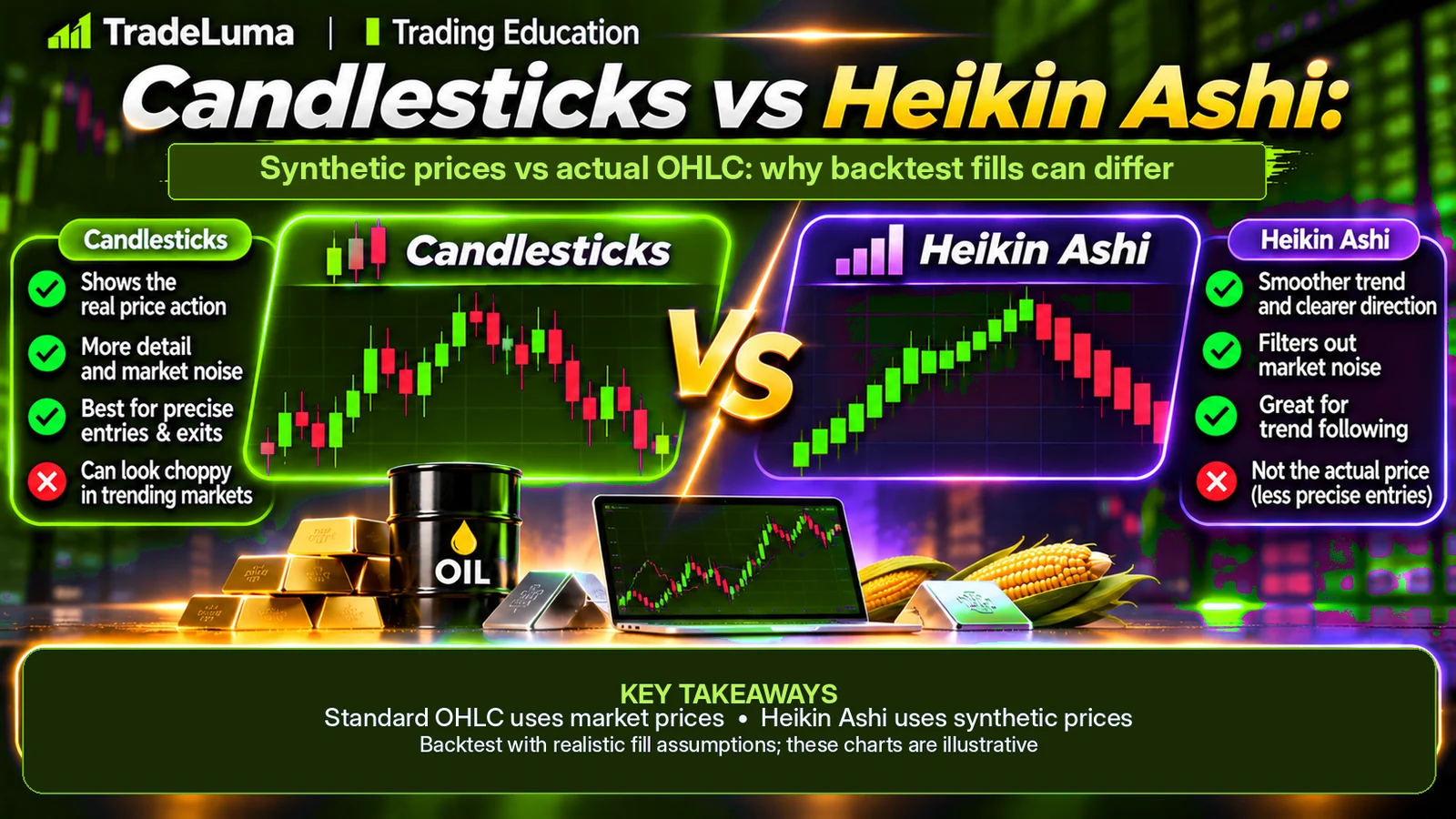
Heikin Ashi vs Real Candlesticks: Why Your Backtest Could Be Misleading
Learn how synthetic Heikin Ashi OHLC differs from actual market prices and how to configure TradingView's standard OHLC fill option.
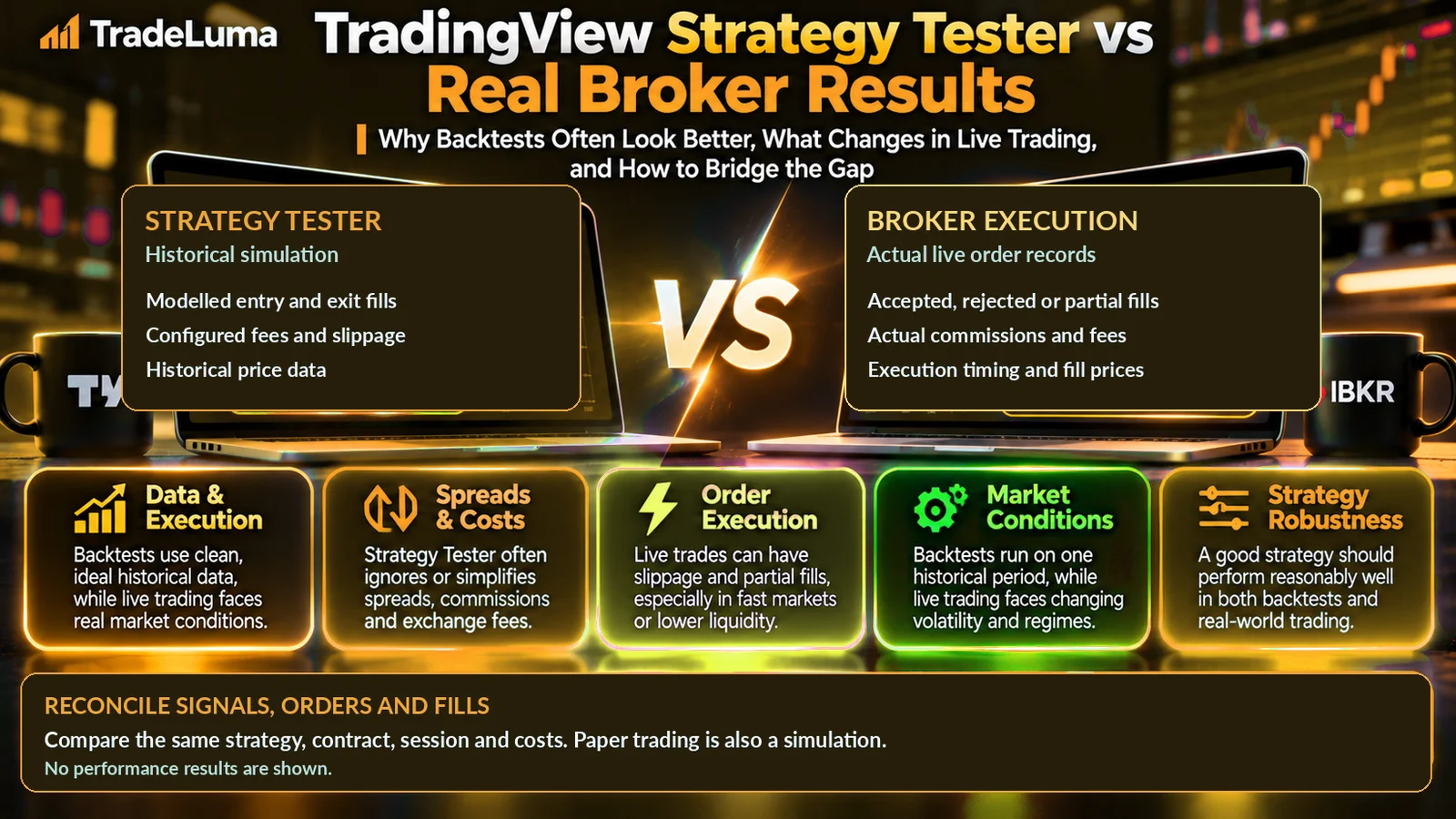
TradingView Strategy Tester vs Real Broker Results: Where Does the Profit Go?
Compare simulated and actual trade records using timestamps, commissions, slippage, missed orders, partial fills and a reconciliation workflow.

Trading Strategy Subscriptions vs Prop Firm Challenges: What Are You Paying For?
Compare trading strategy subscriptions with prop firm evaluations, recurring fees, drawdown rules, simulated accounts, payout terms and consumer risks.