
Market Insights
OPEC+ Showdown: Will the November 29 Meeting Trigger an Oil Price Shock?
What to watch at the November 29, 2026 OPEC+ meeting: output policy, compliance, spare capacity, oil inventories and WTI futures risks.
On this page+
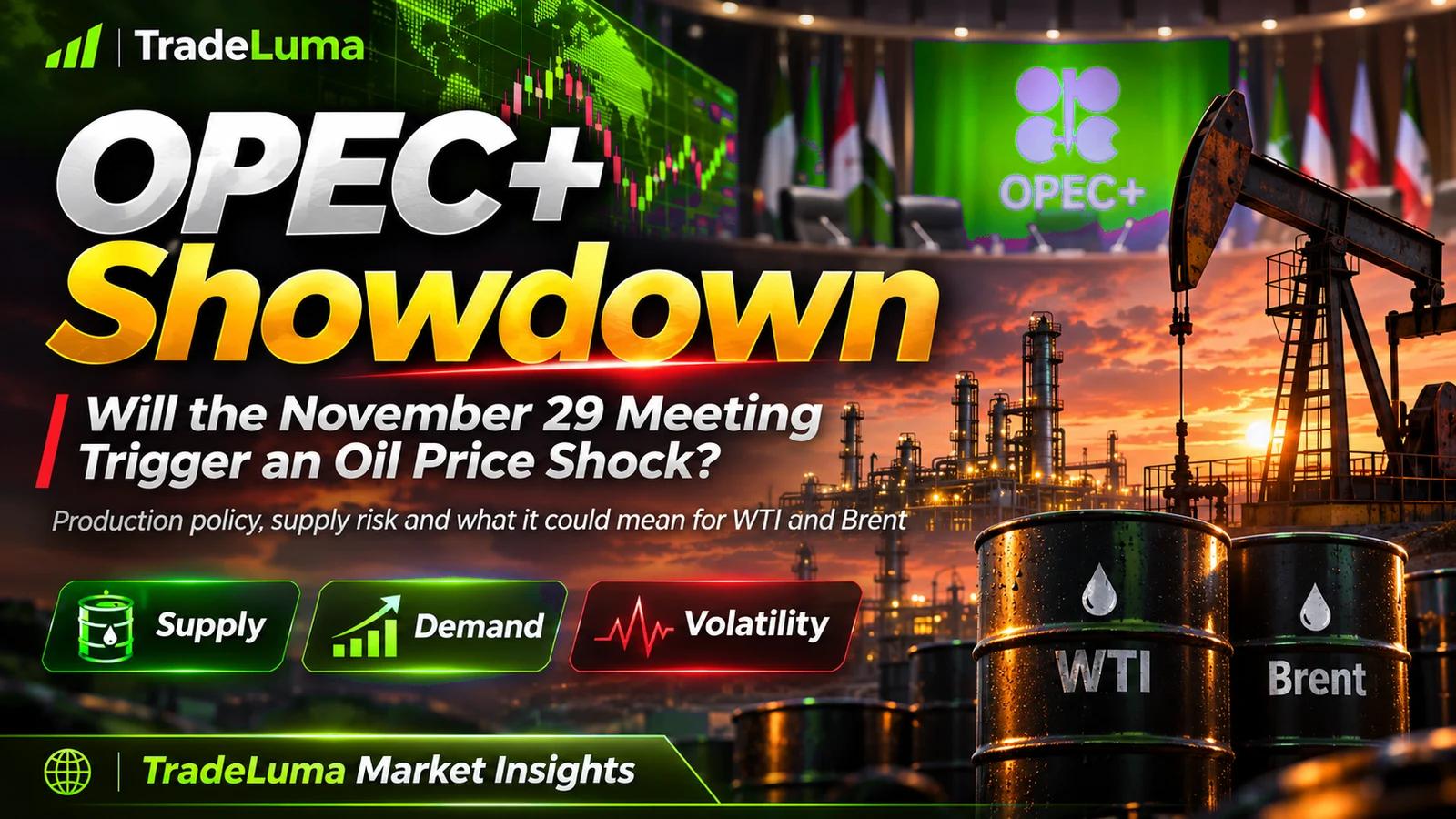
OPEC has scheduled its 42nd OPEC and non-OPEC ministerial meeting for November 29, 2026. The Joint Ministerial Monitoring Committee and seven participating countries involved in additional voluntary production adjustments are also scheduled to meet that day. For oil traders, the important distinction is between what participants announce and what changes in physical supply. This is a preview, not a report of a decision that has already happened. This is general education, not personalised investment advice; futures trading can result in losses exceeding deposits.
Three decisions to watch
The headline production target, the timing of implementation and the distribution of adjustments between participating countries can each matter. Announced quotas do not directly equal actual barrels reaching the market: compliance, compensation for past overproduction, export logistics and domestic consumption affect that relationship.
Watch for details about the next policy period rather than assuming every change applies immediately. A production-capacity assessment can have implications for future baselines without immediately increasing output.
How WTI and Brent could respond
A larger-than-expected supply increase could pressure crude prices if demand is unchanged, while a tighter-than-expected policy could support prices. A decision close to expectations may produce a limited response, or a reversal as traders unwind earlier positions.
Demand revisions, inventories, refinery maintenance, geopolitical disruptions and exchange rates may overwhelm an OPEC announcement. Compare front-month and deferred contracts: changes in the futures curve can reveal how the market is pricing near-term supply relative to later delivery.
Why Sunday matters for futures traders
November 29 is a Sunday. Many CME energy contracts normally reopen on Sunday evening in Chicago, corresponding to Monday morning in eastern Australia. An announcement before reopening can generate a price gap rather than a continuously tradable move.
Check product-specific holiday hours after Thanksgiving, the active WTI contract month and broker availability. A market order or stop-loss order can execute at a worse price than expected if liquidity is thin.
A scenario-based preparation checklist
Write down three plausible outcomes: tighter supply, policy broadly unchanged and looser supply. For each, identify what information would invalidate the interpretation. There is no need to assume a specific price target before the announcement.
Use the futures tick value and actual contract quantity to calculate dollar exposure, include trading costs and maintain a separate margin buffer. Review oil futures curve behaviour before interpreting a change in the front-month price.
Frequently asked questions
When is the next OPEC+ meeting?+
The ministerial meeting is scheduled for November 29, 2026, subject to calendar changes.
Will an output cut automatically lift oil prices?+
No. The result relative to market expectations, demand, compliance and inventories all matter.
Can I trade WTI during the Sunday announcement?+
It depends on the announcement time and exchange and broker trading hours. A pre-open announcement may result in a gap.
Put it into practice
Use the risk maths next to the guide.
Open TradeLuma's free position-size, risk/reward, expectancy, and drawdown tools to test the numbers behind a risk-management decision.
Open free trading calculators →Continue learning
Related guides.
December 2026 ISM Manufacturing and Services PMI: What Traders Should Watch
The December 1 and 3 US ISM reports cover November activity. Learn what new orders, employment and prices may mean for gold, yields and Nasdaq.

The Santa Claus Rally 2026: What Could It Mean for Nasdaq and Gold?
Understand the seven-session Santa Claus rally window, the difference between equity and gold seasonality, year-end liquidity and scenario planning.
December 2026 US Jobs Report: The Next Major Test for Nasdaq, Gold and the Fed
The November 2026 US employment report is scheduled for December 4 at 8:30 am ET. Learn what payrolls, wages, revisions and unemployment may mean.