
Futures
Futures Trading Fees Explained: Commissions, Exchange Fees & Hidden Costs
Understand the real cost of futures trading, including broker commissions, exchange and regulatory fees, spread, slippage, market data and round-turn costs.
On this page+
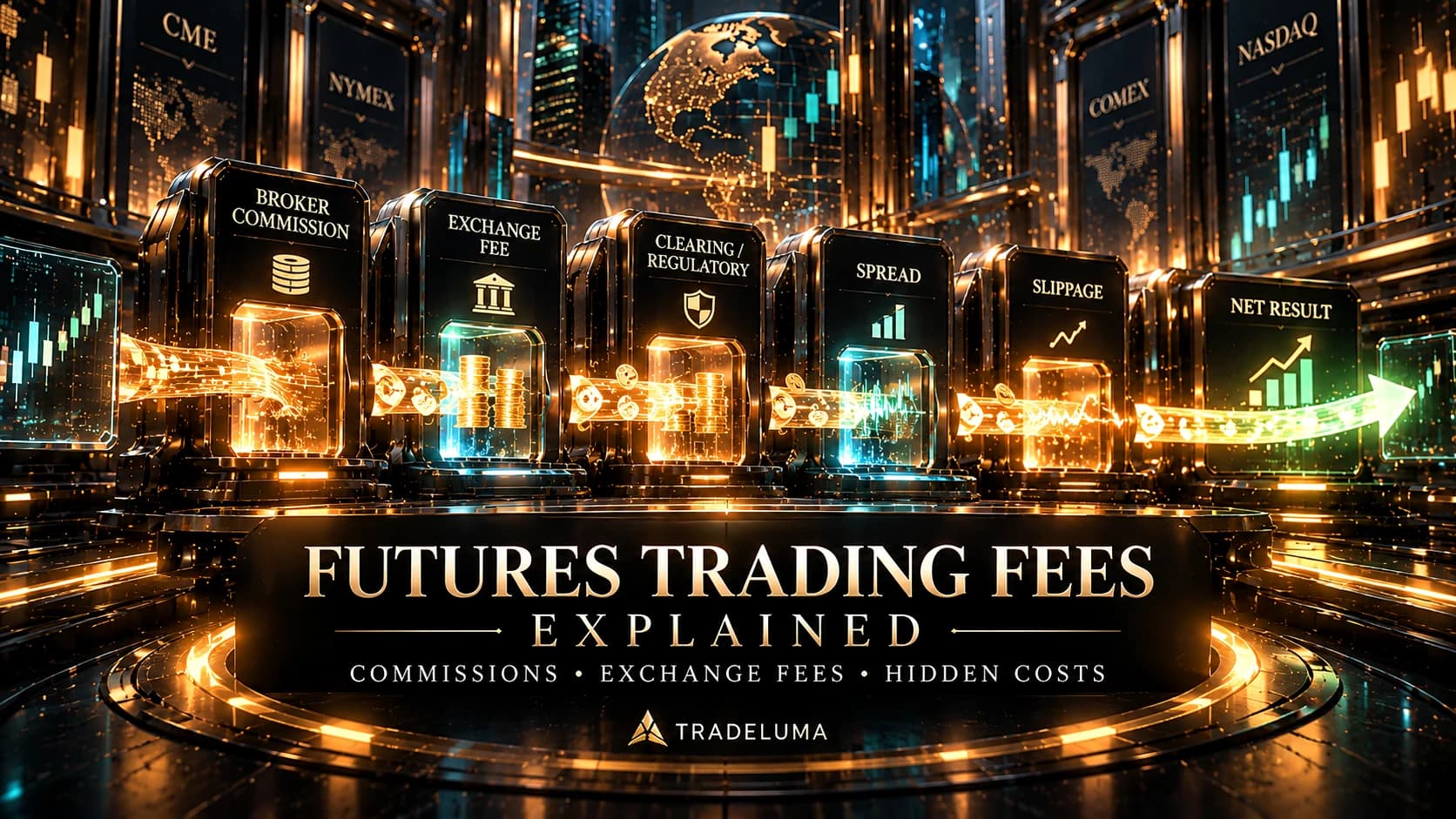
The advertised broker commission is only one part of the cost of trading futures. A complete round trip can include broker commission, exchange and clearing charges, regulatory assessments, bid-ask spread, slippage, market-data subscriptions and other broker or platform costs. These expenses matter most when a strategy trades frequently or targets small moves, because a few dollars of friction can consume a meaningful share of the expected edge. This guide explains each layer, how per-side and round-turn quotes differ, how to estimate all-in cost before trading, and how automated traders can measure the real cost from broker fills instead of relying on headline commission rates.
Per side versus round turn: the first fee quote to decode
Futures commissions are often quoted per contract per side. One side means one transaction: buying to open is one side, and selling to close is another. A complete open-and-close sequence is commonly called a round turn.
If a broker advertises a commission of X dollars per contract per side, the commission component of one round turn is approximately 2 × X before adding exchange, clearing, regulatory and execution costs. Comparing brokers requires checking whether each advertised number is per side, round turn or already an all-in quote.
Broker commission
Broker commission pays the brokerage or futures commission merchant for providing order routing, account infrastructure and related services. Pricing can vary by contract, exchange, account type, monthly volume and whether the broker uses fixed or tiered pricing.
A low headline commission is useful only if the trader understands what it excludes. Some brokers quote the execution commission separately from exchange and regulatory fees, while others present an all-in estimate. The account statement and fee schedule should be treated as the source of truth.
Exchange and clearing fees
Futures exchanges charge transaction and clearing-related fees for access to the market and central clearing infrastructure. These charges vary by exchange, product, membership status, incentive programme, venue and transaction type rather than being one universal futures fee.
CME Group implemented updated fee schedules in October 2026, including CME and CBOT schedules effective 1 October and new NYMEX/COMEX schedules around the same period. Traders should therefore use the current exchange schedule or their broker's current pass-through fee table rather than relying on an old screenshot or backtest assumption.
Regulatory fees and the NFA assessment
Some customer futures transactions also carry regulatory assessments. In the United States, the National Futures Association currently assesses futures customer transactions through futures commission merchants. As of 1 July 2026, the NFA assessment is $0.01 per side, with a scheduled increase to $0.02 per side from 1 July 2027.
The regulatory component is small relative to many other costs, but it illustrates why an 'all-in' calculation is more useful than one commission number. Exact applicability depends on the account, broker, exchange and jurisdiction, so traders should verify their statement rather than assuming every fee structure is identical.
The bid-ask spread is a real cost even when no fee is charged
The bid is the highest displayed buying price and the ask is the lowest displayed selling price. A marketable buy normally interacts with the ask, while a marketable sell normally interacts with the bid. Crossing that difference creates an immediate economic cost relative to the mid-price.
A one-tick spread may sound small, but its dollar value depends on the contract. On a strategy with a small profit target, repeatedly paying one tick to enter and another execution cost to exit can materially reduce expectancy even when commissions are low.
Slippage can cost more than the commission
Slippage is the difference between the price a strategy expected or requested and the actual average fill price. It can occur because the market moves while the order is travelling, because there is not enough depth at the best price, or because a stop order becomes marketable during a fast move.
Slippage is not fixed. It tends to increase during volatile releases, thin sessions, gaps and large orders relative to available liquidity. A backtest that assumes zero slippage can therefore overstate a strategy's edge even when the broker commission is modelled correctly.
Limit orders do not make trading free
A resting limit order may avoid crossing the spread if it receives a fill, but that creates non-execution risk. The market can move away without filling the order, partially fill it, or fill only after conditions have changed.
Limit-order strategies should therefore model fill probability and opportunity cost as well as fees. Replacing market orders with limit orders only to assume perfect fills in the backtest can produce a cost estimate that is just as unrealistic as assuming no spread.
Market-data subscriptions and platform costs
Live futures data may require exchange market-data subscriptions, especially when a trader wants real-time depth rather than delayed quotes. Brokers and data vendors can package these subscriptions differently depending on professional status, exchange bundle and account activity.
Platform, API, VPS or automation-infrastructure costs are not exchange transaction fees, but they still belong in the operating economics of the strategy. A trader evaluating monthly profitability should separate per-trade costs from recurring fixed costs rather than ignoring the latter.
Why micro futures are not automatically one tenth of the trading cost
Micro equity-index futures are generally one tenth the contract size of the corresponding E-mini, but broker, exchange and regulatory charges do not necessarily shrink by the same one-to-ten ratio. That means explicit fees can represent a larger fraction of one tick, one point or one small profit target in the Micro contract.
Micro contracts can still be extremely useful for position-size precision. The important comparison is not simply the dollar fee per contract; it is the fee relative to the contract's tick value, average trade size and expected gross edge.
A simple all-in round-trip cost formula
A practical starting formula is: round-trip explicit cost = 2 × (broker commission per side + exchange/clearing fees per side + regulatory fees per side). Then add the strategy's expected spread and slippage cost for entry and exit.
If the broker already quotes an all-in per-side rate, do not add the same pass-through fees again. The goal is to reconstruct the actual statement economics without double counting.
Convert spread and slippage into dollars using tick value
Execution friction becomes easier to compare when expressed in ticks. If the average entry and exit together lose 1.5 ticks relative to the strategy's ideal prices, multiply 1.5 by the contract's tick value and number of contracts to estimate the dollar execution cost.
This makes cost comparisons portable across MES, MNQ, gold, crude oil and other futures. The same one-tick slippage assumption does not have the same dollar consequence in contracts with different tick values.
Scalping is especially sensitive to fees
A scalping strategy may make many round trips and target only a few ticks on each trade. In that environment, commission, spread and slippage can consume a large percentage of the gross profit before the strategy reaches net profitability.
The correct test is not whether each individual fee looks small. It is the monthly and per-trade cost burden relative to average gross profit, average loss and total turnover. A strategy with a narrow gross edge can disappear after realistic friction is applied.
Swing trading has lower turnover but different cost risks
A swing strategy may trade less often, so commissions represent a smaller percentage of expected profit. However, wider bid-ask spreads at certain hours, rollover, overnight broker charges where applicable, gaps and larger stop-order slippage can still affect realised performance.
Holding longer therefore does not eliminate transaction costs; it changes which costs matter most. The correct model should match the strategy's actual entry times, holding period, order types and exit behaviour.
Rollover can create an extra round trip
A futures position cannot always remain in the same expiry indefinitely. If a trader closes the expiring contract and opens the next contract, that rollover creates additional orders and therefore additional explicit fees, spread and possible slippage.
Longer-horizon strategies should include expected rollover frequency in their cost model. Continuous back-adjusted charts can make the research series look seamless even though the live account must execute real contracts and pay the cost of changing expiries.
How transaction costs change strategy expectancy
Gross expectancy is the average result before costs. Net expectancy is what remains after commissions, fees, spread and slippage. A strategy can have positive gross expectancy but negative net expectancy when the edge per trade is small relative to turnover.
One useful diagnostic is the cost-to-edge ratio: divide average all-in round-trip cost by average gross profit per trade. A rising ratio can reveal that a strategy is becoming too expensive even before its gross signal quality changes.
Backtests should not use one generic commission for every contract
Different contracts have different exchange charges, tick values, liquidity and typical spreads. Using one flat commission and zero slippage across every market can distort portfolio comparisons, especially when mixing micro and standard contracts.
A better research process stores contract-specific explicit fees and uses execution assumptions appropriate to the product and session. Those assumptions should be reviewed whenever the broker, exchange schedule or order-routing method changes.
How automated traders should measure real execution cost
An automated system can record the signal price, order submission time, broker acknowledgement, average fill price, quantity, commission and reported exchange or regulatory fees. That creates a direct audit trail from theoretical strategy price to realised account result.
Over time, the system can calculate effective slippage by contract, session, order type and volatility regime. This is more informative than assuming one static slippage value forever, because live execution quality can improve or deteriorate as market conditions change.
Commission-free does not mean cost-free
Whenever a trading product is marketed as commission-free or very low commission, traders should still ask how the venue, broker and order flow are funded and what spread, financing, data or other charges apply. For exchange-traded futures, exchange and regulatory costs do not disappear simply because the broker's own commission component is low.
The economically relevant comparison is the expected total cost to establish and exit the exposure at the size and frequency the strategy actually trades.
A practical futures cost checklist
Before trading a contract, identify the broker commission, whether the quote is per side or round turn, the current exchange and clearing charges, applicable regulatory assessments, market-data subscriptions, typical bid-ask spread and a realistic slippage assumption. Confirm whether overnight or platform fees apply to the specific account.
Then convert everything into an expected dollar cost per round trip and compare that number with the strategy's average target, average gross profit and trade frequency. If the strategy is automated, reconcile the estimate with actual broker statements and fills regularly rather than assuming the original model remains accurate.
Frequently asked questions
How much does it cost to trade futures?+
There is no single cost. A futures round trip can include broker commission, exchange and clearing charges, regulatory fees where applicable, bid-ask spread, slippage and recurring data or platform costs. The exact amount depends on the broker and contract.
What is a round-turn futures commission?+
A round turn covers both sides of a completed trade: opening the futures position and later closing it. If a fee is quoted per side, the round-trip commission component is normally about twice the per-side amount before other charges.
Are exchange fees included in futures commissions?+
Sometimes, but not always. Some brokers advertise an all-in rate while others quote their commission separately and pass through exchange, clearing and regulatory charges. Check the broker fee schedule and account statement.
What is the NFA fee on futures in 2026?+
As of 1 July 2026, the NFA assessment fee for applicable futures customer transactions is $0.01 per side. NFA has scheduled the rate to increase to $0.02 per side from 1 July 2027.
Do futures have a bid-ask spread?+
Yes. Exchange-traded futures have bids and asks. Crossing the spread is an economic execution cost even though it does not appear as a separate commission line on the account statement.
What is slippage in futures trading?+
Slippage is the difference between the expected or requested trade price and the actual average fill price. It can increase during fast markets, thin liquidity, gaps and large orders.
Are Micro E-mini futures cheaper to trade than E-minis?+
They often have lower dollar fees per contract, but their contract size is also much smaller. Because many fees do not shrink in a perfect one-to-ten ratio, the cost can represent a larger fraction of a Micro contract's tick value or profit target.
Do limit orders avoid futures trading costs?+
A resting limit order may avoid crossing the spread if it fills, but commissions and exchange charges still apply and the order may not fill. Fill probability and opportunity cost should be part of the strategy model.
Should backtests include futures commissions and slippage?+
Yes. A realistic backtest should include contract-specific explicit fees and an execution assumption for spread and slippage. Otherwise a small gross edge can appear profitable when live net expectancy is negative.
Do futures traders pay market-data fees?+
Many traders pay exchange or broker market-data subscription fees for real-time futures quotes or depth. Pricing depends on exchange bundles, account status and broker or vendor arrangements.
How do I compare futures brokers by cost?+
Compare the expected all-in round-trip cost for the exact contracts and monthly volume you trade. Include broker commission, exchange and regulatory pass-through fees, data or platform charges and realistic execution quality rather than comparing headline commission alone.
How should an automated trading system track futures costs?+
Record signal price, submitted order, fill price, quantity, commissions, reported fees and timestamps. That allows the system to measure realised slippage and all-in cost by contract, session and order type and compare live execution with backtest assumptions.
Futures workflows
Explore the strategy side of TradeLuma.
Browse TradeLuma's futures strategy catalogue and the chart, rollover, and reference methodology used for each published strategy.
Explore futures strategies →Continue learning
Related guides.

How Much Money Do You Need to Trade Futures? Account Size, Margin & Risk
Work out how much capital you need to trade futures using margin, stop distance, point value, risk per trade, trading costs and drawdown buffer.

Micro E-mini Futures Explained: MES vs MNQ vs MYM vs M2K
Compare MES, MNQ, MYM and M2K Micro E-mini futures by index, multiplier, tick value, trading hours, expiry, settlement and risk.

1-Ounce Gold Futures vs Micro Gold (MGC) vs Gold (GC): 2026 Guide
Compare 1-Ounce Gold (1OZ), Micro Gold (MGC) and Gold (GC) futures by contract size, tick value, trading hours, settlement, expiry and risk.