
Technical Analysis
BOS vs CHoCH vs MSS in Trading: How Market Structure Actually Changes
Learn BOS vs CHoCH vs MSS in trading, how each market-structure break is defined, why swing selection matters, and how traders avoid false signals.
On this page+
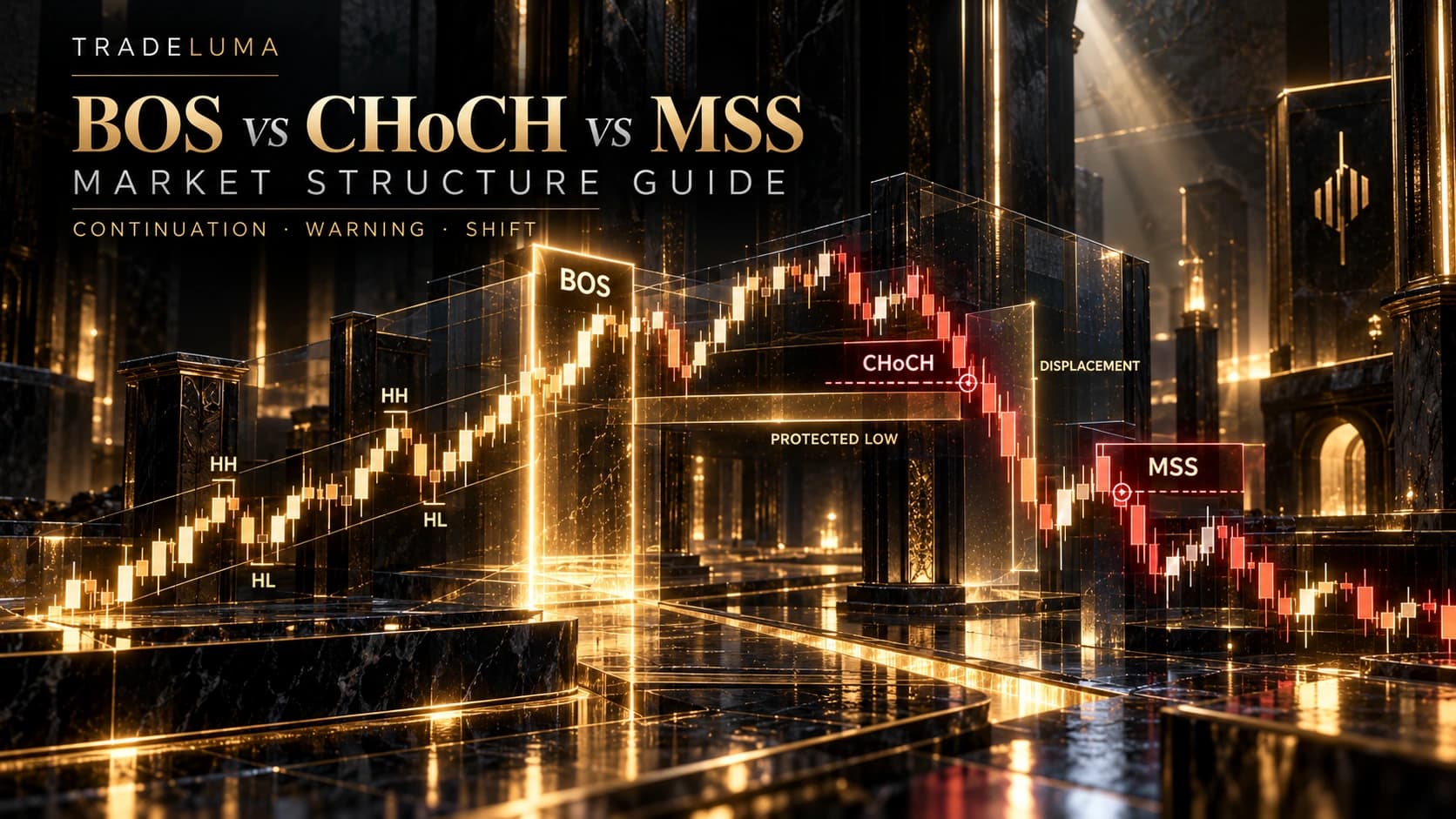
BOS, CHoCH, and MSS are labels traders use to describe changes in market structure. The labels sound precise, but they only become useful after the trader has already defined which swing highs and lows matter, what counts as a break, and which timeframe controls the analysis. In this guide, Break of Structure (BOS) means a break in the direction of the existing swing sequence, Change of Character (CHoCH) means the first meaningful break against that sequence, and Market Structure Shift (MSS) means a stronger structural transition backed by decisive displacement. Other educators use the terms differently, so consistency matters more than the label itself.
BOS vs CHoCH vs MSS at a glance
All three terms describe price interacting with previously identified structural levels. BOS asks whether the current trend sequence is continuing. CHoCH asks whether that sequence has suffered its first meaningful break in the opposite direction. MSS is commonly used when the counter-trend break is more decisive, often with visible displacement.
The same candle can receive different labels if two traders started with different swing maps. That is why the correct order is structure first, label second. Mark the trend and the structural swing before price reaches it, then classify what happens.
Define the swings before the labels
An uptrend is commonly described by higher highs and higher lows. A downtrend is commonly described by lower lows and lower highs. That sounds simple until a chart contains dozens of small pivots inside one larger move.
A rules-based trader needs a repeatable way to decide which pivots count. The rule might use a fixed number of bars on each side of a swing, a minimum ATR distance, a chosen timeframe, or another objective filter. Without that step, market structure can change every time the chart is zoomed in or out.
What is a Break of Structure (BOS)?
A BOS generally describes price breaking a meaningful swing in the direction of the prevailing structure. In a bullish sequence, a break above the prior significant high can be labelled bullish BOS. In a bearish sequence, a break below the prior significant low can be labelled bearish BOS.
BOS is confirmation of what price has already done, not a guarantee of what comes next. A trader still has to define whether a wick is enough, whether a candle must close beyond the level, and whether a minimum distance or follow-through is required.
What is a Change of Character (CHoCH)?
CHoCH is commonly used for the first structural break against the established sequence. In an uptrend, that may be a break below a protected higher low. In a downtrend, it may be a break above a protected lower high.
The word 'change' can make the signal sound stronger than it is. A CHoCH says the old sequence has been damaged. It does not prove that a complete reversal has started. Price can break a higher low, stall, and later resume the original trend.
What is a Market Structure Shift (MSS)?
MSS is the least standardised of the three terms. Some traders use MSS and CHoCH almost interchangeably. Others reserve MSS for a stronger counter-trend break with displacement, or for a shift that follows a liquidity sweep.
For a testable framework, it helps to set a higher bar for MSS. One example is requiring price to break a protected swing against the prior trend with a body close and an expansion move that exceeds a volatility threshold. The exact rule is less important than applying the same rule to every setup.
BOS versus CHoCH: the trend decides the name
A close above a swing high can be continuation or change depending on the structure that existed before the break. If the market was already bullish, the break may be BOS. If the market was bearish and that high was protecting the downtrend, the same upward break may be CHoCH.
This is why BOS and CHoCH should never be labelled in isolation. The trader must first state whether structure is bullish, bearish, or unclear and identify the swing that is expected to hold if that view is correct.
CHoCH versus MSS: warning versus stronger transition
A useful distinction is to treat CHoCH as the first warning and MSS as a stronger version of the structural transition. A weak close just through a protected swing might qualify as CHoCH, while a forceful break with displacement can meet a stricter MSS rule.
This distinction is optional rather than universal. Traders who cannot define a measurable difference between CHoCH and MSS are often better off using one term consistently than creating two subjective labels for the same event.
Protected highs and protected lows
A protected low is the swing low that must hold for a bullish structural thesis to remain intact. A protected high is the swing high that must hold for a bearish structural thesis to remain intact. These references make CHoCH and MSS easier to define.
The protected swing should be selected before the break. Choosing a different low only after the first one fails makes the structure impossible to test honestly. The goal is not to find a level that makes the chart look clean; it is to decide which level invalidates the current structural interpretation.
Does a wick count as BOS or CHoCH?
There is no universal rule. Some methods count any trade beyond the swing. Others require a candle close beyond the level because a wick can represent a brief probe that is immediately rejected.
For testing, a close-based rule is easier to reproduce. Traders can also compare variants: wick break, body close, close plus a minimum percentage of ATR, or close plus follow-through. The important point is to choose the definition before reviewing results.
Internal versus external market structure
Markets contain smaller swing sequences inside larger ones. A five-minute bearish CHoCH can occur while the four-hour structure remains strongly bullish. Neither label is necessarily wrong; they describe different resolutions.
This is where internal and external structure language can help. External structure refers to the larger swing sequence that controls the broader context. Internal structure describes smaller fluctuations inside that move. A trading plan should state which layer determines bias and which layer is only used for timing.
How liquidity sweeps can appear before a shift
A common SMC sequence begins with price trading beyond an obvious high or low, reclaiming the level, and then breaking structure in the opposite direction. Traders may describe the first event as a liquidity sweep and the later break as CHoCH or MSS.
The sweep is not required for every structural change, and the chart cannot prove who caused it. It simply provides additional context: price failed to maintain acceptance beyond one level and then broke an important swing on the other side.
Why displacement matters
Displacement describes unusually forceful price expansion. Large bodies, rapid movement, reduced overlap, and a strong close through structure are common visual characteristics. It can help distinguish a marginal structural break from a decisive one.
Displacement should also be defined objectively when possible. Examples include candle range relative to ATR, body size relative to recent bars, or distance travelled within a fixed number of candles. This turns a visual impression into something that can be tested.
FVGs and order blocks after the structural break
After a forceful CHoCH or MSS, traders often look for a retracement into a fair value gap or an order-block zone created near the origin of the displacement. Those zones can provide a more precise area for studying the retest.
The structural break and the retracement zone should remain separate conditions. An FVG does not make an MSS valid, and an order block does not guarantee a reaction. Each condition should have its own definition so the setup does not become a collection of labels added after the outcome.
What a failed CHoCH looks like
A CHoCH can fail when price briefly breaks the protected swing, cannot build new structure in the opposite direction, and then reclaims the original trend. This is one reason a CHoCH should not automatically be treated as a reversal entry.
Some traders wait for a new-direction BOS after the CHoCH, stronger displacement, or a successful retest before changing bias. That additional confirmation usually means a later entry, so the trade-off between earlier price and stronger evidence should be tested rather than assumed.
Multi-timeframe conflicts
A lower-timeframe CHoCH against a higher-timeframe trend can represent a reversal, a deeper pullback, or ordinary noise. The label alone cannot resolve the conflict. Traders need a timeframe hierarchy.
One approach is to let the higher timeframe define directional context, the middle timeframe define the setup, and the lower timeframe define execution. If a lower-timeframe signal conflicts with the higher-timeframe thesis, the plan should already say whether that signal is ignored, used for an exit, or treated as a possible transition.
Entries, invalidation, and targets
A structural label is not a complete trade. Entries may occur on the break, on a retest of the broken swing, inside an FVG, at an order block, or only after a new swing confirms the new direction. Each method changes the stop distance and the probability of missing the move.
Invalidation should relate to the structure being traded. Targets might reference the next swing, opposing liquidity, a fixed reward multiple, or another rule. Position size should be calculated from the actual stop distance rather than from how convincing the BOS or MSS label appears.
How to backtest BOS, CHoCH, and MSS without hindsight
The test should begin with the swing algorithm. Then define the trend state, which swing is protected, what counts as a break, whether a close is required, the displacement threshold for MSS, the entry, stop, target, trading session, and transaction costs.
Record every qualifying event. Useful statistics include how often BOS continues, how often CHoCH develops into an opposite-direction trend, how often the original structure is reclaimed, maximum adverse excursion, retest frequency, expectancy, and performance by timeframe and market regime.
A simple labelling checklist
Before calling a break BOS, CHoCH, or MSS, ask five questions: what was the structure before the break, which swing mattered, was that swing identified in advance, what exact rule confirms the break, and what additional condition makes an MSS different from a CHoCH in this strategy?
If those questions cannot be answered consistently, the label is probably too discretionary to support a reliable trading rule. Clear definitions make the chart less exciting, but they make the analysis much more useful.
Frequently asked questions
What is the difference between BOS and CHoCH?+
BOS usually describes a break in the direction of the existing structure, while CHoCH describes the first meaningful break against that structure.
Is MSS the same as CHoCH?+
There is no universal convention. Some traders use the terms interchangeably, while others reserve MSS for a stronger counter-trend break with displacement or additional confirmation.
What comes first, CHoCH or BOS?+
In a reversal model, traders may see a CHoCH against the old trend first and then a BOS in the new direction. In a continuing trend, repeated BOS events can occur without a CHoCH.
Does CHoCH mean the trend has reversed?+
No. It shows that the previous swing sequence has been broken, but price can still reclaim the level and resume the original trend.
Does a wick count as a Break of Structure?+
That depends on the strategy. Some methods count wick breaks, while others require a candle close. The rule should be defined before the setup and tested consistently.
What is a bullish BOS?+
A bullish BOS is commonly defined as price breaking above an important prior swing high while the market is already in a bullish structural sequence.
What is a bearish CHoCH?+
A bearish CHoCH commonly occurs when a bullish structure breaks below the protected higher low that had been supporting the uptrend.
Which timeframe is best for BOS and CHoCH?+
There is no single best timeframe. The important requirement is a consistent hierarchy so one timeframe defines context and another, if needed, defines execution.
Technical analysis
Continue with the topic hub.
Browse the related TradeLuma guides and build the topic from foundations through practical application.
Explore Technical analysis guides →Continue learning
Related guides.

Market Structure in Trading: Higher Highs, Lower Lows and Trend Changes
Learn how market structure uses swing highs and lows to describe trends, ranges, breakouts, and possible trend changes without relying on prediction.

Smart Money Concepts (SMC) Trading: BOS, CHoCH, Liquidity, Order Blocks & FVGs
Learn Smart Money Concepts trading, including BOS, CHoCH, liquidity sweeps, order blocks, fair value gaps, displacement, risk and backtesting.

Swing highs and swing lows: the building blocks of market structure
Understand swing highs and swing lows, why they matter for market structure, and how traders use them to frame trend, entries, and invalidation.