
Trading Instruments
NQ vs QQQ vs TQQQ: Three Different Ways to Trade the Nasdaq-100
Compare Nasdaq-100 futures, QQQ and TQQQ by leverage, contract sizing, session access, daily reset, costs and execution risks.
On this page+
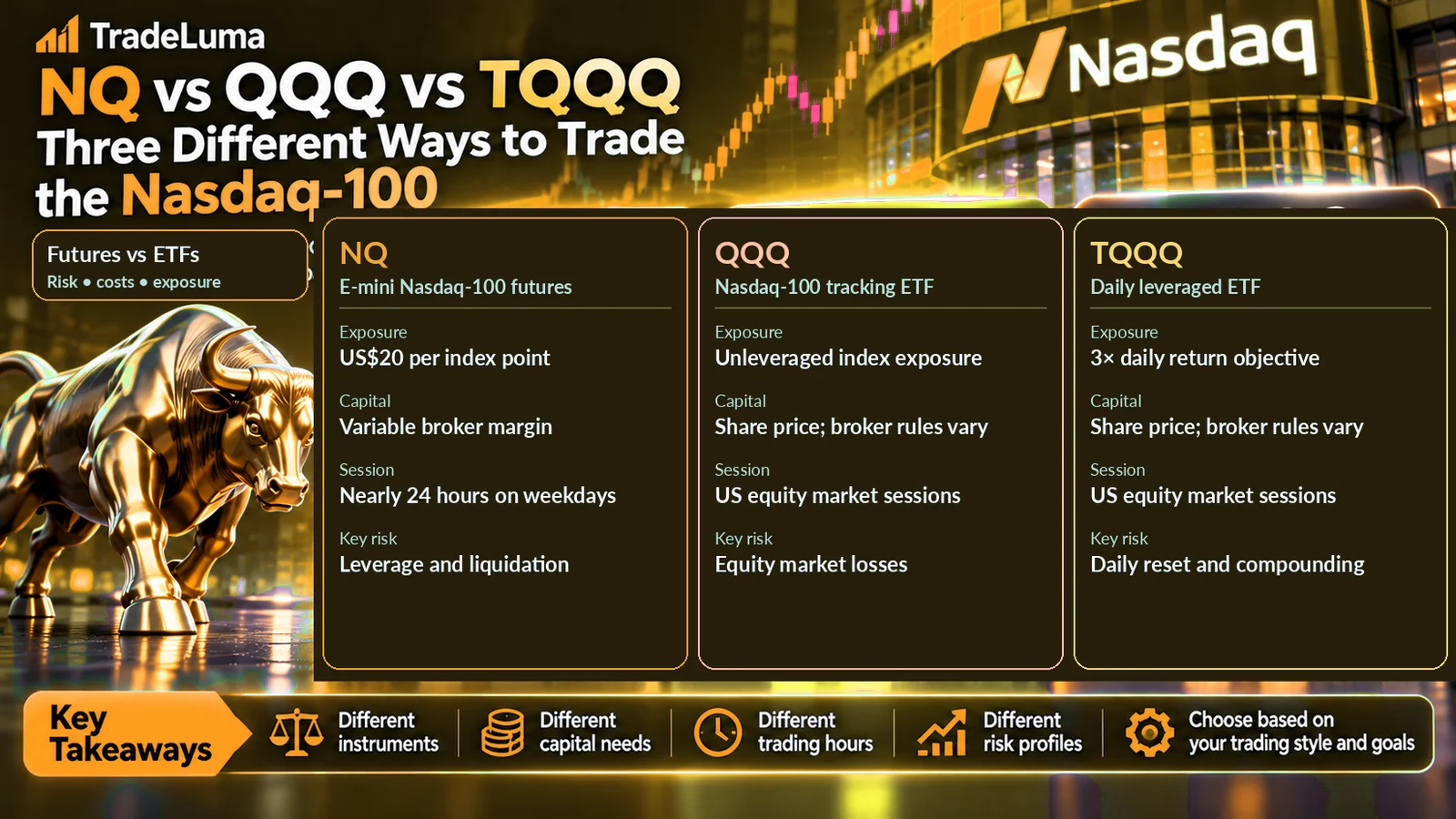
NQ futures, QQQ shares and TQQQ shares provide different forms of Nasdaq-100 exposure. NQ is a margined derivative, QQQ is an ETF designed to track the index, and TQQQ targets three times the index's daily performance before fees and expenses. They are not interchangeable signals, even if the same index is the reference. This educational guide is not personalised investment advice; trading can result in losses.
Compare notional exposure and sizing
NQ uses a US$20 multiplier and a 0.25-point tick worth US$5. At a hypothetical 25,000 index reading, one NQ represents US$500,000 notional exposure. MNQ and NNQ offer smaller contract multipliers of US$2 and US$0.20 per point respectively.
QQQ and TQQQ trade in shares, with fractional availability depending on broker. A fully paid share position is funded by purchase price; futures require collateral and can generate losses beyond the initial deposit. TQQQ embeds leverage within the fund even when bought without borrowing.
Daily reset is the critical difference
TQQQ aims for three times daily index performance, not three times cumulative performance over weeks or months. Suppose the index rises 10% and then falls approximately 9.09%, finishing where it started. A frictionless 3x daily example rises 30%, then falls approximately 27.27%, finishing about 5.45% lower.
Actual fund returns differ due to costs, tracking, derivatives and market conditions. The example is hypothetical and illustrates compounding rather than a prediction. QQQ also has expenses and tracking differences.
Trading hours and carrying costs
NQ generally trades across extended CME Globex sessions with daily breaks. QQQ and TQQQ have regular US equity hours plus broker-dependent extended or overnight sessions. Do not assume a futures signal generated outside stock hours can be executed at the same price in an ETF.
Futures costs include commissions, exchange fees, spread and rollover; ETFs incur fund expenses and trading costs. Leveraged ETF financing and daily rebalancing affect longer holding-period results. Futures margin can change substantially.
Testing a strategy on the correct instrument
A futures strategy needs the correct contract multiplier, tradable month and fill assumptions. An ETF strategy needs appropriate share quantities, trading hours and data adjusted for corporate actions. Testing on one product and routing to another can create unexplained differences.
TradeLuma publishes Nasdaq strategies using Micro E-mini futures as the reference. That does not establish equivalent results on NQ, QQQ or TQQQ. Validate the intended instrument and account mode independently before enabling automated trading.
Frequently asked questions
Is NQ the same as QQQ?+
No. NQ is a futures contract; QQQ is an ETF.
Does TQQQ return three times QQQ over a year?+
Not necessarily. Its stated objective is three times daily index performance before fees and expenses.
Can I reuse futures strategy signals for ETFs?+
Only after separate validation of sizing, sessions, price behaviour and broker execution.
Put it into practice
Use the risk maths next to the guide.
Open TradeLuma's free position-size, risk/reward, expectancy, and drawdown tools to test the numbers behind a risk-management decision.
Open free trading calculators →Continue learning
Related guides.

Yen Carry Trade Explained: Bank of Japan Rates, USD/JPY & Nasdaq Risk
What is the yen carry trade? Learn how borrowing yen works, why BOJ rate hikes and a stronger yen can trigger global selling, and how Nasdaq futures may react.
Nasdaq Futures Hit the 7% Upside Limit: Why NQ and MNQ Could Not Rise Further
Nasdaq-100 futures reached CME's +7% overnight price ceiling on 23 November 2026. Learn NQ and MNQ price limits, order restrictions, market hours and trading risks.
Futures Settlement Price vs Last Price: Daily P&L, Mark-to-Market & Margin
Why futures settlement price differs from the last traded price. Learn CME daily marks, variation P&L, initial margin, final settlement and worked ES examples.