
Technology & Market Infrastructure
Microsoft's Global Outage: Outlook, Teams and Copilot Disrupted as Banks Turned to Fax
Microsoft's November 2026 Outlook outage disrupted Teams, Copilot and global businesses. Explore the cause, recovery, MSFT implications and trading resilience.
On this page+
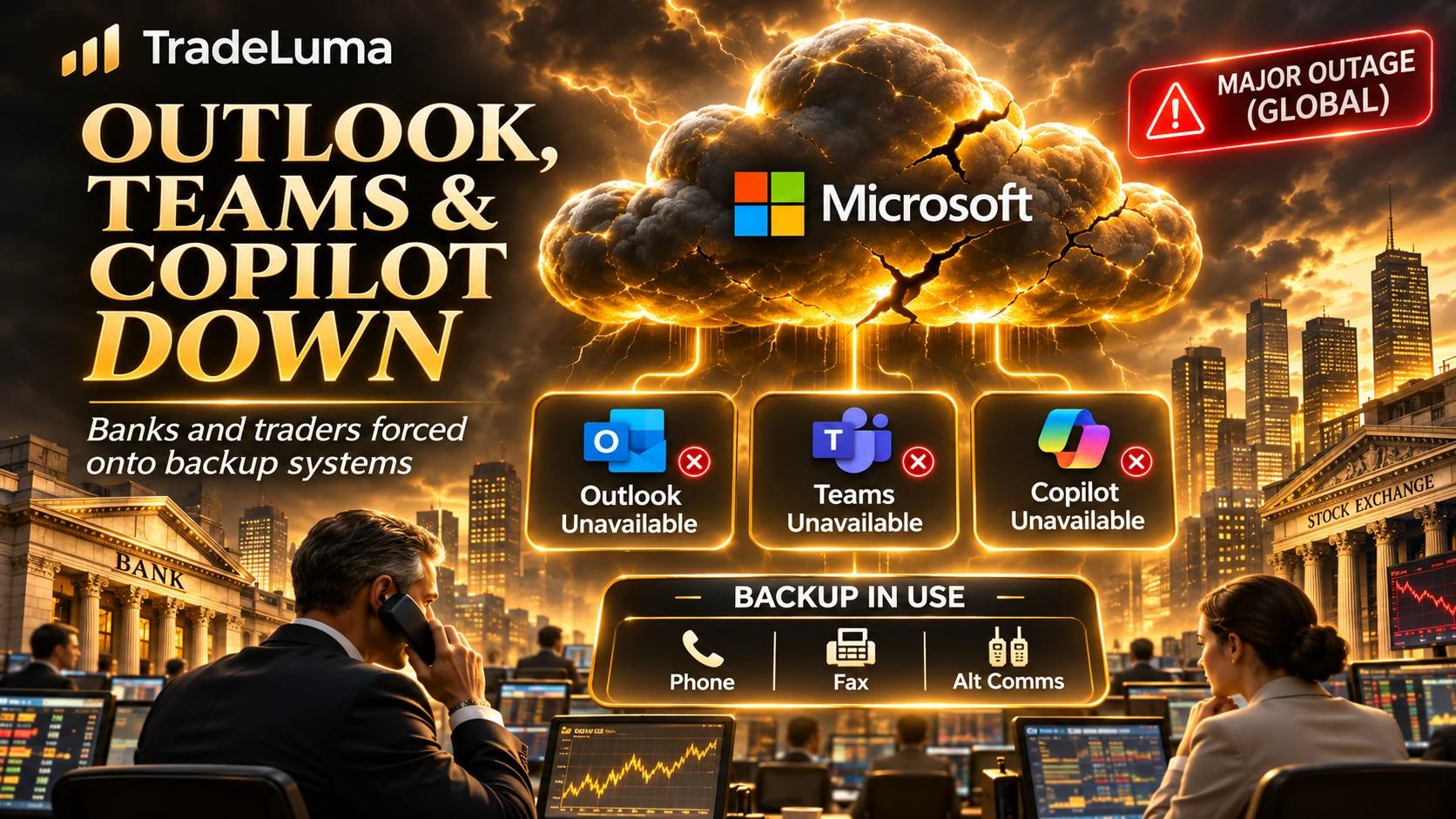
On November 12, 2026, a Microsoft 365 service failure spread from severe Exchange Online access problems into a global business-communications crisis. Outlook email access and delivery were disrupted, while Teams features that depended on Exchange and some Microsoft Copilot experiences also failed. Downdetector received reports from 74 countries and territories in roughly an hour; Reuters subsequently described banks, insurers, shipping firms and trading desks resorting to phones, faxes and other backup channels. Microsoft's November 13 updates described improving stability after a prolonged incident, not an instantaneous universal recovery. The distinction matters: the incident did not switch off every Teams meeting, every Azure service or every financial market. This analysis explains what failed, the technical recovery problem, why some firms confirmed trades by fax, what MSFT investors can reasonably infer and how traders can design more resilient operations.
What happened during the November 12–13 Microsoft outage?
Microsoft reported Exchange Online connectivity failures on November 12 that prevented some users from accessing mailboxes through Outlook on the web, desktop clients, mobile synchronisation methods and application interfaces. The affected service was fundamental to many organisations' daily work, so the incident quickly spilled into calendar workflows, approvals, collaborative tools and integrations. Microsoft's service-health record put the start of the major disruption at 16:17 UTC on November 12, equivalent to early Friday morning in Melbourne.
Within about an hour, the user-reporting platform Downdetector had received reports from 74 countries and territories, according to contemporary news coverage. The figure describes the geographic reach of reports, not evidence that every person in those places lost access. Reuters and the Associated Press described problems continuing into November 13 across business, government and health-sector organisations. Recovery became increasingly visible Friday, although some users still faced delays and intermittent service rather than a clean simultaneous return.
Outlook and Exchange Online were at the centre of the disruption
The most consequential failure was the inability to connect reliably to Exchange Online, Microsoft's hosted email and calendar backend. Users reported inboxes failing to load, messages not sending or arriving promptly, and Outlook web or desktop sessions producing errors. When a core messaging platform stops responding, dependent work such as sending trade confirmations, issuing customer instructions or approving internal transactions can stall even if the underlying financial transaction-processing platform remains functional.
Microsoft's incident notices listed several affected access mechanisms, including Outlook on the web, MAPI, Exchange ActiveSync and REST-style interfaces. That breadth explains why merely switching from the desktop Outlook application to a browser or phone did not reliably solve the problem. An alternative client may still require the same shared mailbox and authentication or data infrastructure.
Were Teams and Copilot completely down? The important distinction
A headline saying 'Teams went down' captures the disruption but can obscure an important technical nuance. Microsoft's incident advisory said many core Teams features—including normal meetings and messaging—remained largely functional for affected organisations. Features relying on Exchange Online, such as calendars, meeting scheduling, invitations and certain chat workflows, could nevertheless fail. Experiences varied across tenants, regions, devices and moments of the recovery.
Microsoft 365 Copilot was also exposed to the interruption. Some users could not load Copilot Chat or obtain responses, while other experiences failed when attempting to retrieve work emails, calendar details or Microsoft 365 files. A failure to obtain business context is distinct from a fundamental failure of an AI model itself. The incident demonstrated how a seemingly separate AI interface can depend on older enterprise messaging and identity systems.
Why 74 countries does not mean 74 countries were entirely offline
Downdetector's reported geographic spread was a powerful sign of a broad international event. It does not establish the exact number of unique users affected, how long each incident lasted or whether all services were unavailable in every reporting country. Outage trackers aggregate user-submitted complaints; a single person can file more than one report, and reporting levels vary with public awareness and local usage.
The more defensible description is that reports arrived from 74 countries and territories, spanning parts of the Americas, Europe, Asia and the Pacific. Separate reporting identified impact within organisations in Australia, Japan, the United States and several European markets. For readers assessing business risk, that distinction prevents a striking number from turning into an inaccurate claim of a universal worldwide shutdown.
What Microsoft said about the technical cause
Microsoft initially noted elevated load, but later clarified that a large number of servers had unexpectedly become unavailable. Remaining infrastructure then had to handle displaced requests, leading to further strain. Service-health updates described a core server process becoming overwhelmed, while some restarted servers turned unresponsive again after normal traffic returned. This made the event more complex than an ordinary short-lived application restart.
During the recovery Microsoft paused deployments and configuration changes, shifted traffic, restarted and isolated portions of affected infrastructure, limited certain request types and tested earlier configurations. Later commentary connected the incident to a network-capacity upgrade and subsequent network change. Those statements point to a technical path worth investigating, but should not be presented as a complete independently verified post-mortem until Microsoft issues its formal incident review.
Why the recovery took so long
Restoring a failed shared service is not simply a matter of turning servers back on. A restarting server can appear healthy under light load and then fail when queued mailbox requests, mobile sync activity and client reconnections arrive together. That was the pattern Microsoft described: some servers were returned to service but became unresponsive again as traffic resumed. Without careful traffic management, apparently successful recovery can cause another overload.
Microsoft's gradual approach included isolating infrastructure, rerouting connections, controlling traffic and incrementally bringing capacity back. On November 13, news reports noted improving stability, reduced email queues and better service in several regions. Nevertheless, 'improving' did not mean that every mailbox, invite and integration was immediately working, and delayed messages could persist after connectivity began returning.
Why banks and traders went back to fax machines
The sharpest illustration of the operational problem came from financial services. Reuters reported that some trading and administrative tasks slowed while institutions searched for alternative ways to authenticate instructions and confirm transactions. A Taiwanese financial company used fax to confirm trades, while other firms used telephone calls and alternative channels. The decision was not nostalgia: regulated firms sometimes retain documented fallback procedures for situations in which ordinary electronic communication becomes unreliable.
The important distinction is between an outage of work communications and an outage of an exchange or a brokerage matching engine. Most affected institutions in the reporting said their core processing or trading systems were still running, although trade confirmation, investor relations, client contact and administrative approval became more difficult. This event should not be used to claim that the global stock market stopped executing orders.
Euronext, insurers and shipping: the ripple effect beyond email
At Euronext, listing-related teams experienced communication problems and instructed companies to use phone contact for urgent matters. UK insurer Aviva deployed backup numbers and other workarounds for earnings communications. Global shipping company Maersk asked customers to telephone when urgent messages could not depend on routine channels. These examples show that a workplace communications outage can produce material friction even when the organisation's main product remains available.
The indirect damage is often difficult to measure. Delayed corporate announcements, postponed approvals, duplicate customer requests, missed instructions and extra manual reconciliation each consume staff time. Some effects appear quickly in public headlines; others remain inside operational incident logs. An honest market assessment should separate documented interruptions from unverified estimates of all-company financial losses.
What happened in Australia and other public services?
Australian government agencies and enterprises reported Microsoft communications difficulties during Friday, November 13 local time. Contemporary public notices warned that email-based enquiries or responses could be delayed and provided alternative contact methods for urgent matters. Elsewhere, reporting documented disruption across public administration, healthcare, education and transport, with frontline services varying in their dependence on Microsoft-hosted collaboration.
For hospitals, clinics and other organisations handling sensitive or time-critical information, a contingency channel must also meet privacy and authentication needs. A paper record, telephone confirmation or approved alternative messaging platform may be preferable to sending sensitive material through an unapproved personal account. Continuity planning has to preserve confidentiality and an auditable record, not simply restore speed.
OpenAI and Anthropic connectors were affected: what that means
News reporting during the initial disruption identified problems with Microsoft 365 connectors used by OpenAI and Anthropic services. A connector lets another application retrieve authorised information from Microsoft tools such as email or files. If the upstream Microsoft service cannot supply that information, features relying on the connector may produce errors even if the external application's core model and other capabilities are available.
This is a useful illustration of dependency chains in modern software. A service advertised as an AI tool, a brokerage dashboard or a workflow automator may silently rely on email, identity, storage or approval APIs from a different vendor. Measuring the availability of the front-end website alone will not reveal every fragile connection in the end-to-end task.
Did Microsoft stock crash because of the outage?
The outage was serious for customers, but a broad sell-off in MSFT should not be inferred from images of red market screens. News coverage of the November 13 US session described mixed technology-share performance, and one market recap said Microsoft shares edged higher by about 0.2% despite the outage. The wider Nasdaq fell for several other reasons, including company-specific turbulence elsewhere in the AI sector. That evidence does not support attributing every technology-market move to Microsoft 365 service failures.
For investors, the longer-term questions are customer retention, possible service credits, brand trust, the cost of engineering remediation and whether management changes redundancy or deployment practices. Enterprise agreements and high switching costs can make short-term revenue disruption smaller than headlines imply. None of those considerations guarantees that future outages will be ignored by shareholders.
Microsoft 365 is not identical to Azure, Windows or the entire internet
A global Microsoft 365 connectivity incident can affect many products without making every Microsoft cloud system or every Windows device unavailable. Exchange Online was the central impacted dependency in this event; Teams' partial functionality illustrates the difference. Some systems hosted on premises or run independently could continue operating while users lost access to cloud-hosted email, scheduling and certain AI-connected features.
Investors and technical teams should verify the exact service and incident ID before attributing failures to Azure compute, identity services, Windows updates or cyberattacks. Shared branding does not mean every Microsoft product has the same infrastructure or failure domain. Equally, 'the exchange engine was still working' does not mean every trader had a reliable way to communicate with counterparties.
Was this a cyberattack or an AI failure?
Microsoft stated that it had no indication malicious activity caused the incident, and later public statements said the disruption was not related to a cyberattack or AI. The company's technical explanations focused on server availability, capacity and changes affecting networking or service behaviour. Investigations can evolve, so a careful article distinguishes the company's statements from an independently completed root-cause review.
An outage alone does not demonstrate a data breach, ransomware incident, stolen credentials or exposure of customer files. Describing a problem as a security hack without evidence creates an entirely different market narrative. If later facts reveal a security dimension, that would require a dated factual update rather than rewriting the original event retroactively.
Why cloud concentration is the bigger business story
Enterprises choose integrated cloud software for understandable reasons: fewer separate contracts, common identity, centralised compliance, collaboration and relatively consistent administration. Integration has a trade-off. If many essential workflows rely on one messaging and calendar backend, a failure in that layer can interrupt approvals, meetings, trading confirmations and AI tools at the same time.
Buying a second application is not automatically resilience if it uses the same identity provider, email forwarding service or network path. Meaningful redundancy requires identifying shared dependencies, defining independent failure domains, testing staff access while the primary provider is unavailable and ensuring customers can still reach the business through a trusted alternative.
A practical outage checklist for financial firms and trading desks
Before an incident, designate at least two verified communication paths that do not depend on the same email or identity system. Keep a current incident contact tree, record who can authorise exceptional trade confirmation procedures and test the escalation process outside normal business hours. Document where time-critical evidence, trade records and customer instructions will be stored if the normal collaboration platform is inaccessible.
During an outage, establish whether order routing and broker connectivity are independently healthy; do not assume an email error means a filled order failed or that a broker timeout means an order was never received. Avoid issuing repeated instructions blindly, verify positions with the broker's authoritative interface, and prevent duplicate requests. After recovery, reconcile outstanding messages, transactions and approvals before resuming unattended automation.
What the outage teaches automated traders about resilient execution
Automated trading infrastructure should separate signal delivery, execution authority, broker state and operational notifications. If a service uses Microsoft 365 for alerts or administrative communication, an outage can prevent people seeing warnings even while a trading engine continues to run. Likewise, if a strategy depends on cloud-based approval or account verification, losing that dependency could block or delay entry and exit workflows.
TradeLuma's approach to safety emphasises bounded risk, duplicate controls, broker reconciliation, clear paper-versus-live separation and visibility into execution states. No trading platform can eliminate provider-wide outages, and this article is not a claim that TradeLuma was affected. The practical lesson is to test failure scenarios, confirm whether open positions remain protected and know when to pause new entries without inadvertently losing control of existing exposure.
How to verify recovery without mistaking one successful login for resolution
When a service begins returning, check more than the homepage or a single Outlook inbox. Test authentication, message sending and receiving, calendar changes, mailbox search, integrations and third-party APIs separately. Establish whether delayed email queues have cleared and whether users in different regions or tenants experience the same results. A local success can coexist with an ongoing global advisory.
Operations teams should close incidents only after the essential business functions have passed a representative checklist. Preserve timestamps and external service notices so they can be reconciled with transaction records and customer complaints. Microsoft promised more information about the incident; the full technical and commercial consequences were not yet established at this article's November 14 publication.
What to watch next: the post-incident review and enterprise response
Three developments matter beyond the initial outage: Microsoft's formal explanation of the triggering changes and why automatic recovery failed; any customer compensation or revised service-level commitments; and the extent to which large organisations adjust continuity plans or diversify critical communication systems. A single disruption is not enough to forecast Microsoft 365 cancellation rates or MSFT's long-run valuation.
For traders, the conclusion is operational rather than directional. A confirmed service disruption can damage communication confidence and add near-term friction, but it does not automatically provide a reliable trade in Microsoft shares or the Nasdaq. Watch company disclosures, documented customer effects and dated market prices while avoiding unsupported claims based on conceptual cover graphics.
Frequently asked questions
Was Microsoft Outlook down globally in November 2026?+
A major Exchange Online/Outlook disruption began November 12, 2026 and generated reports from 74 countries and territories. Impact differed by region, organisation and time; the figure does not mean every Outlook account was offline.
When did the major Microsoft 365 outage start?+
Microsoft's incident reporting identified November 12, 2026 at 16:17 UTC for the major Exchange Online disruption. This corresponds to early Friday, November 13 in Melbourne, Australia.
Were all Microsoft Teams meetings and chats unavailable?+
No. Microsoft's advisory said core Teams messaging and meetings largely remained functional even though Exchange-dependent calendars, scheduling and some workflows were disrupted.
Did Microsoft Copilot stop working?+
Some Microsoft 365 Copilot experiences became unavailable or could not retrieve authorised work content. Impact varied by feature, and it does not prove that every AI model was offline.
How many countries reported the Microsoft outage?+
Downdetector registered outage reports from 74 countries and territories in roughly an hour. This is a report-geography figure, not a count of every affected Microsoft account.
Was the November 2026 Microsoft outage caused by hackers?+
Microsoft said it had no indication malicious activity was responsible and described technical server and network issues. A complete formal post-incident review was still needed.
Why were banks using fax machines?+
Some organisations retained approved fax and phone procedures to confirm transactions and contact counterparties while email was unreliable. This did not mean all stock exchanges or bank settlement systems went offline.
Did Microsoft's outage cause the Nasdaq to crash?+
There is no basis for attributing the Nasdaq's November 13 decline entirely to the outage. Other market news mattered, and Microsoft shares were reported to have edged higher in one session recap.
Were OpenAI and Anthropic completely down?+
Reports described problems with their Microsoft 365 integrations or connectors, not evidence that their underlying AI model services were universally offline.
How should an automated trader respond to a cloud-service outage?+
Check broker-reported positions and order status independently, avoid duplicate submissions, pause new entries if required, use approved backup communications and reconcile activity after recovery. Do not assume that a failed notification proves an order failed.
Put it into practice
Use the risk maths next to the guide.
Open TradeLuma's free position-size, risk/reward, expectancy, and drawdown tools to test the numbers behind a risk-management decision.
Open free trading calculators →Continue learning
Related guides.

CoreWeave's 50% Stock Crash: Is Nvidia's AI Cloud Partner Sitting on a Debt Time Bomb?
CoreWeave stock plunged roughly 49% in a month as some bonds yielded 15%. Explore CRWV debt, Nvidia ties, $104B backlog and November 10 earnings risks.

Why Google Stock Fell After Earnings While Microsoft Rose: The AI Cash Flow Test
Google vs Microsoft October 2026 earnings explained: why Alphabet fell after hours while Microsoft gained, AI capex, Azure, Google Cloud and free cash flow.

SoftBank's $7 Billion AI Nightmare: Masayoshi Son's $64.6 Billion OpenAI Bet Faces a Reckoning
SoftBank swung to a ¥1.12T ($7.1B) quarterly loss as US data-centre charges hit $3.7B and financing costs jumped. What happens to its $64.6B OpenAI investment and 9984 stock?