
Psychology
Trading psychology: habits, routines, and discipline
Discover how routines, self-awareness, and discipline improve trading psychology, reduce impulsive decisions, and support more consistent execution.

Good trading psychology is not only about staying calm in difficult moments. It is also about building habits that reduce the number of difficult moments that need a split-second decision. A trader who starts the session prepared, follows a repeatable routine, and reviews decisions honestly usually has a psychological edge over someone who relies on willpower alone.
Why habits matter as much as mindset
Many traders think psychology begins after a trade goes wrong. In reality, psychology begins before the market opens. Sleep, preparation, platform readiness, watchlist quality, and position-sizing rules all shape how much pressure the trader will feel later. Good habits lower the chance that emotion becomes the main decision-maker.
Habits matter because they convert useful actions into defaults. When the process is familiar, the trader spends less mental energy deciding what to do next. That leaves more attention available for evaluating the setup itself instead of negotiating with fear, urgency, or frustration.
Build a pre-session routine that removes guesswork
A practical pre-session routine can include checking the calendar for major market events, reviewing the market structure, confirming strategy conditions, setting daily risk limits, and making sure the broker or execution platform is ready. The routine does not need to be complicated. Its purpose is to remove avoidable uncertainty.
A trader who begins with a written sequence is less likely to enter the first trade impulsively. The pre-session routine acts like a runway. It creates a stable starting point for the day rather than allowing the market to define the trader's mood from the first minute.
Use simple rules to protect discipline during the session
Discipline improves when the trading plan includes practical boundaries such as maximum size, maximum daily loss, session stop time, and conditions that mean no trade. These rules reduce the number of mid-session debates. Without them, the trader may keep searching for exceptions whenever the market feels urgent.
Checklists also help. A short checklist can confirm that the setup is valid, the risk is acceptable, the position size is correct, and the trade is not simply an emotional reaction to what just happened. A disciplined trader does not try to remember everything in the heat of the moment.
Self-awareness makes emotional problems visible earlier
Psychology becomes easier to manage when the trader can notice the early signs of drift. Common signals include rushing to enter, watching unrealised profit and loss too often, widening the plan after a loss, or taking unusually small size from hesitation. These are not random behaviours. They are clues that the trader is moving away from the written process.
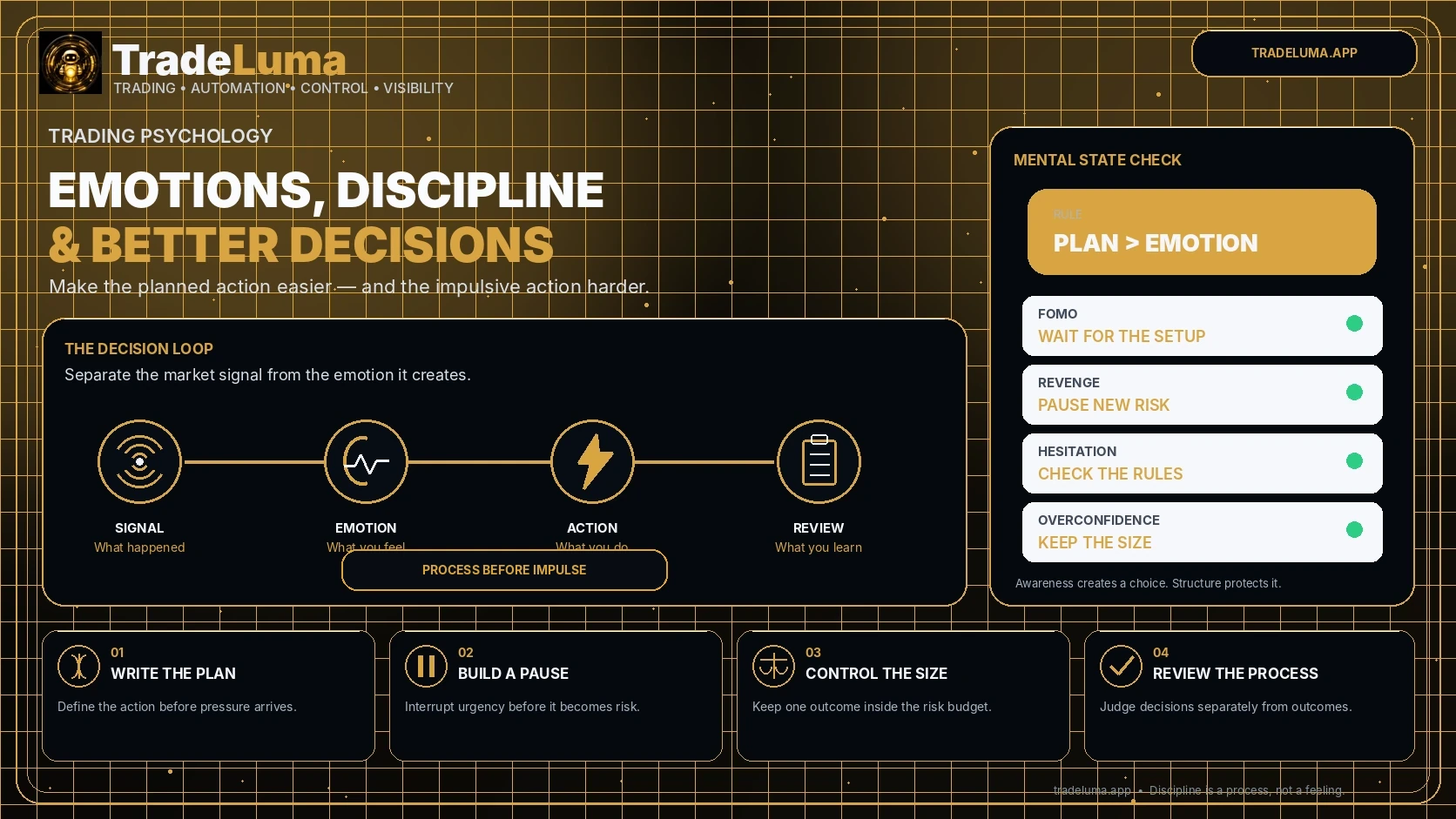
Naming the state can be useful. Labels such as calm, rushed, frustrated, fearful, and overconfident are simple, but they make patterns easier to track. When the same emotional state repeatedly appears before the same mistake, the trader has found a process problem that can be improved.
Separate discipline from perfectionism
A disciplined trader still has losing trades, makes occasional mistakes, and feels normal human emotions. Discipline is not emotional perfection. It is the ability to return to the process quickly and consistently. Perfectionism is often destructive because it treats every deviation as a personal failure rather than information that can be studied and corrected.
The better standard is process quality. Did the trade meet the rules? Was the risk respected? Was the exit handled according to plan? Those questions are more useful than asking whether the most recent trade won or lost.
Review routines turn experience into improvement
A review routine is where habits become better over time. End-of-day or end-of-week review can include screenshots, notes on execution quality, a summary of rule breaks, and a short assessment of emotional state. The goal is to find what repeats, not to produce a dramatic story about every trade.
Patterns matter more than isolated events. If the trader repeatedly enters late after watching momentum, increases size after a winner, or becomes passive after two losses, the review should turn that observation into a specific change in the next routine or checklist.
How automation fits into trading psychology
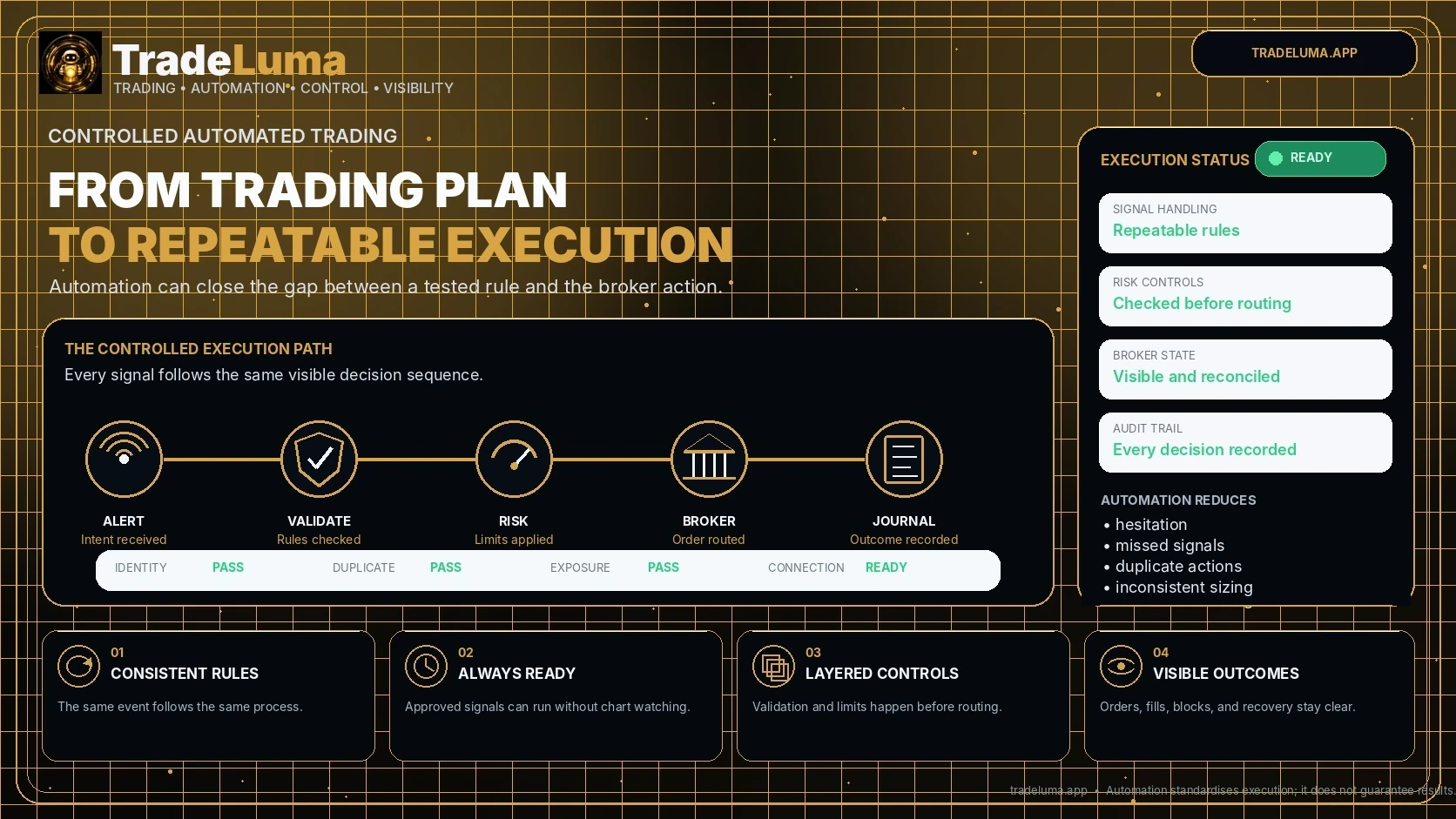
Automation can support psychology by reducing hesitation, standardising execution, and enforcing limits that are otherwise easy to bend. It is especially helpful when the main weakness is inconsistency in following already-defined rules. A controlled alert-to-order workflow can make discipline easier to keep.
At the same time, automation does not replace responsibility. Traders still choose the rules, size the risk, decide when live routing is appropriate, and determine whether to intervene manually. Strong psychology is still required because the trader remains accountable for the system they operate.
The practical goal: make good behaviour easier
The strongest psychological improvement often comes from simple structural changes: a written plan, a repeatable routine, limited size, a visible checklist, and regular review. These tools make good behaviour easier and impulsive behaviour harder.
That is the real purpose of trading psychology. It is not to become emotionless. It is to build a working environment where emotions are less able to rewrite the trading plan without permission.
Frequently asked questions
What is the role of routine in trading psychology?
Routine reduces avoidable uncertainty and decision fatigue. It helps traders begin the session prepared and makes disciplined behaviour more repeatable.
How can traders improve discipline?
Use a written plan, clear session limits, simple checklists, and regular review. Discipline becomes easier when the process is explicit and easy to follow.
Why is self-awareness important in trading?
Self-awareness helps traders recognise emotional drift such as rushing, hesitation, frustration, or overconfidence before those states cause avoidable rule breaks.
Can automation help trading psychology?
Yes. Automation can reduce hesitation and enforce rules, but it does not replace strategy quality, supervision, or responsible risk decisions.
Continue learning
Related TradeLuma guides
Build a controlled automation workflow with TradeLuma
Configure alerts, test in paper mode, apply execution controls, and follow broker outcomes from one workspace.