
Education
Time-Based Stop-Losses: Should You Exit a Trade Before Your Price Target Is Hit?
Compare elapsed-time stops, bar-count exits and session deadlines, with practical testing and execution considerations for automated strategies.
On this page+
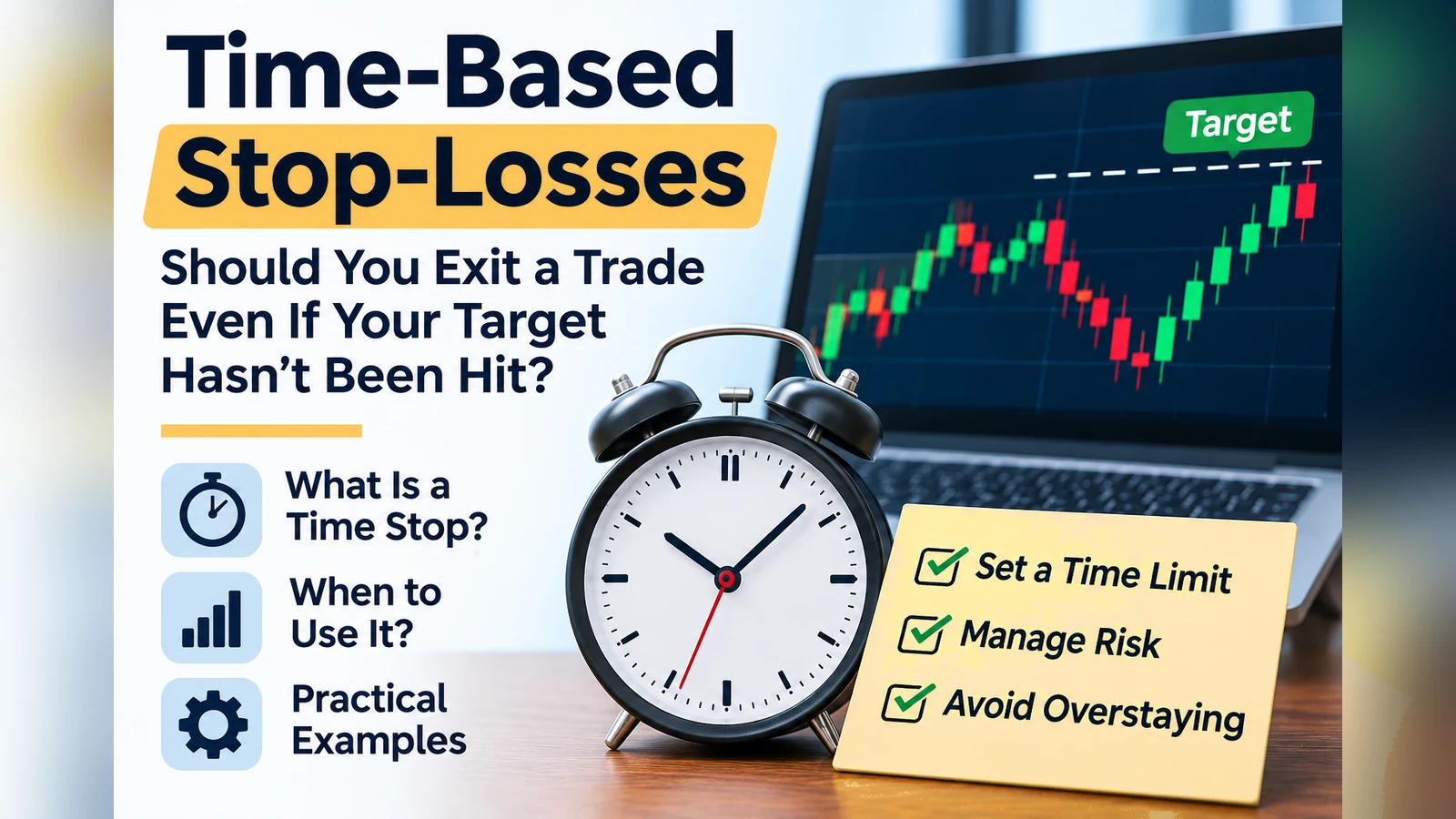
A trade can fail to behave as expected without ever touching its protective stop or profit target. Perhaps a breakout remains stalled near its entry for hours, or a strategy designed for the morning session is still holding exposure when the underlying market environment changes. A time-based exit addresses the duration of the position rather than waiting exclusively for a specific price. It may improve an approach that depends on a short-lived opportunity, but it can also remove future winners. The useful question is whether the rule improves a clearly defined strategy after realistic costs and independent testing.
What a time stop actually does
A time stop instructs the strategy to exit when a specified amount of time has passed or a particular session deadline is reached. It can apply to a winning, losing or nearly flat position. It does not replace the need to define what happens if price moves sharply against the position beforehand.
An approach can maintain a protective price stop while also requiring an exit after a maximum holding period. The first eligible exit condition then determines the intended action. The actual outcome still depends on the order type, market conditions and successful execution. A time stop is therefore a rule for requesting an exit, not a guarantee of an exact fill.
When the passage of time contains information
A strategy has an underlying hypothesis about the behaviour it seeks to capture. A short-term breakout may depend on a burst of participation following a particular level being crossed. If the expected continuation fails to occur within the intended window, the original reason for holding exposure may weaken.
A longer-term trend strategy, on the other hand, might intentionally tolerate extended consolidation. Imposing the same time limit on both approaches could produce very different results. Define why duration matters for the specific setup before selecting a number of minutes or bars. Otherwise the rule is merely an arbitrary adjustment to historical profits.
Choosing between bars and elapsed clock time
A limit of ten completed bars behaves differently on a one-minute chart than on a fifteen-minute chart. A fixed amount of elapsed time is different again when sessions contain gaps or maintenance breaks. Decide whether the counter should begin at the signal, order submission, first partial fill or complete entry, and specify what happens when a trade is reopened after an exit.
For a strategy based on completed bars, an exit instruction may not be evaluated until a bar closes. For a clock-based rule, the market might not be available at the scheduled instant. These details affect reproducibility and should be part of the written strategy specification.
A worked hypothetical breakout example
Imagine a fictional strategy entering a position after a breakout at a price of 100. Its planned target is 104 and its protective stop is 98. After sixty minutes the price is 100.5 and the strategy has a one-hour maximum holding rule. An exit at 100.5 would capture a gross half-point gain before fees if that price were available.
Without the time rule the position could later reach the target, reach the stop or remain open. The time exit may be beneficial in some paths and harmful in others. This example is illustrative, not a tested result. Evaluate the full distribution of outcomes rather than selecting only the paths that justify the new rule.
Maximum holding period versus a session close
An intraday strategy may need to close positions before the regular cash market ends, irrespective of when an individual entry occurred. A session deadline is not the same as holding every position for a fixed duration. It can prevent a late entry from extending into a period the strategy was never designed to trade.
Consider early closes, exchange holidays and daylight-saving transitions when calculating the cutoff. Use the relevant exchange time zone rather than the user's device clock. If a venue becomes unavailable before the intended exit, the strategy must handle outstanding exposure explicitly instead of assuming the deadline itself liquidated the position.
Measuring whether the exit improves a strategy
Compare the original rule set with an alternative that introduces one clearly defined time exit. Use identical data, entry rules, instrument assumptions and transaction costs. Measure net returns, expectancy, drawdown, average duration and exposure time.
Review trades that would have reached the original target after the new exit and trades that would have deteriorated after it. A rule that reduces maximum drawdown but also removes a large proportion of net returns presents a trade-off rather than an automatic improvement. Consider whether fewer long-held positions allow capital to be used elsewhere, but only credit benefits that can actually be modelled.
Avoiding a perfectly fitted duration threshold
Testing hundreds of holding-period values and selecting the most profitable one can create an apparently impressive historical result by chance. Examine a range of nearby settings and look for stable behaviour consistent with the strategy's hypothesis. Reserve a separate out-of-sample period or use a properly designed walk-forward process.
Include different market regimes and record how much data was used to choose the threshold. An exit rule that performs well only at precisely seventeen bars deserves scrutiny. The goal is a plausible and repeatable process, not the single historical duration that maximises a chart's ending balance.
Implementing a reliable automated time exit
Record the actual entry and its execution time, calculate the intended deadline in a consistent time zone, and reconcile the position before requesting closure. If another exit has already executed, the time rule must not submit an unintended opposing order.
Working stops and targets should be handled according to their order relationships, and partial fills require explicit treatment. TradeLuma's existing guides on order lifecycle, automation readiness and conflicting signals provide further context for evaluating such a workflow. A time stop may simplify a decision that would otherwise depend on emotion, but its operational details and investment consequences still require independent testing.
Frequently asked questions
Is a time stop the same as a stop-loss order?+
No. It is an exit condition based on time or duration. A price-based stop may remain active independently.
Can a profitable trade be closed by a time stop?+
Yes. The rule can close any eligible position regardless of its current profit or loss.
What is the best time-stop duration?+
There is no universal duration. It depends on the strategy's hypothesis, market, holding period, costs and independently validated performance.
Should I count from the alert or the fill?+
Define the convention explicitly. Actual exposure begins with execution, so a rule intended to limit exposure duration should account for fill timing and partial entries.
Can a time stop execute during a market closure?+
Not necessarily. Order handling depends on the venue and broker, and an exit may have to wait until eligible trading resumes.
Does adding a time stop always reduce risk?+
It may reduce time in the market but can change other risks, including trading costs and missed profitable moves. Evaluate the overall strategy rather than one metric.
Put it into practice
Use the risk maths next to the guide.
Open TradeLuma's free position-size, risk/reward, expectancy, and drawdown tools to test the numbers behind a risk-management decision.
Open free trading calculators →Continue learning
Related guides.

Trading Strategy Exposure: Is Less Time in the Market Actually Better?
Learn to calculate time in market, distinguish temporal and notional exposure, compare capital efficiency and evaluate drawdown without misleading annualisation.

Is Your Trading Strategy Only Profitable Because of a Few Big Trades?
Measure profit concentration, remove top winners from a backtest and assess whether a trading strategy's performance is robust.
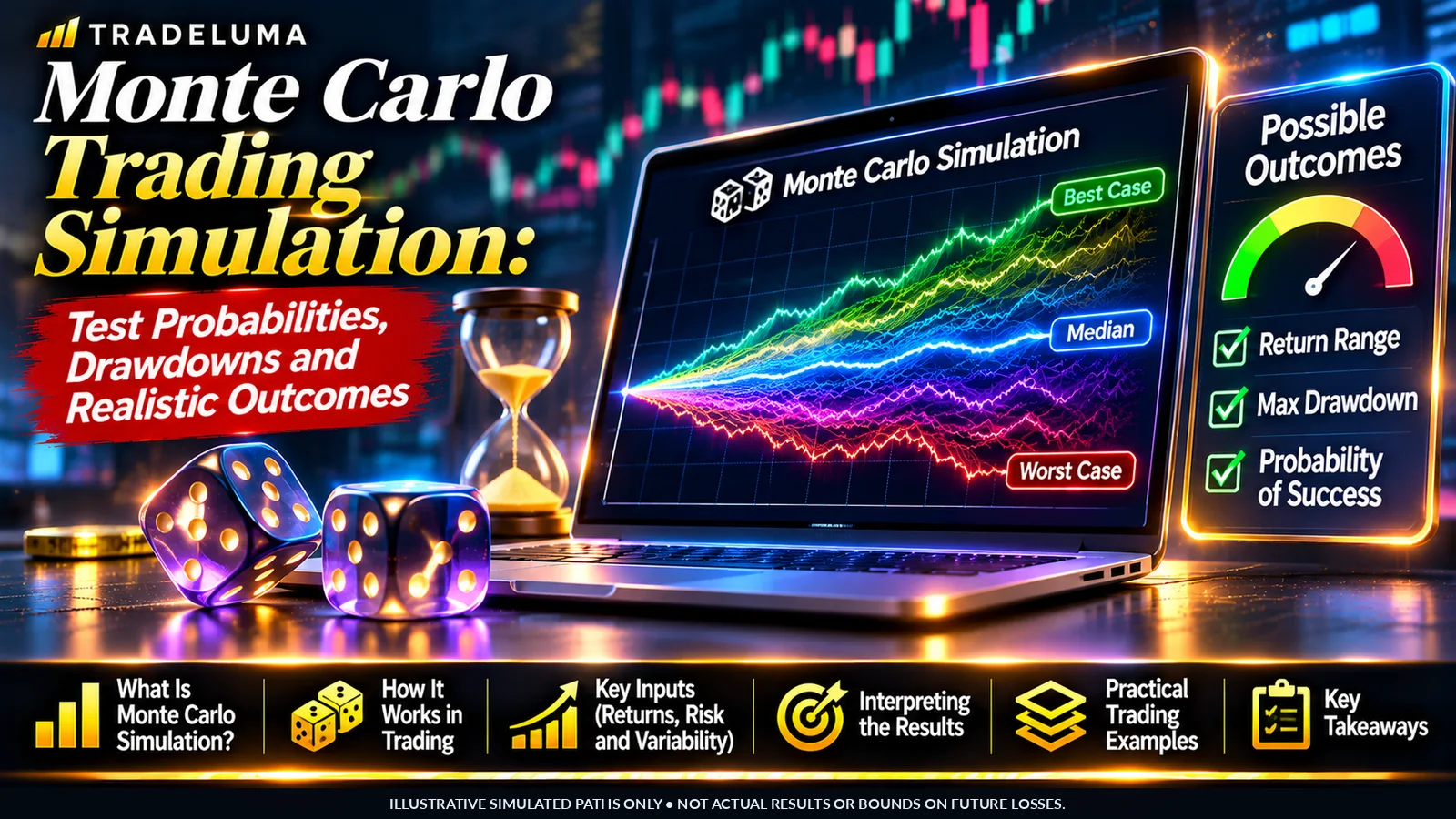
Monte Carlo Simulation for Trading Strategies: How Bad Could Your Next Drawdown Be?
Learn permutation and bootstrap simulations, drawdown percentiles, losing streaks, capital constraints and limitations using reproducible hypothetical futures examples.