
Trading Styles
Swing Trading Strategies: Pullbacks, Breakouts and Trend Setups
A practical guide to swing trading strategies, including trend pullbacks, breakouts, moving-average setups, range trades, stops, targets, and overnight risk.
On this page+
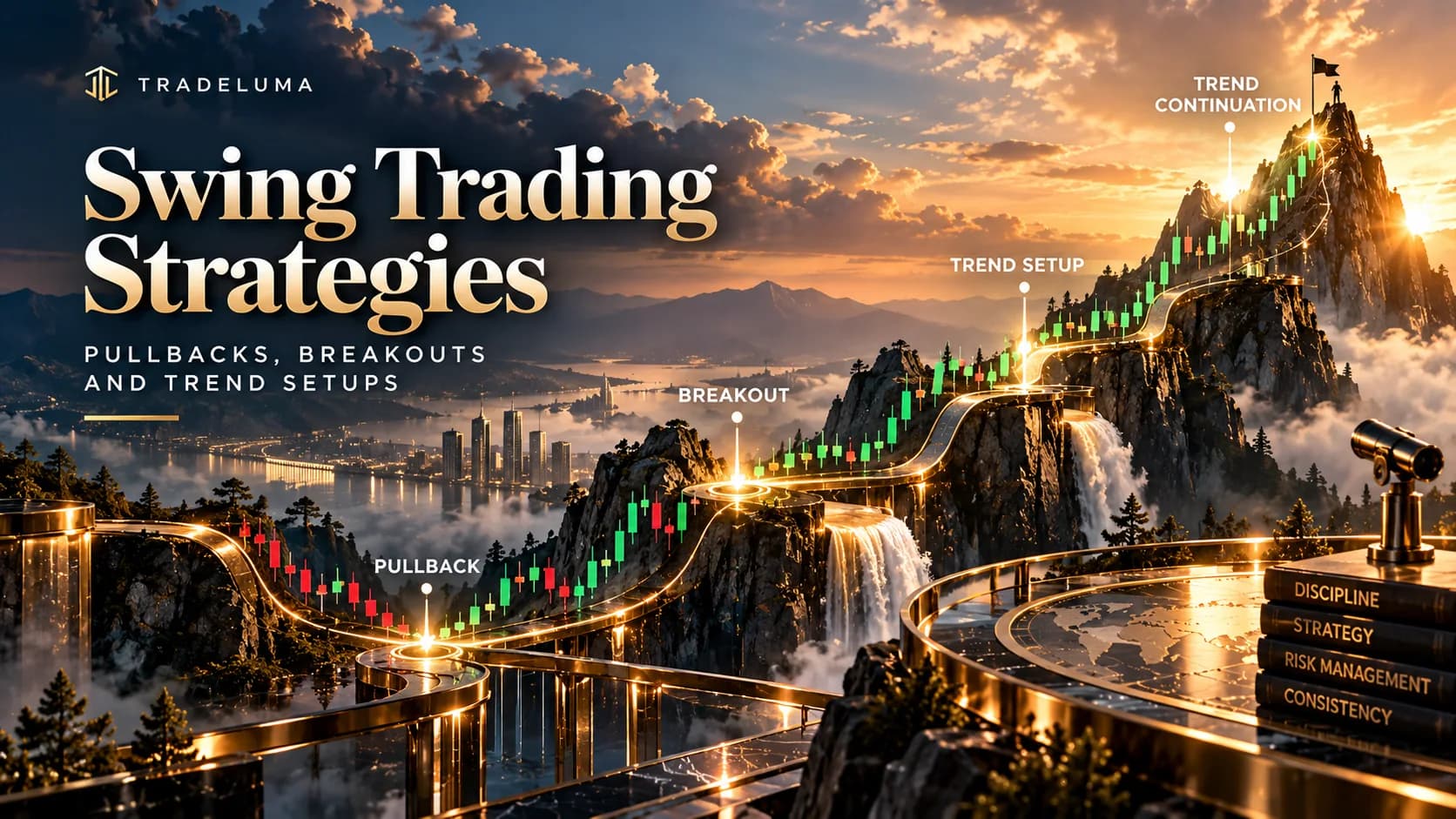
Swing trading aims to capture price moves that develop over several sessions rather than minutes. The holding period gives a trade more time to work, but it also introduces overnight gaps, news exposure, and wider stops than many intraday approaches. The most useful swing strategies are therefore built around clear market structure, selective entries, position sizing that fits the larger stop distance, and a plan for what happens if the market opens far from the previous close.
What makes a setup suitable for swing trading
Swing setups need enough price movement to justify holding beyond the current session. Traders often look for a clear daily or four-hour structure, visible support and resistance, an established trend, or a consolidation that could release into a multi-session move.
The timeframe should be slow enough that the setup is not invalidated by ordinary intraday noise but fast enough to produce a reasonable number of opportunities. Many traders use a higher timeframe for direction and a lower timeframe only to refine the entry.
Trend pullback swing strategy
A trend pullback strategy waits for the market to establish higher highs and higher lows in an uptrend, or lower highs and lower lows in a downtrend. Instead of entering after an extended move, the trader waits for price to retrace toward a prior breakout area, moving average, trendline, or other structural zone.
The key decision is whether the pullback is temporary or the trend is ending. Confirmation can include rejection from support, a renewed break in the trend direction, improving momentum, or a failure of the countertrend move to create new structure. The stop belongs where the original trend thesis is objectively invalid.
Breakout swing strategy
Breakout swing trades focus on price leaving a multi-session range, chart pattern, or significant high or low. Because the intended move may last several days, traders often prefer breakouts from well-defined compression rather than very short intraday levels.
A close beyond the range, expansion in true range, or a successful retest can be used as confirmation. Traders should still plan for failed breakouts because price can move beyond a level, attract entries, and then reverse back into the range before the next session.
Moving-average trend structure
Moving averages can help define whether the market is broadly trending and whether a pullback remains aligned with that direction. A simple approach might require price to remain above a rising medium-term average for long setups, then use a shorter average or price structure to identify the pullback.
Crossovers alone can lag and generate repeated signals in sideways conditions. The moving average is often more useful as context than as a complete strategy. Slope, separation, price structure, and volatility can add information about whether a trend is strong enough to justify a swing entry.
Range-reversal swing strategy
Some markets spend long periods rotating between established support and resistance. A swing trader may look for rejection near one boundary and target the midpoint or opposite side of the range, particularly when momentum is not strongly directional.
The risk is a true range breakout. Stops should be beyond the point where the boundary is no longer functioning, and traders may reduce or avoid range entries when volatility expands sharply or price begins closing consistently outside the established area.
How swing traders use stops
Swing stops usually need more room than day-trading stops because the position must survive normal movement across multiple sessions. Stops may be based on swing structure, ATR, prior highs or lows, or a level that invalidates the setup rather than an arbitrary fixed percentage.
A wider stop does not have to mean more account risk. Position size can be reduced so the amount at risk remains within the trader's plan. This relationship between stop distance and position size is central to responsible swing trading.
Targets, trailing exits, and holding winners
Swing trades can use fixed reward-to-risk targets, prior support or resistance, measured moves, or trailing exits that follow the trend. Fixed targets give a known objective, while trailing logic can capture larger moves when the market trends farther than expected.
Whichever method is used, it should be tested consistently. Taking profit early after every small gain can destroy the payoff profile of a strategy that depends on occasional larger winners, while holding every trade indefinitely can give back too much open profit when momentum fades.
Overnight gaps and event risk
Swing traders accept that markets can open at a different price from the previous close. Earnings, economic data, geopolitical events, contract-specific announcements, and changes in global markets can all create gaps that bypass a planned stop price.
Risk planning can include smaller position size around major events, avoiding certain releases, using instruments with appropriate liquidity, or accepting that the realised loss can occasionally exceed the theoretical stop. Overnight risk is a structural feature of swing trading, not an execution mistake.
A swing-trading routine that reduces overtrading
Because setups develop more slowly, swing traders can screen markets at scheduled times rather than watching every tick. A routine might include reviewing the higher-timeframe trend, marking key levels, checking upcoming events, calculating position size, and setting alerts for prices where a valid setup could form.
This slower workflow can improve selectivity, but it still requires discipline. Adding trades simply because nothing has happened for several days defeats the advantage of waiting for higher-quality conditions.
How to test a swing strategy
Backtests should include overnight gaps, realistic transaction costs, and enough history to cover both persistent trends and difficult sideways periods. If the instrument rolls between contracts or has changing session behaviour, the data treatment should match how the strategy will actually be traded.
Out-of-sample testing and paper trading can then confirm whether alerts, entries, stop behaviour, and holding periods work as expected. Review not only net profit but also drawdown, average hold time, gap losses, losing streaks, and how sensitive results are to small changes in entry and exit rules.
Frequently asked questions
What is a good swing trading strategy?+
A good swing strategy has objective entry and exit rules, positive expectancy after costs, manageable drawdowns, and a holding period that fits the trader's risk tolerance. Trend pullbacks and multi-session breakouts are common examples.
How long do swing traders hold trades?+
Swing trades are commonly held for several days to several weeks, although the exact holding period depends on the market, timeframe, and strategy.
Is swing trading safer than day trading?+
Neither style is automatically safer. Swing trading has fewer intraday decisions but adds overnight and gap risk. Day trading avoids most overnight exposure but can involve more trades, costs, and rapid decisions.
Can swing trading be automated?+
Yes, when the setup, entry, stop, target, filters, and position-sizing rules are objective enough to convert into testable signals and controlled broker instructions.
Technical analysis
Continue with the topic hub.
Browse the related TradeLuma guides and build the topic from foundations through practical application.
Explore Technical analysis guides →Continue learning
Related guides.

Forex trading strategies: common approaches for trend, range, and breakout setups
A practical guide to forex trading strategies, including trend following, range trading, breakouts, and the role of sessions, volatility, and risk control.
Day Trading Strategies: Breakouts, Momentum, VWAP and Range Trades
Explore practical day trading strategies including opening-range breakouts, momentum, VWAP pullbacks, range trades, risk controls, and intraday execution costs.

Pullback Trading Strategy Guide: Entries Within an Established Trend
Learn how pullback trading works, how to identify trend continuation zones, compare shallow and deep retracements, and define entries, stops, and exits.