
Trading Styles
Day Trading Strategies: Breakouts, Momentum, VWAP and Range Trades
Explore practical day trading strategies including opening-range breakouts, momentum, VWAP pullbacks, range trades, risk controls, and intraday execution costs.
On this page+

Day trading opens and closes positions within the same trading session, so the strategy must find enough intraday movement to overcome spread, commission, slippage, and market noise. The shorter holding period avoids most overnight gap exposure, but it places more weight on execution quality, session timing, liquidity, and emotional discipline. This guide covers several common day-trading frameworks and the risk controls that determine whether an intraday edge remains viable after real-world costs.
What a day-trading strategy needs to define
An intraday strategy needs more than an entry signal. It should define the session, instruments, allowed trading window, setup, confirmation, stop, target or exit rule, position size, maximum daily loss, and conditions that disable new entries.
Time matters because market behaviour changes through the session. The open can be volatile, the middle of the day can be quieter, and the closing period can bring another wave of participation. A setup that works at one time may be weak at another.
Opening-range breakout strategy
The opening-range breakout defines a high and low during an initial period after the market opens, then looks for price to move beyond that range. The logic is that early order flow establishes a reference area and a decisive break may signal that one side has gained control.
False breaks are common when the opening range is too narrow or volatility is erratic. Traders may require a close beyond the range, minimum volume or range expansion, a retest, or alignment with the higher-timeframe direction before entering.
Momentum day trading
Momentum strategies enter markets that are already moving strongly and attempt to capture continuation before the move exhausts. Signals may include new intraday highs or lows, rapid rate of change, strong candles, relative volume, or a sequence of shallow pullbacks that shows persistent demand or supply.
Because momentum can reverse quickly, exits need to be decisive. A trader should know what evidence means the move has stalled and how much slippage can occur when many participants try to exit at once.
VWAP pullback strategy
Volume-weighted average price, or VWAP, is widely used as an intraday reference. A simple trend-style setup may look for price to establish above VWAP, pull back toward it without breaking broader structure, then resume upward. The reverse can be used for short setups below VWAP.
VWAP is not a guaranteed support or resistance level. It works best as context within a complete setup that includes trend quality, price structure, session timing, volatility, and a defined invalidation point.
Range and mean-reversion day trades
When the market is balanced, traders may fade moves toward intraday support or resistance and target a return toward VWAP or the middle of the range. Oscillators and volatility bands are sometimes used to identify stretched conditions, but the price structure still matters.
The danger is continuing to fade after the market transitions into a trend. A range strategy should have a clear breakout condition that stops new mean-reversion entries once price begins accepting beyond the established boundary.
Breakout-pullback continuation
Instead of entering the first move beyond a level, some day traders wait for price to break out, pull back toward the former boundary, and then resume in the breakout direction. This can reduce the chance of buying the most extended point of the move.
The trade-off is that the market may never retest and the trader misses the move. A rule-based process should accept that missed trades are part of selectivity rather than chasing after the setup has already moved far from the planned entry.
Scalping versus broader intraday trades
Scalping targets very small moves and may hold positions for seconds or minutes. Broader day trades can remain open for an hour or more. The shorter the target, the larger the effect of transaction costs and execution latency because each cost represents a greater share of the expected profit.
A strategy should therefore match the infrastructure available to the trader. If the average expected move is only slightly larger than spread and slippage, even a small deterioration in fills can remove the edge entirely.
Daily loss limits and session risk
Day trading creates many opportunities to continue trading after a difficult start. That can become dangerous when a trader increases size, lowers standards, or repeatedly enters during poor conditions in an attempt to recover losses before the session ends.
A predefined maximum daily loss, maximum number of trades, and pause after consecutive losses can limit this behaviour. These controls do not make a weak strategy profitable, but they can prevent one abnormal session from causing disproportionate account damage.
Liquidity, spread, and slippage
Intraday strategies depend heavily on execution. A chart may show that the market touched an entry or target, but the real fill can be worse when the spread widens or available liquidity is thin. Market orders prioritise execution but can experience slippage; limit orders control price but may not fill.
Backtests should therefore use assumptions that reflect the actual instrument and session. A strategy that looks excellent on mid-prices with zero commission may be materially weaker once realistic bid-ask spread and slippage are included.
When day traders should stay out
Not trading is an important part of an intraday plan. Very low liquidity, unusually wide spreads, major scheduled announcements, repeated whipsaws, or a market that has already exceeded its normal session range can make some setups less reliable.
Objective no-trade rules reduce the temptation to force activity simply because the screen is open. A strategy can improve by removing its weakest conditions just as much as by adding another entry filter.
How to test a day-trading strategy
Intraday testing should use accurate session times, enough price resolution for the rules being evaluated, realistic costs, and data that includes both active and quiet market periods. If stops or targets can be touched inside a bar, the backtest method should model intrabar order sequencing as realistically as possible.
After historical testing, paper trading can validate alert timing and order behaviour. Review expectancy, profit factor, maximum intraday drawdown, average trade, time-of-day performance, slippage sensitivity, and whether the strategy remains stable when nearby parameters are changed.
Frequently asked questions
What is the best day trading strategy?+
There is no single best strategy for every market. Opening-range breakouts, momentum, VWAP pullbacks, and range trades can all be valid when their rules show positive expectancy after realistic costs.
Is day trading more profitable than swing trading?+
Neither style is inherently more profitable. Day trading may create more opportunities but also more costs and execution demands, while swing trading allows larger multi-session moves but carries overnight risk.
What is VWAP used for in day trading?+
VWAP is an intraday volume-weighted average price that traders often use as a reference for trend context, pullbacks, mean reversion, and relative position within the session.
Why are trading costs important for day traders?+
Day traders often make more trades and target smaller moves, so spread, commission, slippage, and execution quality can consume a larger share of gross profit than in slower strategies.
Technical analysis
Continue with the topic hub.
Browse the related TradeLuma guides and build the topic from foundations through practical application.
Explore Technical analysis guides →Continue learning
Related guides.
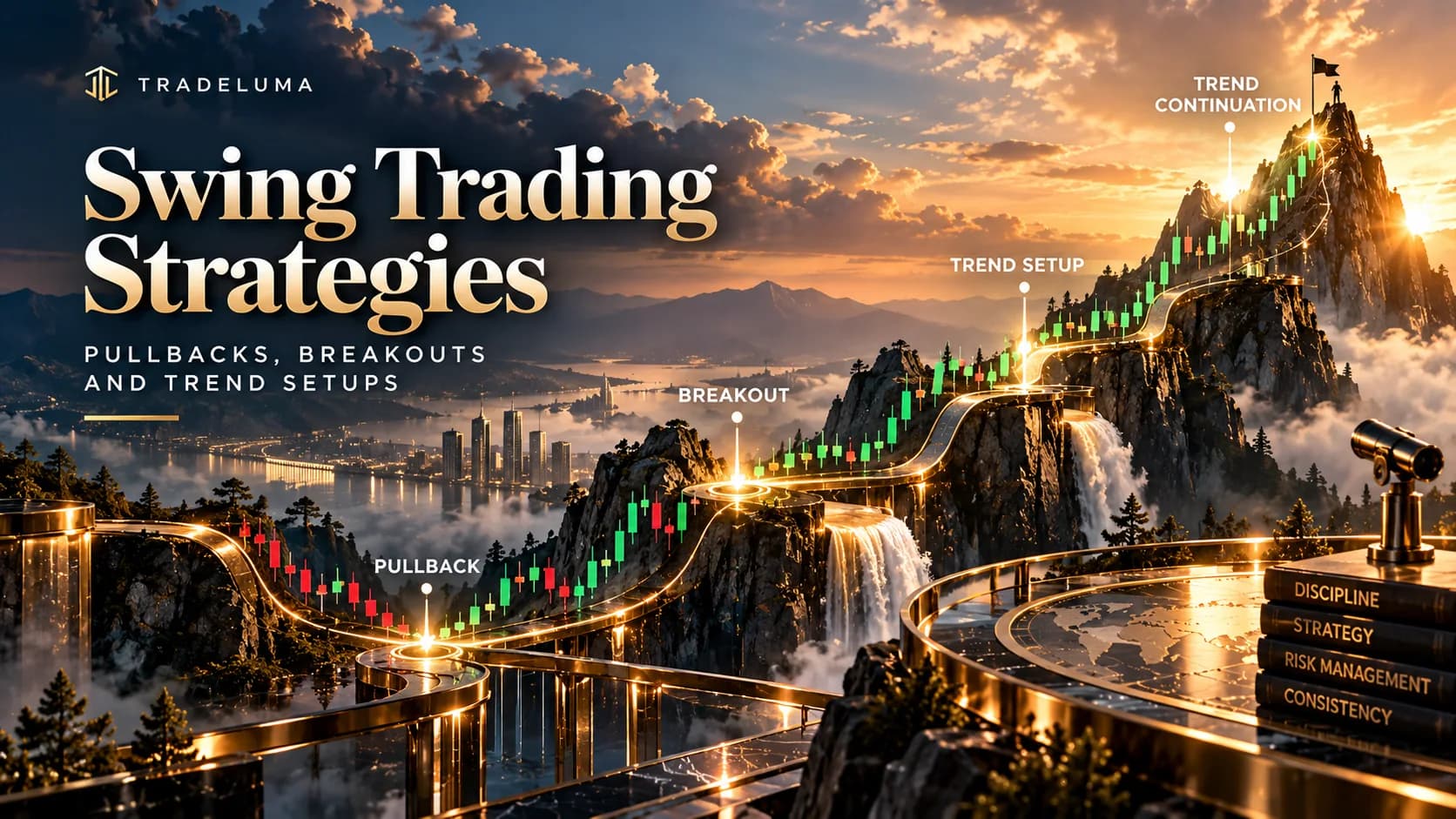
Swing Trading Strategies: Pullbacks, Breakouts and Trend Setups
A practical guide to swing trading strategies, including trend pullbacks, breakouts, moving-average setups, range trades, stops, targets, and overnight risk.

Forex trading strategies: common approaches for trend, range, and breakout setups
A practical guide to forex trading strategies, including trend following, range trading, breakouts, and the role of sessions, volatility, and risk control.
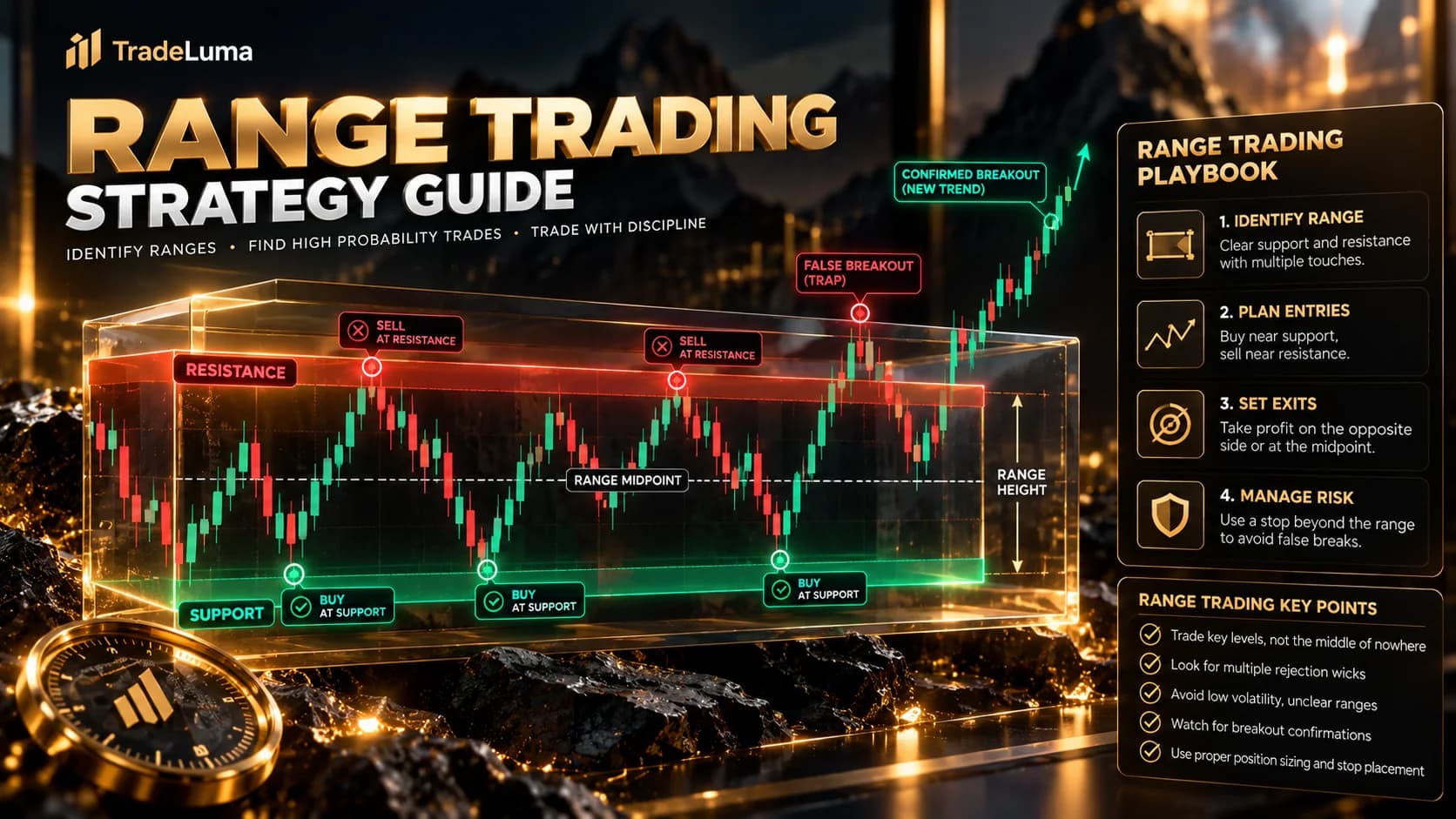
Range Trading Strategy: How to Trade Sideways Markets
Learn how range trading identifies support, resistance, failed breakouts, and mean reversion when markets move sideways instead of trending.