
Trading Styles
Scalping Trading Strategy: How Short-Term Trading Works
Learn how scalping works, including liquidity, spread, slippage, latency, momentum and mean-reversion setups, plus short-term risk controls.
On this page+

Scalping is a very short-term trading style that aims to capture small price movements, often with positions held for seconds or minutes. The attraction is frequent opportunity and limited time in the market, but the edge must survive something slower strategies can sometimes absorb more easily: spread, commission, slippage, latency, queue position, and rapid changes in liquidity. A scalping strategy therefore needs unusually clear entry and exit rules, realistic execution assumptions, and strict controls that prevent a high trade count from multiplying small mistakes.
What scalping means
Scalping sits at the shortest end of active trading. The strategy attempts to take a small portion of a move and exit quickly rather than hold through a full intraday trend or multi-session swing.
Some scalpers place many trades per session, while systematic approaches may be selective and only trade when a very specific short-term condition appears. Frequency is a consequence of the rules, not the objective by itself.
Why execution costs dominate short-term strategies
If a strategy targets a small price move, a one-tick worse entry and one-tick worse exit can consume a meaningful share of the expected profit. Commission, exchange fees, spread, and slippage must therefore be included in testing from the beginning.
The average trade after costs is a critical metric. A backtest with a strong gross profit but a tiny net average trade may be fragile to even modest deterioration in fills.
Liquidity and spread
Scalpers generally prefer liquid markets because tight spreads and deeper order books reduce execution friction. Liquidity is not constant, though; it can change by session, around announcements, and during sudden volatility.
A strategy can include spread or volume filters, but these filters should reflect information actually available at decision time. Historical bars alone may not capture the full behaviour of the order book.
Momentum scalping
Momentum scalping looks for short bursts of directional movement. Triggers can include a break of microstructure, a new short-term high or low, rapid range expansion, or a shallow pullback after an impulse.
The risk is entering near exhaustion. A fast strategy needs a clear signal that momentum has failed and an exit process that does not rely on the move continuing indefinitely.
Mean-reversion scalping
Mean-reversion scalpers look for temporary short-term extensions away from a reference such as VWAP, a moving average, a range midpoint, or a volatility band. The target is often a partial return toward that reference.
Strong trends are the main danger. Price can remain extended and continue moving, so the strategy needs a regime filter or invalidation rule that stops repeated fading when the market is no longer balanced.
Breakout and pullback scalping
A short-term breakout strategy enters when price moves through a recent range or micro resistance level. Some systems enter immediately; others wait for a quick retest or pullback before joining continuation.
False breakouts occur frequently on short charts. Confirmation can reduce some of them but also creates later entries. The trade-off should be tested rather than decided from individual chart examples.
Stops, targets, and position size
Scalping stops are often tight in price terms, but that does not justify oversized positions. A sudden burst of volatility or a poor fill can cause the realised loss to exceed the planned stop distance.
Position size should still be calculated from account risk, instrument value, and the invalidation level. Maximum contracts and maximum daily loss are useful additional controls when many trades can occur quickly.
Latency and automation
Very short-term strategies can be sensitive to the time between signal generation, order routing, broker acknowledgement, and fill. A delay that is irrelevant on a four-hour strategy may materially change a scalp entry.
Automation can improve consistency, but it does not eliminate market latency or slippage. Monitoring should distinguish signal time, platform processing time, broker submission, and fill time so execution problems can be diagnosed accurately.
Scalping versus day trading
All scalping is short-term, but not all day trading is scalping. A day trader may hold a position for an hour or more and target a larger intraday move, while a scalper typically exits much faster and may trade more frequently.
Because the expected move is smaller, scalping places greater emphasis on execution costs, microstructure, and infrastructure. Day trading strategies can sometimes tolerate more entry slippage if their target is substantially larger.
How to backtest a scalping strategy realistically
Use high-resolution data where possible and model intrabar order sequencing, spread, commission, slippage, session boundaries, and minimum tick size. If the strategy relies on fills at prices touched only briefly, bar-based testing may overstate execution quality.
Then test cost sensitivity. Increase assumed slippage, delay entries, and evaluate nearby parameters. A robust scalping edge should not disappear immediately when execution assumptions become slightly less favourable.
Frequently asked questions
What is a scalping trading strategy?+
Scalping is a short-term strategy that aims to capture small price movements, usually with positions held for seconds or minutes.
Is scalping the same as day trading?+
Scalping is a form of intraday trading, but day trading can include much longer holding periods and larger targets within the same session.
Why are costs so important in scalping?+
Because each target is relatively small, spread, commission, slippage, and latency can consume a large share of the expected profit.
Can scalping be automated?+
Yes, when the rules are objective and the execution path is reliable, but automated scalping still requires realistic latency, slippage, broker, and risk controls.
Trading indicators
Continue with the topic hub.
Browse the related TradeLuma guides and build the topic from foundations through practical application.
Explore Trading indicators guides →Continue learning
Related guides.

Position Trading Strategy: How Longer-Term Trading Works
Learn how position trading uses daily and weekly trends, technical or fundamental context, wider stops, gap risk, and longer holding periods.
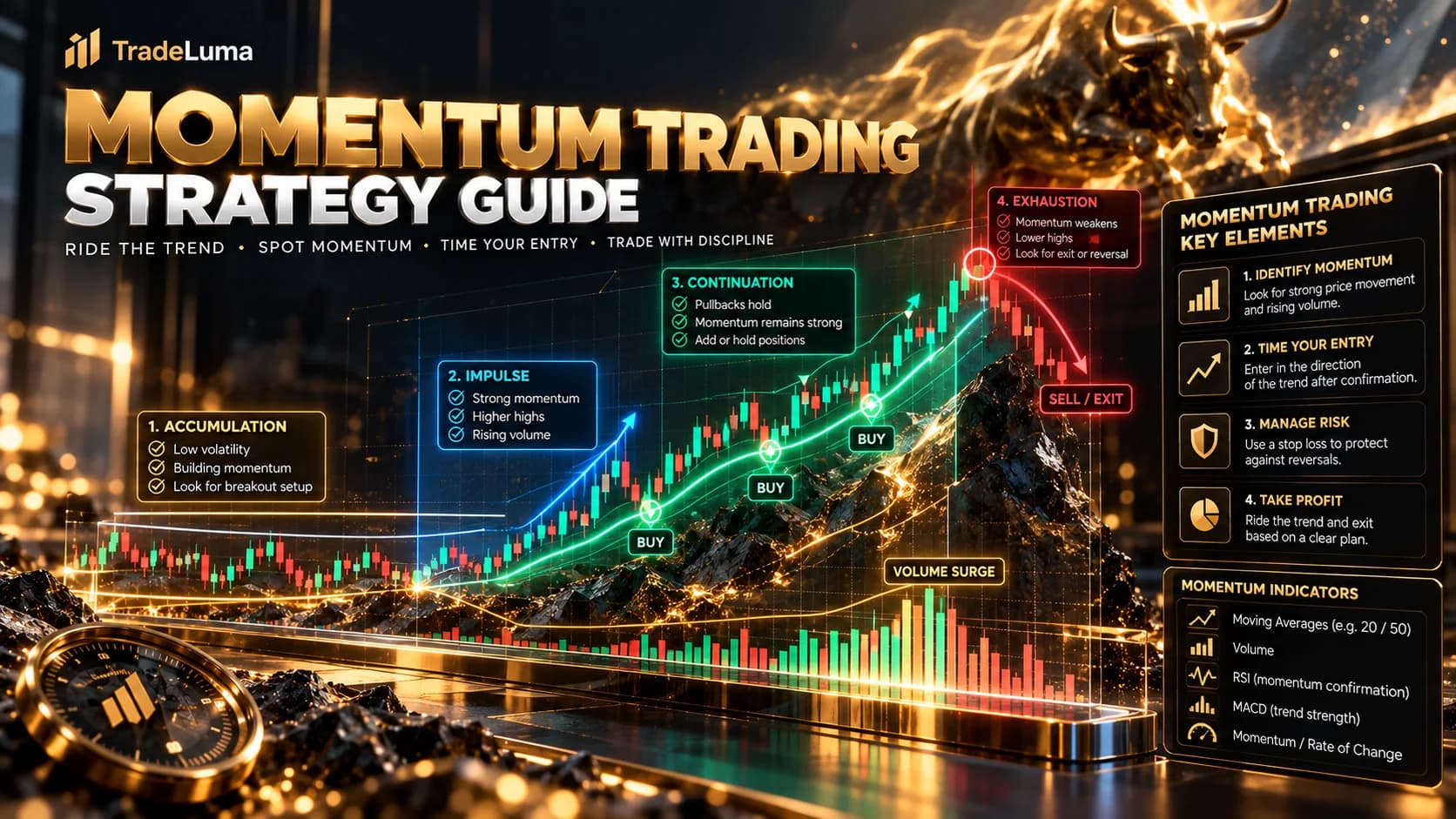
Momentum Trading Strategy: How to Identify Strong Price Moves
Learn how momentum trading works, how traders identify acceleration and continuation, and how to manage the risk of entering fast-moving markets.

Best Trading Timeframes: 5-Minute, 1-Hour, 4-Hour or Daily?
Compare 5-minute, 1-hour, 4-hour and daily trading timeframes, including signal frequency, noise, costs, holding periods, and strategy fit.