
Trading Styles
Pullback Trading Strategy Guide: Entries Within an Established Trend
Learn how pullback trading works, how to identify trend continuation zones, compare shallow and deep retracements, and define entries, stops, and exits.
On this page+

Pullback trading aims to enter an existing trend after price temporarily moves against that trend. Instead of chasing the initial impulse, the trader waits for a retracement and looks for evidence that the dominant direction is resuming. Pullbacks can improve entry price and create clear structural invalidation, but they also carry a central risk: what looks like a temporary retracement can become a full trend reversal. A robust pullback strategy therefore needs an objective trend definition, an acceptable retracement zone, a trigger, and a clear point where the continuation idea is wrong.
What a pullback is
In an uptrend, a pullback is a temporary decline within a broader sequence of higher highs and higher lows. In a downtrend, it is a temporary rally within lower highs and lower lows.
The key word is temporary, but that is only known with certainty after the fact. The strategy must therefore define evidence that distinguishes a normal retracement from a developing reversal.
Define the trend first
Trend can be defined through swing structure, moving-average slope, channel direction, higher-timeframe bias, or a combination. The definition should be objective enough that two executions of the strategy reach the same conclusion.
Entering pullbacks when the higher-timeframe structure is already deteriorating can turn a continuation strategy into an unplanned reversal bet.
Shallow versus deep pullbacks
Strong trends often produce shallow retracements because buyers or sellers step in quickly. Deeper retracements can offer a better entry price but may also signal that momentum is weakening.
A strategy can define acceptable depth using prior structure, moving averages, ATR, percentage retracement, or Fibonacci zones. The method should be tested for the target market.
Common pullback entry triggers
Possible triggers include a break above the pullback's short-term high in an uptrend, a bullish rejection candle near support, momentum turning back with the trend, or a close back above a moving average. Bearish pullbacks use the opposite logic.
Waiting for confirmation reduces some early entries but can worsen the price. The trade-off between confirmation and reward-to-risk should be evaluated in the backtest.
Using support and prior breakout zones
Former resistance can become support after a bullish breakout, while former support can become resistance after a bearish break. Pullback traders often watch these areas for a retest.
The level should be treated as a zone. A small intrabar penetration does not necessarily invalidate the setup, but a decisive structural break may.
Where stops can be placed
A logical stop often sits beyond the swing point that would invalidate the continuation thesis. Volatility can be incorporated so the stop is not positioned inside ordinary market noise.
Because pullbacks vary in depth, position sizing should adapt to the stop distance. A deeper stop should generally mean a smaller position for the same planned account risk.
Exits for pullback trades
Targets can reference the prior swing high or low, a fixed reward-to-risk multiple, an ATR objective, or a trailing exit designed to capture a larger trend extension. Each approach changes the payoff distribution.
A trend-following pullback system may accept a lower win rate in exchange for larger winners, while a shorter target can improve win rate but cap the right tail.
When pullback strategies fail
Pullbacks fail when the broader trend ends, a major event changes the market regime, or the original impulse was only a false breakout. Repeated attempts to buy a falling market or short a rising reversal can compound losses.
Use maximum attempts, daily risk limits, or a structural regime filter when appropriate. The strategy should define when it stops treating the move as a pullback.
Frequently asked questions
What is pullback trading?+
Pullback trading means entering in the direction of an established trend after price temporarily retraces against that trend.
How do you know if a pullback is not a reversal?+
You cannot know with certainty. Traders use trend structure, retracement depth, confirmation triggers, and invalidation rules to manage that uncertainty.
Where should a pullback stop loss go?+
A stop is often placed beyond the structural point that would invalidate the continuation setup, with position size adjusted to the stop distance.
Are shallow or deep pullbacks better?+
Neither is universally better. Shallow pullbacks can reflect strong momentum; deeper pullbacks may offer better prices but can carry greater reversal risk.
Keep learning
Continue through the TradeLuma research library.
Browse practical guides across trading, automation, execution, futures, technical analysis, and risk management.
Browse all guides →Continue learning
Related guides.

Swing Trading Strategies: Pullbacks, Breakouts and Trend Setups
A practical guide to swing trading strategies, including trend pullbacks, breakouts, moving-average setups, range trades, stops, targets, and overnight risk.

Forex trading strategies: common approaches for trend, range, and breakout setups
A practical guide to forex trading strategies, including trend following, range trading, breakouts, and the role of sessions, volatility, and risk control.
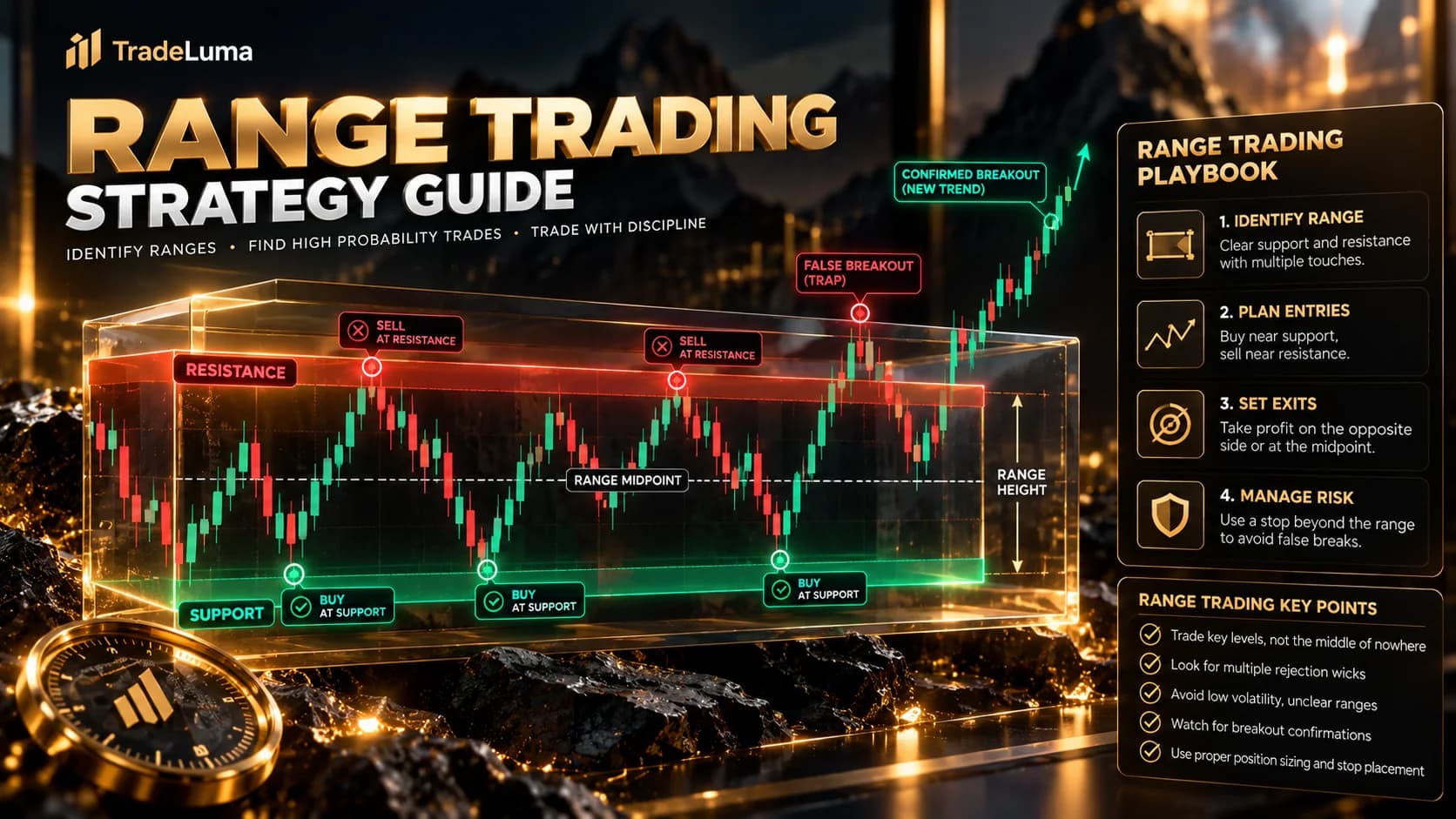
Range Trading Strategy: How to Trade Sideways Markets
Learn how range trading identifies support, resistance, failed breakouts, and mean reversion when markets move sideways instead of trending.