
Trading Styles
Momentum Trading Strategy: How to Identify Strong Price Moves
Learn how momentum trading works, how traders identify acceleration and continuation, and how to manage the risk of entering fast-moving markets.
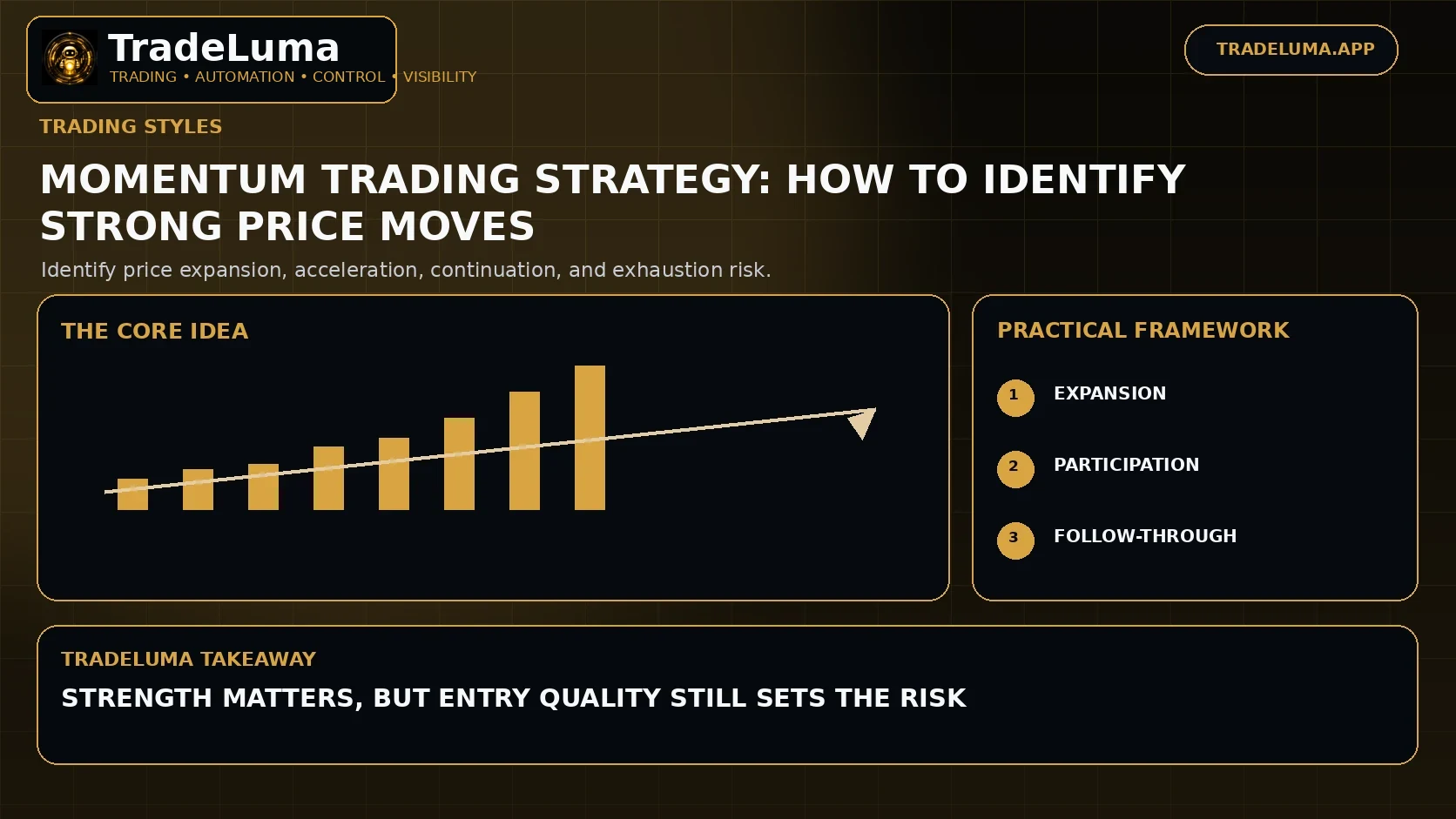
Momentum trading focuses on markets that are already moving with unusual strength and attempts to participate while that directional pressure continues. The approach can use price expansion, rate of change, volume, breakouts, trend structure, or momentum indicators. Momentum can produce fast opportunities, but the same speed that creates potential also increases slippage, late-entry risk, and the chance of sharp reversals.
What momentum trading is
Momentum traders look for evidence that one side of the market is acting with enough urgency to keep price moving in the same direction. The goal is not to buy because price is high or sell because price is low; it is to participate when directional pressure appears persistent.
The holding period can range from minutes to days. What defines the approach is the emphasis on continuation rather than buying weakness or fading an extended move.
Price expansion and range
One sign of momentum is expansion in candle range relative to recent bars. Consecutive closes near the highs of bullish candles or near the lows of bearish candles can show that one side is controlling the auction.
Average true range, recent range percentiles, or simple comparisons with prior candles can help make the idea testable instead of relying on visual excitement.
Rate of change and momentum indicators
Rate of change measures how quickly price has moved over a chosen lookback. RSI, MACD, and other oscillators can also reflect changes in momentum, although each transforms price differently.
An indicator should support a defined setup rather than replace one. A high momentum reading can mean strong continuation, but it can also occur late in a move when the reward-to-risk has already deteriorated.
Volume and participation
Momentum is often more credible when price expansion occurs with stronger participation. Relative volume compares current activity with what is typical for the same instrument or time of day.
Volume is not a guarantee of continuation. Heavy activity can also occur at exhaustion points, so price response after the volume increase matters.
Breakout momentum setups
A common momentum setup begins when price leaves a well-defined range, prior high, prior low, or consolidation. The trader may require a close beyond the level, expanding volume, a minimum range, or immediate follow-through.
Another variation waits for the breakout and then enters the first shallow pullback. This can improve entry location but creates the risk of missing moves that never retest.
Avoiding late entries
Momentum attracts attention after the move becomes obvious. That creates a recurring problem: entering only after price has already travelled most of its normal range. The stop may be far away while the next logical target is close.
Rules based on distance from a moving average, ATR extension, session range, or number of consecutive expansion bars can help define when a setup is too stretched to chase.
Stops and exits
A momentum stop can sit beyond the structure that should hold if continuation is real, such as the breakout level, recent pullback low, or a volatility-adjusted reference. Position size should adapt to that stop distance.
Exits can use fixed reward-to-risk targets, trailing stops, momentum deterioration, or a break of short-term structure. Trailing methods may capture large winners but can return more open profit during reversals.
When momentum strategies struggle
Momentum strategies often struggle in low-volatility ranges where every breakout quickly returns inside the prior area. They can also be vulnerable around major event releases when price gaps through intended stop levels.
A regime filter that considers volatility, trend quality, volume, or time of day can help separate active directional conditions from noisy balance.
How to backtest momentum
Record the exact momentum definition, entry timing, maximum extension, stop, target, trading window, and transaction costs. Review both average results and the distribution of slippage around the fastest trades.
Separate performance by market regime. A strategy that works in strong directional periods may need to stay inactive during quiet or mean-reverting conditions.
Frequently asked questions
What is momentum trading?
Momentum trading attempts to participate in price moves that already show persistent directional strength, using price action, volume, rate of change, or momentum indicators.
Which indicators are used for momentum trading?
Common choices include rate of change, RSI, MACD, moving-average slope, relative volume, and volatility expansion, but none should be used without a complete setup and risk plan.
Is momentum trading the same as trend following?
They overlap, but momentum trading often focuses more on acceleration and shorter bursts of strength, while trend following may hold positions through slower multi-stage trends.
What is the main risk of momentum trading?
A major risk is entering late when the move is already extended, leaving poor reward-to-risk and greater exposure to sudden reversal or slippage.
Continue learning
Related TradeLuma guides
Trading Styles
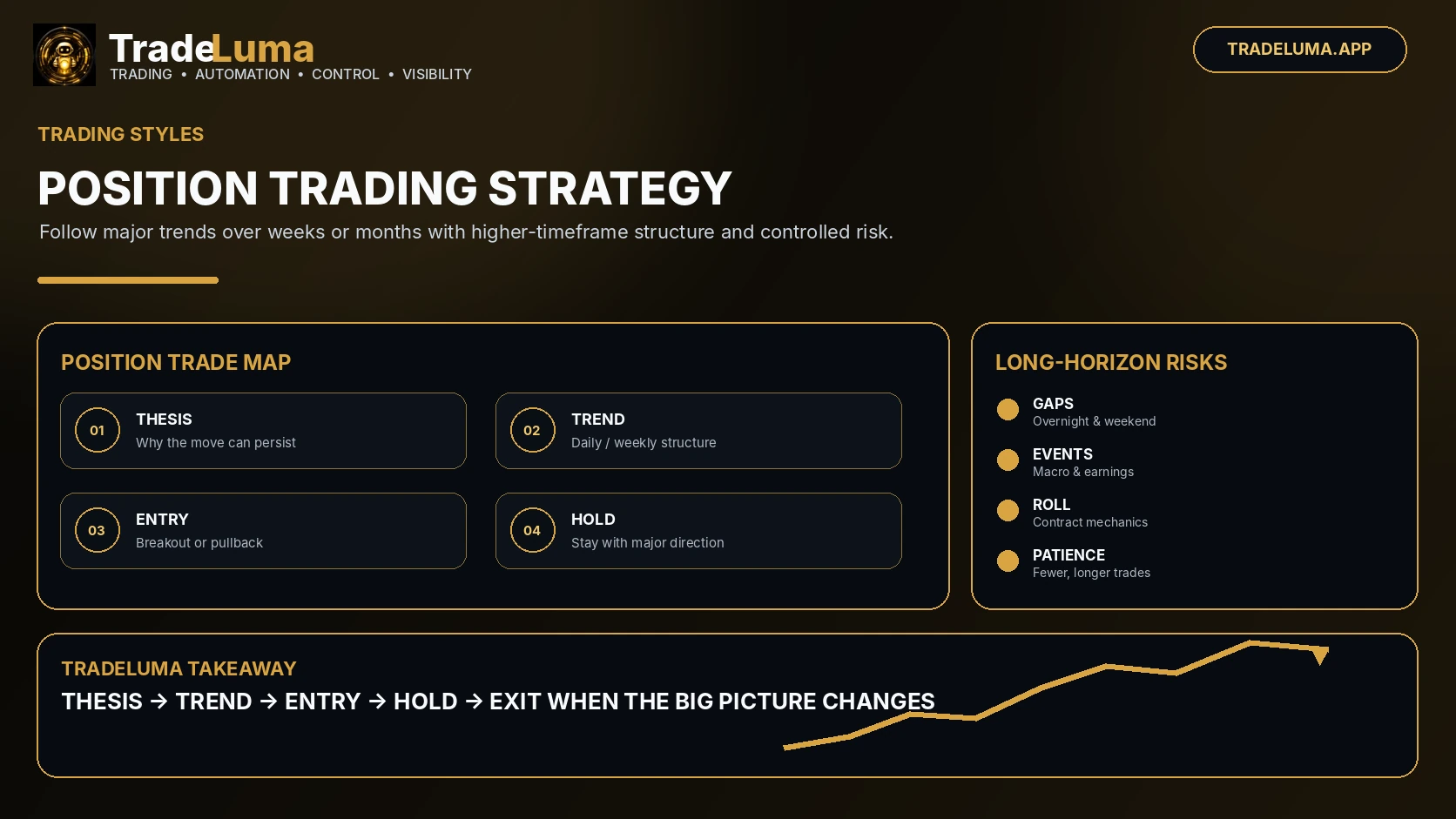
Position Trading Strategy: How Longer-Term Trading Works
20 Aug 2026 · 12 min read
Trading Styles
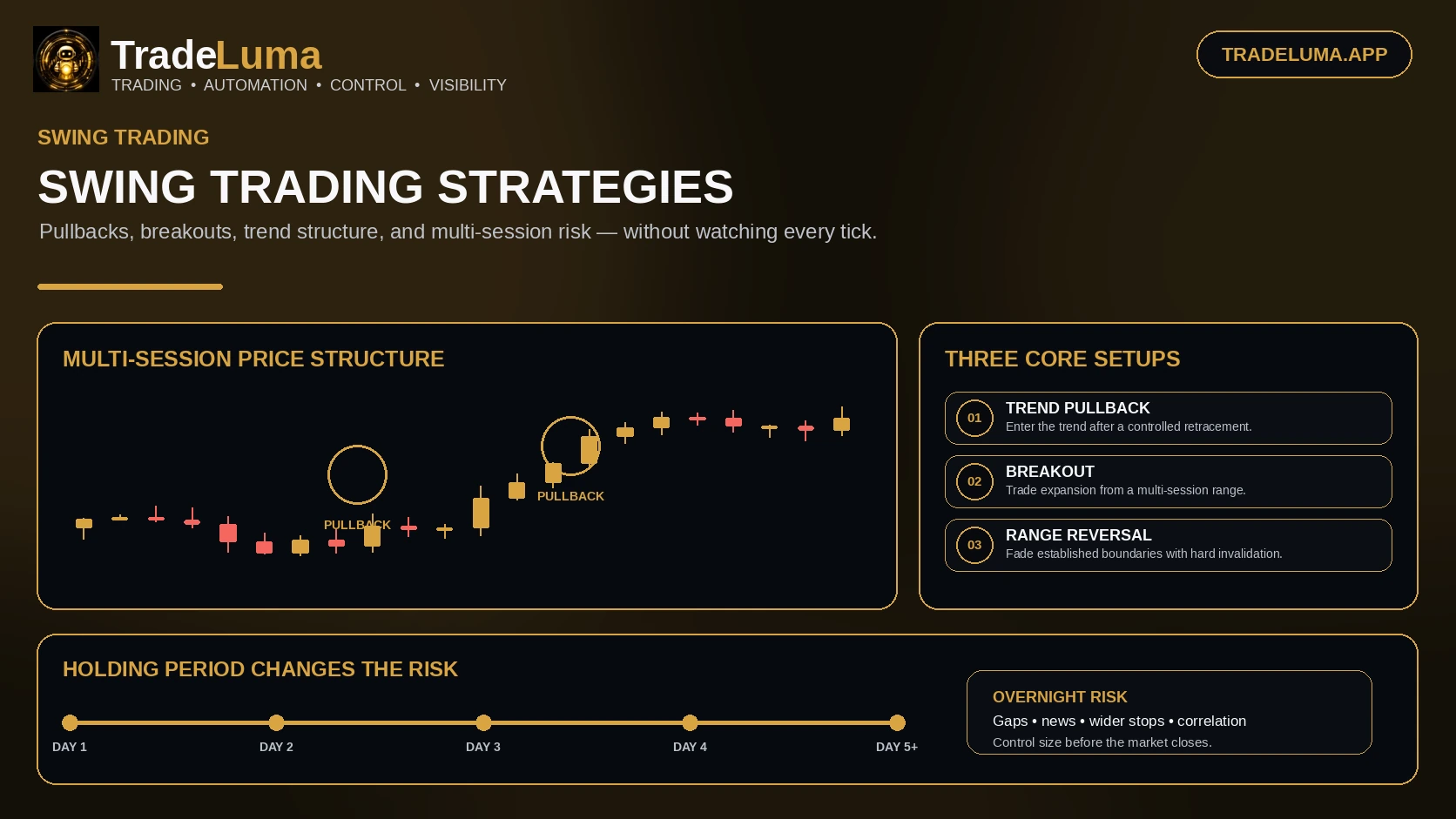
Swing Trading Strategies: Pullbacks, Breakouts and Trend Setups
14 Aug 2026 · 12 min read
Trading Styles
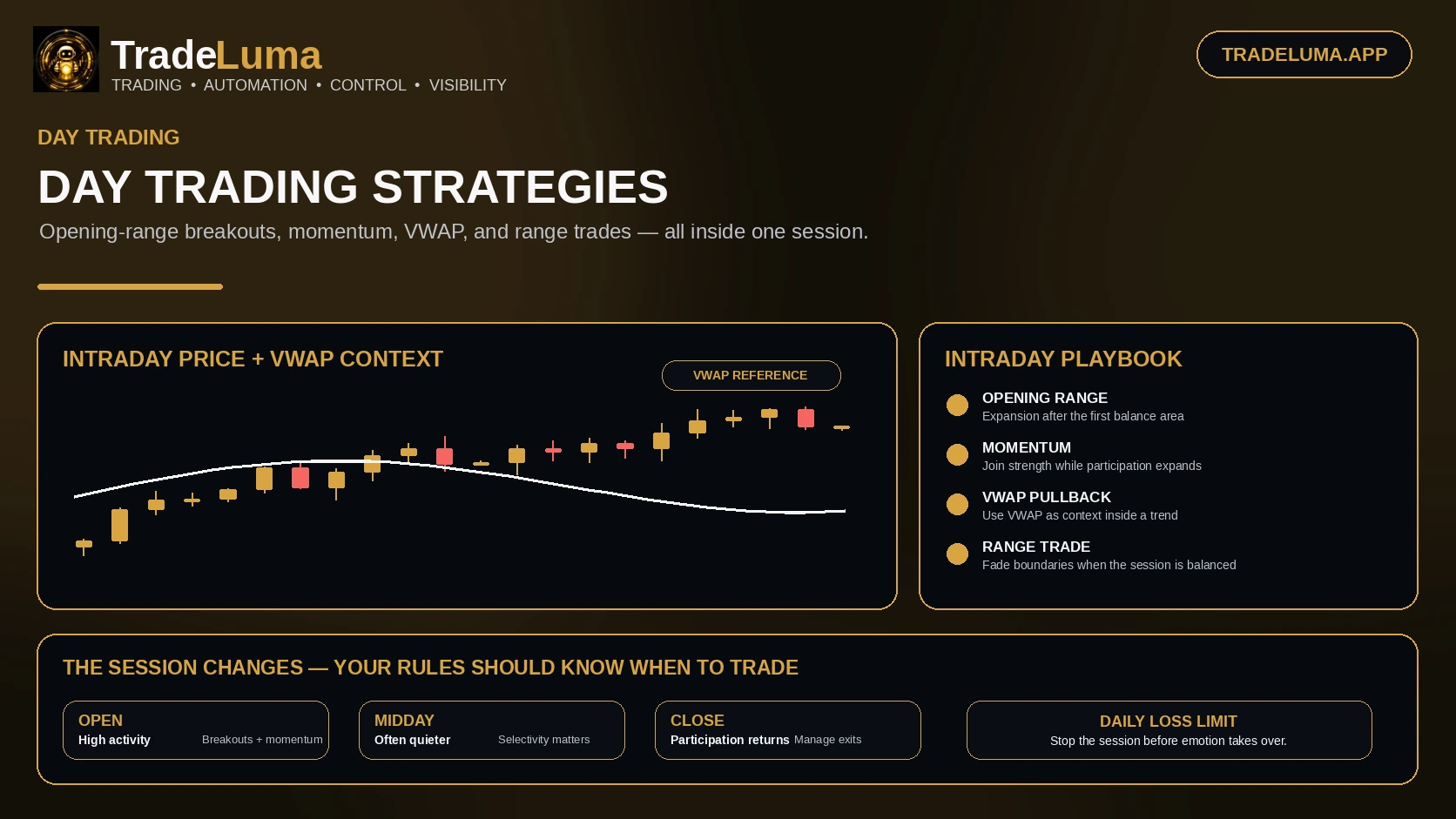
Day Trading Strategies: Breakouts, Momentum, VWAP and Range Trades
14 Aug 2026 · 13 min read
Build a controlled automation workflow with TradeLuma
Configure alerts, test in paper mode, apply execution controls, and follow broker outcomes from one workspace.