
Foundations
Manual trading vs automated trading: where each approach fits
Compare manual and automated trading workflows, including consistency, discretion, monitoring, execution speed, and operational risk.
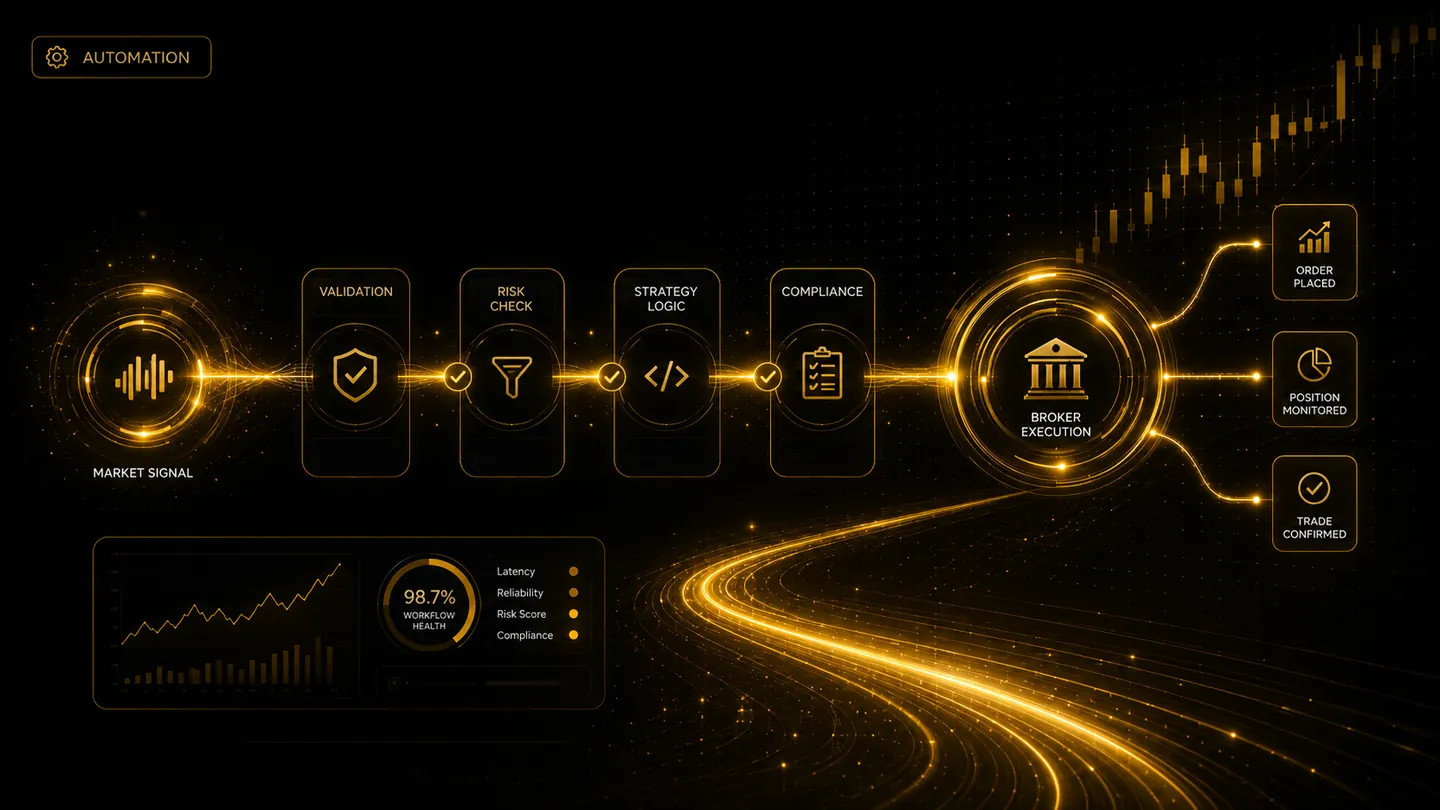
Manual and automated trading are not opposites that require an all-or-nothing choice. Many traders use a hybrid model: analysis remains discretionary while alerts, order entry, protective exits, or record keeping are automated. The right balance depends on how clearly the trading rules can be described and how much judgement is required at the moment of execution.
Where manual trading is strongest
Manual trading allows a person to interpret context that may be difficult to express as code, such as unusual news, changing liquidity, market structure, or a chart pattern that is not precisely defined. It also lets the trader pause when conditions feel abnormal.
The trade-off is inconsistency. A person may hesitate, chase price, change quantity, forget a stop, or miss a signal. Manual execution also becomes harder when several markets or timeframes need attention at once.
Where automation is strongest
Automation performs repeatable tasks consistently. It can receive alerts around the clock, enforce quantity rules, block duplicate instructions, and record events without relying on memory. For rules-based strategies, this consistency may reduce avoidable operational mistakes.
Automation introduces a different category of risk. Incorrect settings can repeat quickly, stale connections can create uncertainty, and a malformed alert can be interpreted incorrectly. Strong controls and clear visibility are therefore more important, not less.
A hybrid workflow is often practical
A trader might choose entries manually but automate protective exits, or use strategy alerts while requiring a manual approval step before live submission. Another trader may fully automate a small, well-tested strategy while keeping experimental ideas in paper mode.
The useful question is not whether automation is better. It is which tasks are sufficiently clear, repetitive, and testable to automate safely, and which decisions still benefit from human judgement.
Frequently asked questions
Does automated execution always act faster than a person?
Software can react quickly, but total execution time also depends on alert generation, internet delivery, platform checks, broker response, market conditions, and order type.
Can manual and automated positions share one account?
They can, but this creates reconciliation and ownership challenges. Traders need clear rules so an automated strategy does not mistakenly close or add to a manually managed position.
Continue learning
Related TradeLuma guides
Foundations
What is automated trading? A practical introduction for self-directed traders
14 July 2026 · 7 min read
Comparisons
Best autotrading apps: what to compare and why TradeLuma stands out
8 Aug 2026 · 12 min read
Risk Management
Stop Loss Strategy: Where to Place Stops and Manage Trading Risk
3 Sept 2026 · 12 min read
Build a controlled automation workflow with TradeLuma
Configure alerts, test in paper mode, apply execution controls, and follow broker outcomes from one workspace.