
Cybersecurity & Markets
JPMorgan, Visa & Mastercard Cyberattack 2026: What Data Was Exposed?
JPMorgan, Visa and Mastercard disclosed third-party cyber incidents in November 2026. What was exposed, what was not, and what JPM, V and MA investors should watch.
On this page+
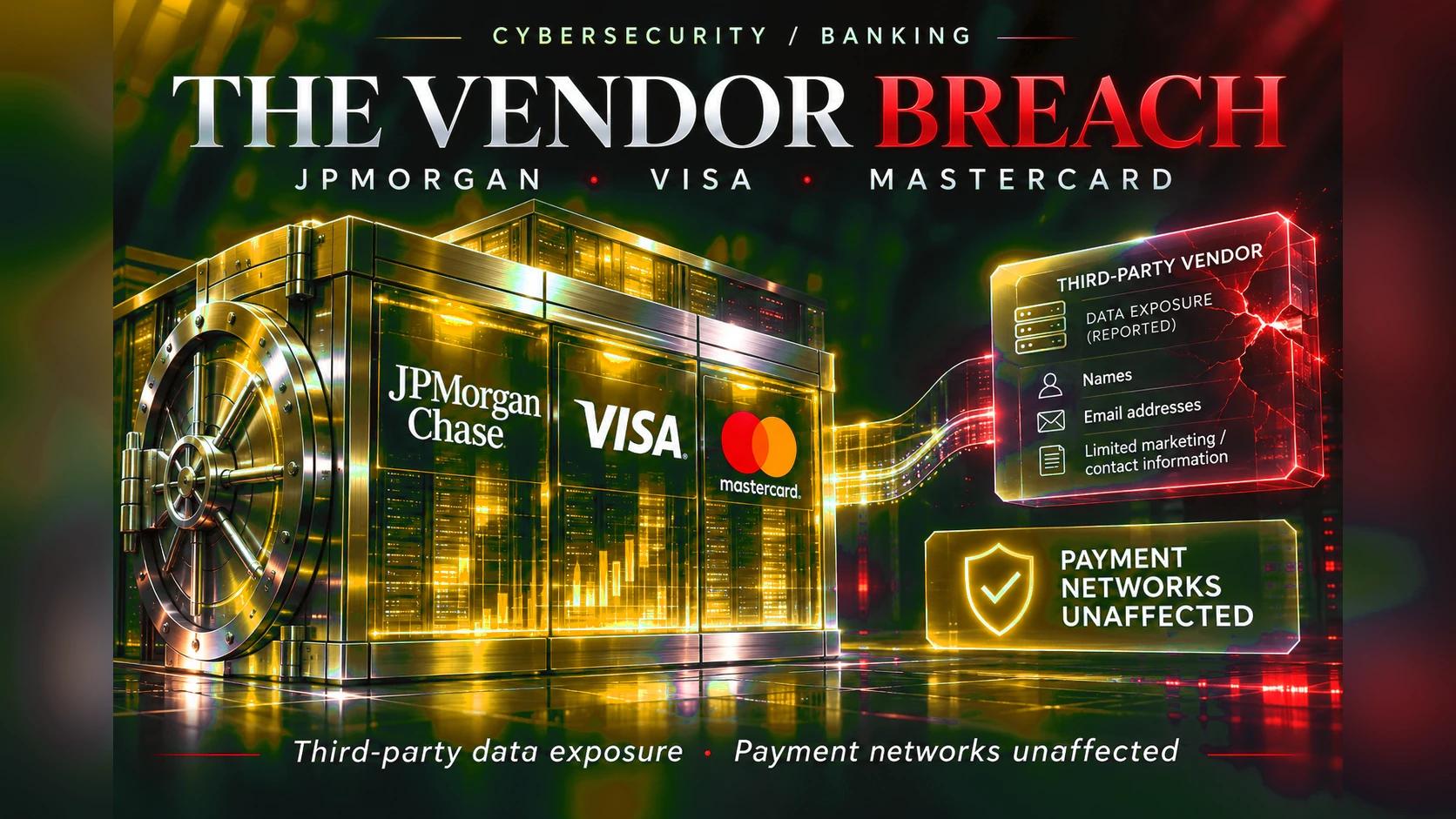
On 19 November 2026, JPMorgan Chase, Visa and Mastercard acknowledged cybersecurity incidents or claims involving outside service providers. The headline is alarming: three of the world's biggest financial brands appeared in the same breach story. But the available evidence describes exposure of some marketing, contact and benefit-program information held by third parties—not a confirmed intrusion into all three companies' core systems, and not a confirmed theft of card numbers. Reuters and the Associated Press reported the companies' responses on 19–20 November. This 23 November TradeLuma explainer separates confirmed statements from hacker allegations, explains why email data still matters, and examines what the news may mean for shares in JPM, V and MA without manufacturing a market reaction.
What happened on November 19, 2026?
JPMorgan Chase disclosed that organisations providing services to the bank had been targeted in a cyberattack. It believed some marketing information held by those outside businesses may have been accessed, including names and email addresses. The bank said it planned to contact affected customers directly. The disclosure followed threat-actor posts earlier in the week alleging that card-related engagement data had been stolen.
Visa and Mastercard separately acknowledged outside-provider incidents or associated claims. The strongest common thread was the dependency on external suppliers that manage marketing, rewards or customer-engagement workflows. Three names appearing together in one news cycle does not, by itself, establish that a single payment network was breached.
Reuters updated its account on November 20; the Associated Press also reported the statements. No evidence in those accounts demonstrated that card transactions had stopped working because of these incidents.
What information was reportedly exposed?
JPMorgan described certain vendor-held marketing records that may include customer names and email addresses. Reuters examined data presented by the alleged attackers and said it appeared to include more than 16,000 customer email addresses, some telephone numbers and postal codes, and 124 bank-employee email addresses. Crucially, Reuters did not independently verify that the dataset was authentic.
Mastercard said the exposure involved a limited quantity of email addresses—not payments information—from a small subset of cardholders in a specific benefit program. Visa described a third-party incident in Asia Pacific; Reuters said posted files appeared to contain contact and campaign records relating to several regional markets but also warned that the data's authenticity had not been established.
There is a practical difference between information a company confirms was accessed, information a journalist can inspect but not authenticate, and information an attacker merely alleges holding. This article does not combine those three categories into one definitive victim count.
Were credit-card numbers, CVVs or bank balances stolen?
The reporting available by November 23 did not establish that the core payment networks, card numbers, security codes or customer account balances had been compromised in these incidents. Visa explicitly said its systems were not involved or impacted and no payments data such as card numbers was affected. Mastercard said its network and card usability were not impacted, and described the exposed material as non-payments information.
That is reassuring but not equivalent to saying that every downstream risk is zero. Email addresses, names, phone numbers and knowledge of a financial relationship can help an attacker craft credible messages requesting passwords, authentication codes or fraudulent transfers.
There is no basis in the cited disclosure to tell all Visa, Mastercard or Chase customers to cancel their cards. A customer who sees suspicious account activity should follow their provider's normal fraud-reporting process rather than rely on generalised headlines.
Was this one attack on JPMorgan, Visa and Mastercard?
A cyber extortion actor calling itself n0n posted claims involving the three companies on November 16. A matching name in a leak-site post is not proof that every claim is accurate, that every stolen record is genuine or that the same vendor served all three businesses.
The companies described separate third-party relationships and impacts. The identity of any shared vendor was not confirmed in the reporting reviewed for this article. Investigators could eventually connect the cases, distinguish them or revise the scope. Until that happens, 'three companies affected by vendor-related incidents' is more defensible than 'one attacker hacked all three financial networks'.
This distinction matters for investors because a narrow supplier-data incident and a failure of an international payments network have radically different operating, regulatory and reputational implications.
Who is n0n, and how reliable are its claims?
Reuters reported that the extortion group n0n claimed to possess cardmember-engagement records, including large numbers of campaign interactions, and cited research platform eCrime.ch. The group also made claims involving Visa and Mastercard. Threat actors can publish real samples, recycled records, manipulated counts or mixtures of these.
Reuters said that its review of the purported leaked dataset could not independently establish authenticity. Even if some emails are real, a record count need not equal a unique affected customer count; marketing interactions may produce multiple entries for one person.
For a responsible market story, the correct framing is 'n0n claimed' or 'purported records' unless a named company or forensic investigator verifies the detail. Neither the alleged number of interactions nor the number of posted files should be translated into an invented number of compromised cards.
Why can a marketing-data leak still be serious?
A criminal does not always need a credit-card number to cause damage. A realistic payment reminder, membership-benefit notice or account-verification email can exploit a victim's trust in a brand. When marketing metadata suggests that someone has a particular card, reward or product relationship, a forged message can feel more persuasive.
The most plausible secondary risk is social engineering: phishing sites, impersonated call centres, malicious attachments and requests for one-time codes. Those outcomes are risks, not confirmed consequences of this specific incident. Businesses should assess the actual data fields accessed before estimating harm.
Security teams often separate confidentiality of customer records, integrity of payment authorisation and availability of the network. The November reporting chiefly raises confidentiality and supplier-governance issues; it did not document a simultaneous payments outage caused by the breach.
Why the earlier Chase outage is a separate story
JPMorgan experienced service disruption earlier in the week, when a software issue reportedly affected transaction processing. The bank said the later-reported third-party cyberattack was not connected to that disruption.
Merging unrelated incidents can create a false escalation narrative: a reader may think attackers disabled the bank and then stole card details, although the available statements support neither causal link. Timeline discipline is particularly important when events occur within days of one another.
For traders, operational availability and a vendor confidentiality incident have different potential cost structures. An outage may drive direct customer-service and remediation costs; a contact-data exposure can instead lead to notifications, vendor reviews, investigations or longer-tail reputational considerations.
What could the incidents mean for JPM, V and MA stock?
JPMorgan trades as JPM, Visa as V and Mastercard as MA. Their revenues, risk exposures and business models differ, so the same headline should not be converted into the same share-price forecast. A limited vendor-held contact dataset could generate a contained remediation expense, while broader forensic discoveries or repeated supplier failures could create greater operational and legal uncertainty.
There is no verified stock-price move attributed specifically to these disclosures in the reporting used here. It would be misleading to claim that JPM, V or MA 'crashed because of the hack' without dated market prices and a defensible causal explanation.
One scenario is limited effects if investigations confirm a small and contained exposure with functioning payment infrastructure. Another is increased costs if incident scope expands or authorities require remediation. A third is a sector-wide reassessment of vendor concentration, with investors differentiating companies according to disclosed controls. These are possibilities, not probabilities or recommendations.
Why third-party cybersecurity matters to financial investors
Banks and networks frequently outsource customer communications, loyalty programs, identity-related support and marketing infrastructure. This creates efficiency but also expands the map of entities that may hold personal information. A supplier can become a point of exposure even when a financial institution's primary systems remain uncompromised.
For investors, the questions are concrete: What data did the vendor need? Was it retained longer than necessary? Were access permissions limited? Can the institution track subcontractors and revoke access? How quickly can it notify customers? Do contractual and insurance arrangements cover investigation and notification costs?
The key concept is concentration risk. A supplier serving many firms may amplify one local breach across several brands. But without verified vendor identity, it is too early to assert this was a single shared-provider failure.
What should customers do now?
Monitor messages that claim to be from a bank or card network and encourage immediate login, code sharing or payment. Do not follow a link from a surprising text or email; instead open the official banking app or type the address manually. Never give a one-time authentication code to someone who contacted you unexpectedly.
Use multifactor authentication where available, unique passwords and transaction alerts. If a service provider informs you that your data was involved, follow the specific instructions in that notification. If your account shows unfamiliar activity, contact the issuer using the number on your card or its authenticated app.
Card replacement is generally a response to suspected card-credential compromise or unauthorised transactions, not simply to news of an email-address leak. The right action depends on the information actually exposed and any personalised notice.
What should traders watch after November 23?
First, look for updated issuer statements and any regulator or customer notifications clarifying affected fields, customer numbers, affected regions and root cause. Second, distinguish an official finding from a leak-site claim. Third, watch whether new evidence implicates a shared vendor rather than assuming one existed from the outset.
For the stocks, pair any new disclosure with the timestamped trading session, trading volume, sector benchmarks and broader market conditions. Isolating a single news effect from a volatile session is difficult. Financial implications need evidence of expense, disruption, litigation or guidance changes—not simply a sensational headline.
This article records what was publicly reported by November 23, 2026. It is educational market commentary and practical security context, not personalised investment or incident-response advice.
Frequently asked questions
Was JPMorgan Chase hacked in November 2026?+
JPMorgan said service providers working for the bank were targeted and some vendor-held marketing records may have been accessed. That is not the same as confirmation that attackers entered the bank's core transaction-processing systems.
Were Visa and Mastercard card numbers stolen?+
Visa said no payments data such as card numbers was affected; Mastercard described limited non-payments email exposure at a provider and said its payment network was unaffected.
What type of customer data was involved?+
Company statements focused on names, email addresses, marketing data and limited benefit-program information. Reuters also reviewed purported records containing some phone numbers and postal codes, but could not independently authenticate them.
How many Chase customers were affected?+
Reuters observed more than 16,000 apparent customer email addresses in purported data, but did not authenticate the dataset. That is not a verified final count of unique affected customers.
Did n0n hack all three financial companies?+
n0n claimed data linked to all three, but the available reporting does not prove that one operation compromised all three companies' own networks or that all the allegations were accurate.
Was the Chase outage caused by this cyberattack?+
No link was established. JPMorgan said its earlier service disruption stemmed from a separate software issue, not the vendor cyber incident.
Should customers cancel their cards?+
The reporting alone does not justify universal card cancellation. Monitor account activity, beware of phishing, and follow the issuer's instructions if suspicious transactions or a specific notification arise.
Were Australian customers affected?+
Reuters reported that purported Visa-related records included Asia-Pacific markets such as Australia, but said it had not verified the data's authenticity. There was no confirmed comprehensive Australian customer count in the cited reporting.
What does the breach mean for JPM, V and MA shares?+
Possible implications include remediation expense, supplier-review costs and reputation risk. The sourced reports do not establish a specific breach-driven share-price decline or a quantified earnings impact.
What is a third-party vendor breach?+
It is an incident affecting a service provider that holds or processes data on another company's behalf. The provider's systems and the financial company's core payment networks are not automatically the same thing.
Put it into practice
Use the risk maths next to the guide.
Open TradeLuma's free position-size, risk/reward, expectancy, and drawdown tools to test the numbers behind a risk-management decision.
Open free trading calculators →Continue learning
Related guides.
The Fed’s AI Bubble Warning: Wall Street Faces a Double Shock from Rate Hikes and Risky AI Debt
November 18 Fed minutes warned of opaque AI-related debt as officials considered further rate hikes. Learn the risks for Nasdaq stocks, bonds, Bitcoin and gold.

FAA Nationwide Ground Stop: Why US Flights Were Halted and What Airline Investors Should Watch
FAA grounded US departures on November 13, 2026 after air traffic communications failed. Explore flight cancellations, airline stocks, causes and recovery.

Anthropic's $69.3 Billion IPO Proposal Was Withdrawn: What Changed?
Updated 11 Nov: Anthropic retracted the $69.3B draft and filed a new $70–$78 IPO range, up to $64.35B. Historical Nov 10 analysis of AI compute economics.