
Stocks & Markets
Berkshire Hathaway’s $9.6 Billion Buyback: Why Buffett’s Successor Is Spending as AI Stocks Crash
Berkshire Hathaway Q3 2026 earnings: $9.6B in buybacks, $12.7B operating profit and Greg Abel's strategy. What BRK.B investors should watch after the AI sell-off.
On this page+
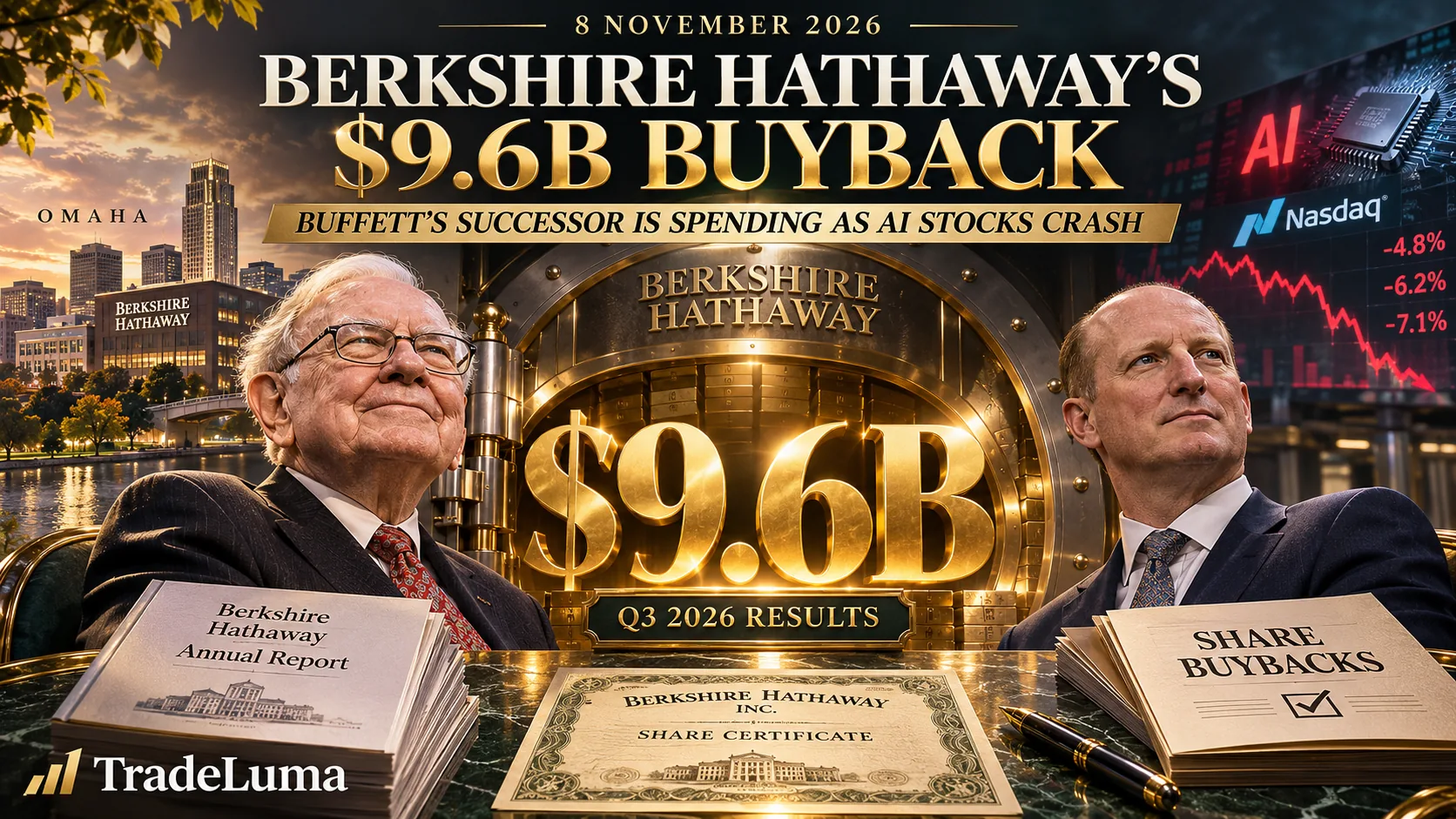
On Saturday, November 7, 2026, Berkshire Hathaway disclosed $9.6 billion of share repurchases in the July–September quarter, even as operating earnings fell nearly 6% to $12.7 billion. The timing makes for an irresistible market headline: Buffett’s successor Greg Abel is putting billions to work while investors question lofty AI valuations after a bruising early-November Nasdaq sell-off. There is an essential distinction, however. Berkshire’s third-quarter repurchases happened before November’s market drop; the earnings announcement is new, but the transactions are not a reaction to that sell-off. Here is what the numbers actually show, why Berkshire still holds an extraordinary pool of liquidity, how Geico and its other businesses performed, and what investors should watch when BRK.B next trades.
Berkshire Hathaway Q3 2026: the numbers in one minute
Berkshire released its third-quarter results on November 7, 2026, covering July 1 through September 30. It reported $12.705 billion of after-tax operating earnings, versus $13.485 billion a year earlier, and $22.112 billion of net earnings attributable to shareholders, versus $30.796 billion in Q3 2025. The first figure is useful for assessing the conglomerate's operating businesses; the second also includes movements in its large investment portfolio.
The standout capital-allocation number was about $9.6 billion spent repurchasing Berkshire shares in the quarter. This is different from Berkshire buying shares of another listed company. It means Berkshire reduced the amount of its own equity outstanding, which can increase each remaining share's proportionate claim on future earnings—if the repurchases are made at sensible prices.
Why a $9.6 billion Berkshire buyback is attracting so much attention
For years, investors closely watched Warren Buffett's reluctance to pursue giant acquisitions at prices he considered unattractive. Greg Abel, who took over as chief executive at the start of 2026, has now overseen a faster pace of repurchases. Berkshire bought approximately $4.8 billion of shares in the first half of 2026 and $9.6 billion in the third quarter, for about $14.4 billion through September.
Contemporary reporting also described roughly $2 billion of further repurchases during the first four weeks of October. That October figure is subsequent activity, not part of Q3 or the $14.4 billion nine-month total. The news invites an important question: does Abel believe Berkshire's own shares offer a better return than acquisitions, additional quoted stocks or simply holding Treasury bills? A repurchase signals management's judgment, not guaranteed undervaluation.
The date trap: Berkshire did not spend Q3 buyback money because of November's AI crash
The Nasdaq's sharp early-November 2026 decline came after Berkshire's September 30 quarter-end. Investors should not combine the two dates to claim Abel began buying Berkshire stock in response to the November 5 technology sell-off. The market turbulence and the company's earnings announcement happened close together, but the announced quarterly repurchases were completed beforehand.
That distinction matters for readers assessing whether management timed the market. Repurchases in October were also reported before most of the November technology correction. The real story is a contrast in capital-allocation styles: Berkshire has been selectively shrinking its own share count while many technology investors debate the costs, financing and eventual returns of the AI infrastructure boom.
Berkshire operating earnings fell 6%: what actually weakened?
Operating earnings decreased by approximately $780 million year over year, from $13.485 billion to $12.705 billion. Berkshire defines this measure to exclude investment gains and losses that can swing with stock-market prices. It is a non-GAAP figure, but Berkshire provides a reconciliation to reported results. Investors should look at both measures, not treat operating earnings as a replacement for GAAP accounts.
The decline did not reflect universal weakness across Berkshire's subsidiaries. Insurance underwriting earnings were substantially lower, and insurance investment income declined. In contrast, railroad, energy and the manufacturing/service/retail group posted stronger results. Consolidated earnings therefore tell only part of the story: the direction of the individual operating segments is key.
Geico and insurance underwriting: the clearest earnings warning
Berkshire's after-tax insurance underwriting profit fell to $1.352 billion from $2.369 billion in Q3 2025, a decline of roughly 43%. Press reports highlighted significantly weaker Geico underwriting profitability. Competition for policyholders, pricing adjustments, advertising investment and claims costs can all affect the margin that insurers earn from premiums after paying losses and expenses.
A lower underwriting margin is not automatically evidence that the insurer's long-term economics have deteriorated permanently. Aggressive pricing and marketing may strengthen future customer growth, but that outcome must be demonstrated in renewal rates, underwriting performance and expense ratios. Investors should monitor whether Geico can recover volume without sacrificing pricing discipline.
BNSF, Berkshire Hathaway Energy and industrial businesses provided an offset
BNSF railroad generated approximately $1.729 billion in after-tax operating earnings, up from $1.449 billion a year earlier. Berkshire Hathaway Energy produced about $1.612 billion versus $1.489 billion. Manufacturing, service and retail operations earned approximately $4.042 billion, up from $3.616 billion. These categories show that several large parts of Berkshire remained profitable and improved despite weakness in insurance.
The railroad is sensitive to freight volumes, operating efficiency and industrial activity; energy businesses face capital spending, regulation and financing costs; manufacturers respond to customer orders, tariffs and input prices. The diversification helps reduce dependence on one product or industry, but it does not eliminate economic risk. A broad downturn can still affect multiple Berkshire subsidiaries at once.
Did Berkshire's cash pile rise or fall? Why $377.4 billion and $356.9 billion both appear
Two popular headlines use different definitions. On September 30 Berkshire's consolidated balance sheet showed about $40.7 billion of cash and cash equivalents, including railroad, utilities and energy, plus roughly $336.7 billion of short-term U.S. Treasury bills in its insurance-and-other businesses. Adding those reported asset lines produces approximately $377.4 billion before adjustments.
However, the Treasury-bill line included about $20.5 billion of purchases that had not yet settled. Berkshire recorded an offsetting payable, which was paid shortly after quarter-end. Deducting that payable gives approximately $356.9 billion of consolidated cash and Treasury bills on a net basis. Another commonly used measure—insurance-and-other operations only, net of that payable—is approximately $352.3 billion. The figures are not necessarily contradictory; always check which businesses and settlement adjustments are included.
What Berkshire's huge liquidity reserve really means
Cash and short-dated Treasury securities provide Berkshire flexibility for insurance claims, acquisitions, subsidiary investment and stock repurchases. Holding substantial liquidity can protect decision-making when credit markets seize up or asset valuations fall. But there is an opportunity cost: unusually large cash positions may underperform equities during prolonged bull markets.
The reserve is also not a promise that management will spend a specific amount on the next market decline. A meaningful acquisition must pass Berkshire's tests for value, cash-generation potential, strategic fit and risk. The company's insurance float—the net liabilities assumed under insurance contracts—stood around $178.5 billion at September 30. Float supports the investment model but is accompanied by claims obligations; it should not be confused with unrestricted owner cash.
Greg Abel versus Warren Buffett: what has changed in 2026?
Greg Abel became Berkshire's chief executive in January 2026. Warren Buffett remains chairman emeritus, and Howard Buffett became chairman in September. The leadership transition changes who formally makes capital-allocation and operating decisions, while Berkshire's long-term culture of financial strength and decentralised businesses remains an important backdrop.
Abel's accelerated repurchases are a concrete change in pace, but it is too early to claim Berkshire has abandoned Buffett's valuation discipline. Buffett himself used repurchases when prices met his criteria. Analysts will watch whether Abel combines selective buybacks with acquisitions and investment in controlled companies while keeping sufficient liquidity for insurance and unexpected opportunities.
Berkshire Hathaway versus the Nasdaq: defensive stock or different risks?
The early-November technology sell-off focused attention on AI spending, data-centre financing and high-growth valuation assumptions. Berkshire owns a collection of established operating businesses and significant financial investments, so its earnings mix is different from that of the Nasdaq's largest growth companies. That can make Berkshire an interesting comparison in a risk-off market.
Different is not the same as risk-free. Insurance losses, industrial weakness, costly acquisitions, the valuations of Berkshire's public-stock holdings and changes in interest rates can all affect BRK.A and BRK.B. Berkshire may outperform a falling growth index in one episode and lag in another. Historical patterns are not a reliable way to forecast the next week.
Could BRK.B rise after the November 7 earnings release?
The report arrived on Saturday, after the U.S. stock market had closed on Friday, November 6. Investors therefore had not yet traded a full regular session following the announcement. A large buyback and resilient non-insurance earnings could support sentiment; weaker insurance underwriting and lower operating profit could limit enthusiasm. The headline alone does not establish a likely opening price.
Because Berkshire's shares had already rallied before the release, market positioning and expectations matter. Traders should compare Monday's price response with the pre-release closing level, watch relative performance versus the S&P 500 and insurers, and avoid assuming that an opening gap will predict the close. Earnings-related moves can reverse as investors read the 10-Q in more detail.
What to watch in Berkshire's next reports and disclosures
Watch insurance underwriting margins, Geico policy growth and pricing, BNSF freight activity, Berkshire Hathaway Energy's capital requirements, operating cash generation, interest income from Treasury holdings and the pace of additional buybacks. Distinguish completed repurchases from management authorisation to repurchase more; a programme does not obligate Berkshire to spend a fixed amount.
Quarterly portfolio disclosures may also provide context about listed equity holdings, but they should be evaluated together with the full 10-Q, which includes operating segment discussion and the cash-flow statement. For active traders, BRK.B volume and price reaction after November 7 earnings are observations—not a substitute for business analysis.
The bottom line: Abel is deploying cash, not chasing November's headlines
The $9.6 billion third-quarter buyback is a major capital-allocation decision and a meaningful signal of management's approach under Greg Abel. But Berkshire remains a complex business: operating profit fell, insurance was under pressure and substantial liquidity remains available. That combination is more informative than any single headline about a cash hoard or a buyback record.
Most importantly, Berkshire's July–September repurchases should not be portrayed as buying shares during the November AI rout. The two stories intersect in how investors think about valuation and risk, not in the transaction dates. For BRK.B, the questions are whether the company can sustain earnings, repurchase at attractive prices and deploy its capital prudently over time.
Frequently asked questions
How much Berkshire Hathaway stock did Greg Abel buy back in Q3 2026?+
Berkshire disclosed about $9.6 billion in repurchases of its own shares during the third quarter of 2026, bringing the total for the first nine months to about $14.4 billion.
When did Berkshire Hathaway report its third-quarter 2026 earnings?+
Berkshire published its third-quarter earnings release on Saturday, November 7, 2026. The underlying reporting period ended September 30.
Did Berkshire buy shares because of the November 2026 AI stock crash?+
The $9.6 billion quarterly repurchases occurred during July–September, before the early-November AI-led sell-off. The earnings announcement and the sell-off were close in calendar time, but they were not the same transactions.
Why did Berkshire Hathaway operating earnings fall?+
Operating earnings declined about 5.8% to $12.705 billion, largely reflecting lower insurance underwriting and investment income, partly offset by improvements in railroad, energy, and manufacturing/service/retail businesses.
Why do reports show both $377 billion and $357 billion of Berkshire cash?+
The roughly $377.4 billion gross total includes cash and Treasury bills before subtracting about $20.5 billion owed for unsettled Treasury purchases. After this adjustment, the consolidated net amount is around $356.9 billion.
Who is Berkshire Hathaway's CEO in November 2026?+
Greg Abel became CEO in January 2026. Warren Buffett is chairman emeritus, and Howard Buffett became chairman in September 2026.
Does a Berkshire Hathaway share buyback mean BRK.B is undervalued?+
Management's repurchase policy reflects its assessment of conservative intrinsic value, but that judgment can be wrong. Buybacks do not guarantee rising share prices or positive future returns.
What is the difference between BRK.A and BRK.B?+
Both represent ownership in Berkshire Hathaway. Class B shares represent a smaller economic interest per share than Class A shares, making their quoted price far more accessible; voting rights and conversion features also differ.
Will Berkshire Hathaway stock rise after Q3 2026 earnings?+
It is uncertain. The market could respond positively to buybacks and business diversification or negatively to weaker insurance performance and valuation concerns. The first regular trading session after the Saturday report provides a fresh price signal.
Keep learning
Continue through the TradeLuma research library.
Browse practical guides across trading, automation, execution, futures, technical analysis, and risk management.
Browse all guides →Continue learning
Related guides.

Nvidia's $330 Billion Intraday Meltdown: Jensen Huang Board Probe Shakes the AI Trade
Nvidia's Nov. 9, 2026 sell-off, Jensen Huang board investigation, $330B intraday swing, China AI-chip risks and the November 17 earnings catalyst explained.

GTA 6's $8.2 Billion Gamble: Record Preorders, an Earnings Miss and the TTWO Stock Countdown
GTA 6 preorders near 7.71M in third-party estimates as Take-Two reports a Q2 bookings miss. Explore TTWO stock, $8.2B FY27 guidance and Nov 19 launch.

Anthropic's $69.3 Billion IPO Gamble: Is the AI Bubble Facing Its Biggest Test?
Anthropic's reported $69.3B IPO ambition meets $895.4B in compute commitments. Explore Claude growth, IPO risks, valuation and the AI trade.