
Execution
Automated trading execution: signal to broker fill
Follow the automated trading execution lifecycle from alert validation and duplicate control to broker submission, fills, reconciliation, and monitoring.
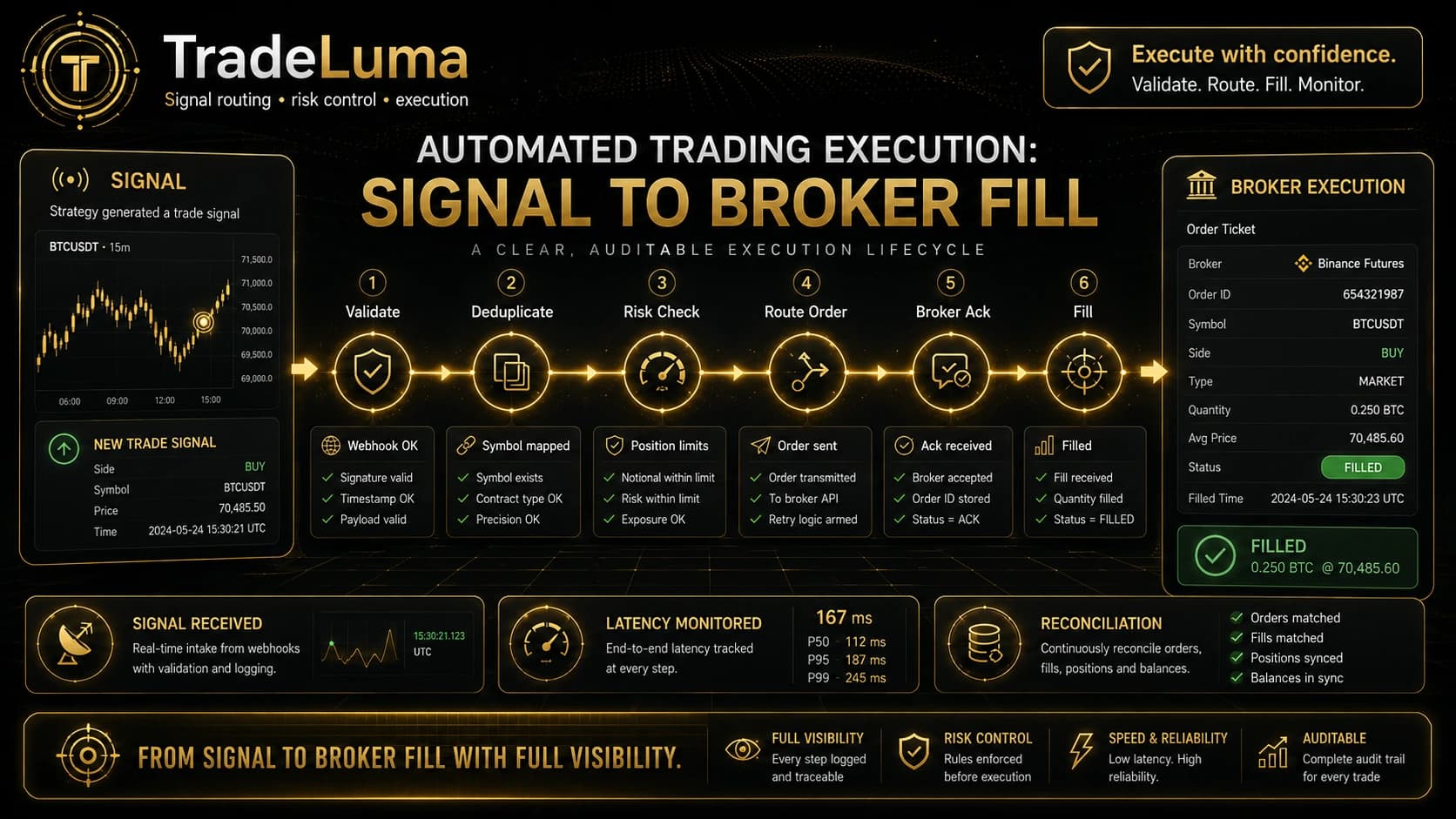
An automated strategy does not jump directly from a chart signal to a completed trade. Between those points is an execution lifecycle made of identity, validation, state, broker communication, and evidence. Understanding that lifecycle helps traders diagnose slippage, prevent duplicate risk, and distinguish a strategy problem from an operational problem.
A signal is an intention, not a fill
A strategy may decide to buy, sell, close, or adjust a position using chart data. That decision says nothing about whether the account is permitted to trade, whether the instrument is available, whether the market is open, or what price can be achieved. Treating a signal as a completed trade creates false positions and misleading performance records.
Execution begins by preserving the original intent exactly: who sent it, which strategy produced it, when it was created, when it arrived, and what action it requested. The system can then evaluate the request without rewriting history if later stages fail.
Ingestion establishes identity and timing
The intake layer authenticates the source, validates the message shape, applies size limits, and records an immutable arrival event. It should use a correlation identifier that follows the instruction through every service and broker event. This identifier becomes the spine of the execution timeline.
Timing should be split into meaningful intervals: signal-to-intake, intake-to-validation, queue wait, broker-submission time, acknowledgement time, and fill time. A single latency number hides where the delay occurred and can lead to the wrong optimisation.
Normalisation turns intent into a consistent command
Different alert sources may call the same action buy, long, entry, or open. Normalisation converts supported variations into one internal command while rejecting ambiguous combinations. It also resolves quantity units, account mode, time-in-force, bracket settings, and the destination symbol mapping.
The normalised command should remain separate from the broker order object. This makes it possible to explain how a user-facing strategy request became the exact contract, side, quantity, and order type sent to the broker.
Idempotency prevents one event becoming many orders
Networks retry and workers restart. Idempotency gives the event a stable key so processing it again returns the existing execution rather than creating new risk. The key should include enough context to distinguish genuinely separate signals while recognising a replay of the same event.
Duplicate control must cover the complete path, not only the public webhook endpoint. A retry can occur after the order is created but before the response reaches the caller. The execution record and broker client-order identifier should make that uncertain interval recoverable.
Pre-trade gates decide whether the order is allowed
Before submission, the platform can check the user's access, strategy status, paper or live permission, broker connection, symbol mapping, trading session, position capacity, maximum quantity, exposure, conflicting working orders, and account-level locks. A rejected instruction should name the gate that made the decision.
Checks must use sufficiently fresh information. Some values can come from a short-lived cache, while position-sensitive close logic may need broker or reconciled state. The design challenge is to protect the account without adding unnecessary delay to every order.
Broker submission begins a new source of truth
Once the broker accepts the request, its order identifier and state become essential. Local status such as submitted should mean that a submission attempt occurred, not that the broker guaranteed a fill. The platform should preserve acknowledgements, warning codes, exchange messages, and order modifications.
Order type shapes the outcome. Market orders prioritise execution but not price; limit orders constrain price but may remain unfilled; stop orders activate only after their trigger condition; and bracket children may depend on the parent fill. The execution engine must reflect the destination broker's actual behaviour rather than an idealised model.
Partial fills, rejections, and timeouts need first-class states
A partially filled order changes account exposure even though the original quantity remains incomplete. The system should accumulate broker executions, update the filled and remaining quantities, and avoid treating the position as all-or-nothing. Protective orders may also need to follow the actual filled amount.
A rejection should retain the broker's reason and identify whether retrying is safe. A timeout is more uncertain: the order may have reached the broker even though the local service did not receive confirmation. Recovery should search by stable identifiers before attempting another submission.
Reconciliation closes the loop
Automated trading must coexist with manual broker actions, disconnects, late events, and software restarts. Reconciliation compares local orders and positions with broker-reported open orders, executions, and holdings. Differences are classified, surfaced, and repaired according to controlled rules rather than silently overwritten.
The broker is the final operational authority for what is actually working or held. The local platform remains the authority for why the action was requested, which controls approved it, and how the workflow responded. A trustworthy journal preserves both views.
Use a flight recorder, not a single success badge
A useful execution record shows the original alert, normalised command, validation decisions, queue events, broker request, acknowledgements, fills, fees, cancellations, rejections, reconciliation changes, and notifications. This makes post-trade review possible without reconstructing events from several disconnected screens.
Measure reliability as well as speed: duplicate events prevented, unresolved orders, rejection categories, reconciliation differences, stale mappings, time spent in each stage, and the percentage of executions with complete terminal state. Faster execution is valuable only when state accuracy and safety remain intact.
Frequently asked questions
What is automated trading execution?
It is the controlled process that turns a strategy instruction into a broker order and then tracks acknowledgement, fills, cancellations, rejections, and resulting positions.
Why does an order remain submitted without filling?
The order may be working at the broker, waiting for its price or trigger, outside the active market, partially filled, delayed in status reporting, or unresolved after a connectivity issue. Broker state and order type must be checked.
Does faster execution always improve results?
No. Lower delay can reduce some price movement, but order type, spread, liquidity, market impact, mapping accuracy, and strategy design may matter more. Speed should not bypass essential controls.
What is the difference between monitoring and reconciliation?
Monitoring follows events as they happen. Reconciliation periodically compares the platform's records with broker-reported orders and positions to detect missing, late, manual, or inconsistent state.
Continue learning
Related TradeLuma guides
Execution
Slippage, spread, and latency: the hidden mechanics behind automated fills
20 July 2026 · 8 min read
Comparisons
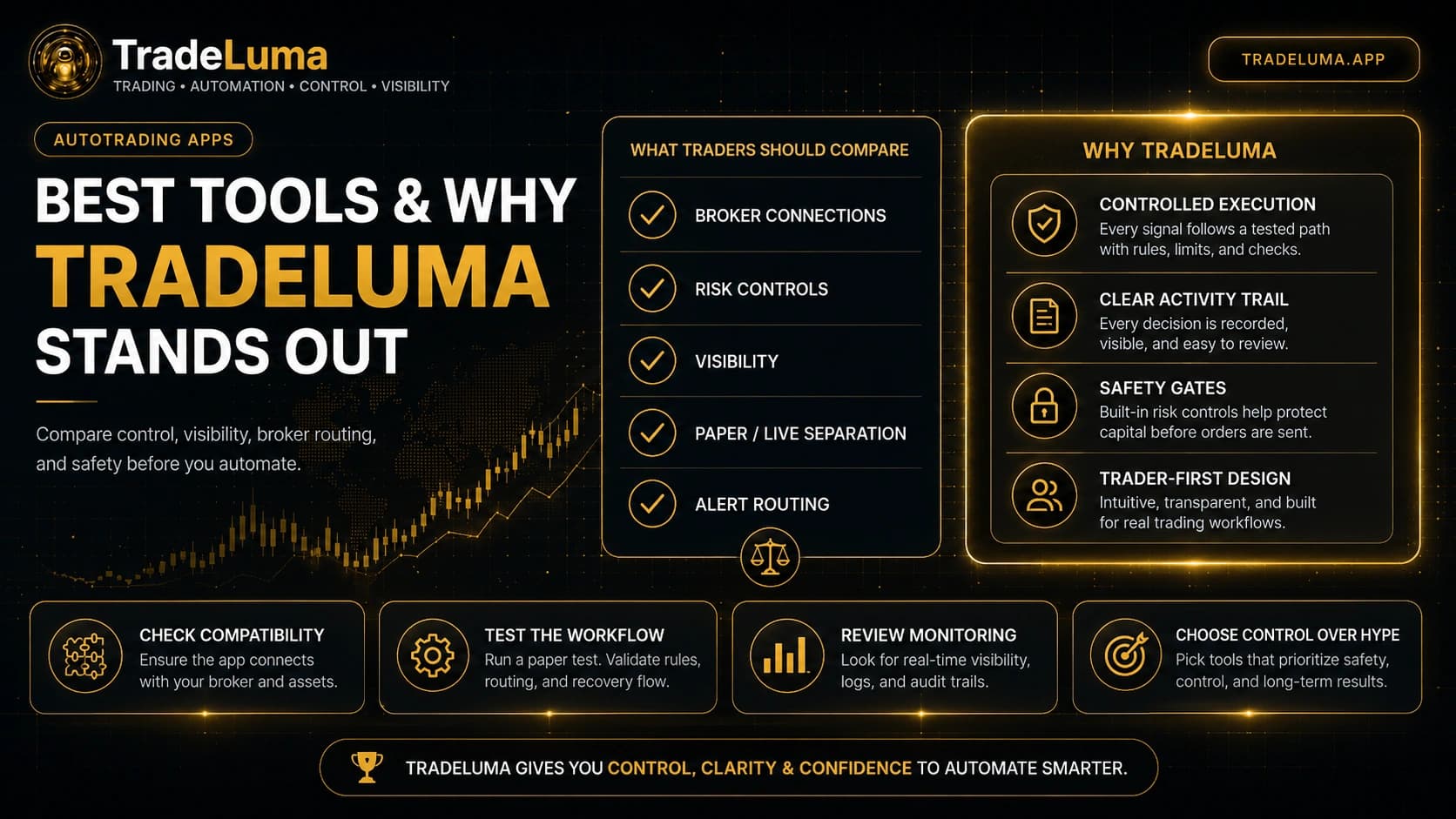
Best autotrading apps: what to compare and why TradeLuma stands out
8 Aug 2026 · 12 min read
Automation
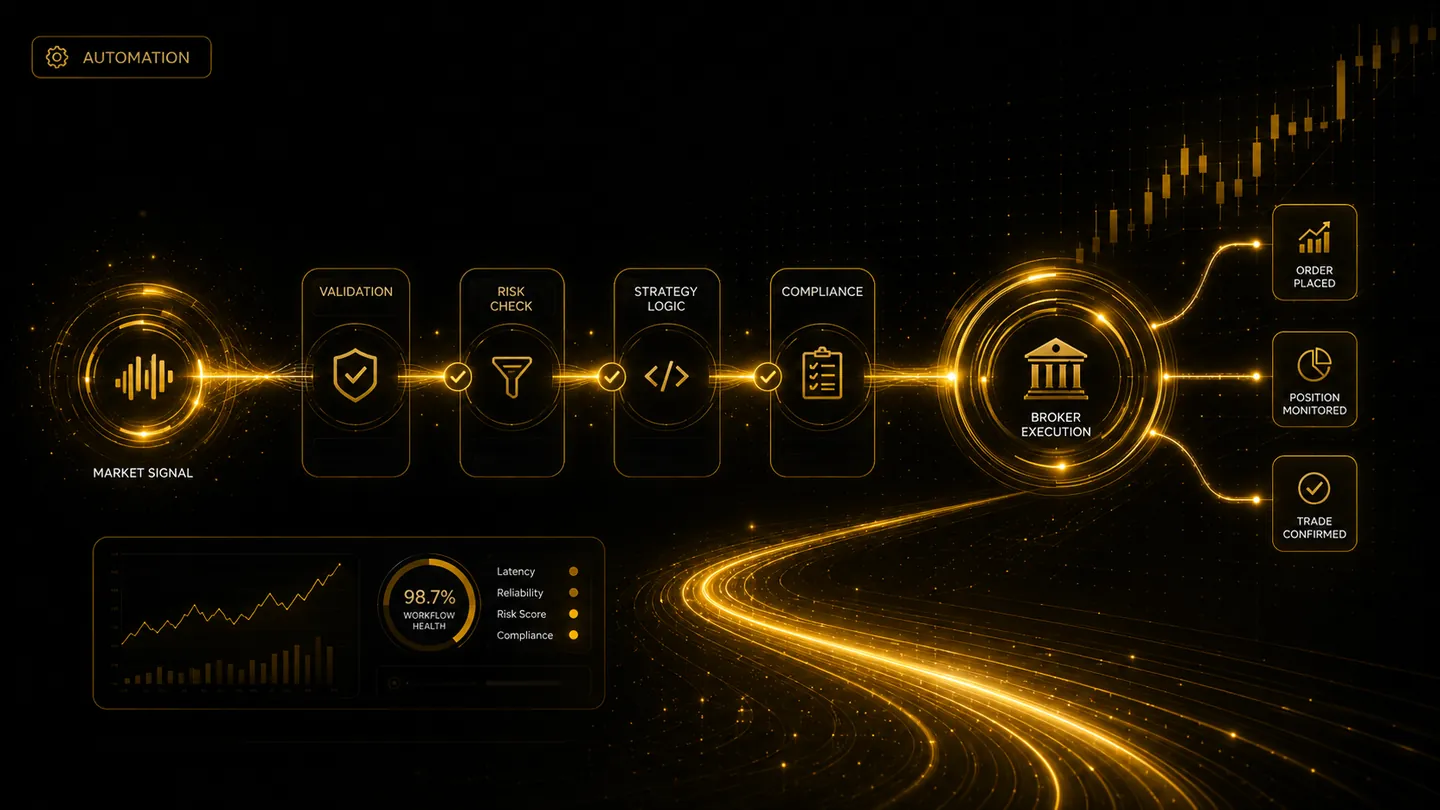
How to build a responsible autotrading workflow from signal to broker
2 Aug 2026 · 11 min read
Build a controlled automation workflow with TradeLuma
Configure alerts, test in paper mode, apply execution controls, and follow broker outcomes from one workspace.