
Trading Foundations
Liquidity in Trading Explained: Why It Matters for Entries and Exits
Learn what market liquidity means, how spread and order-book depth affect execution, and why thin markets can increase slippage and trading risk.
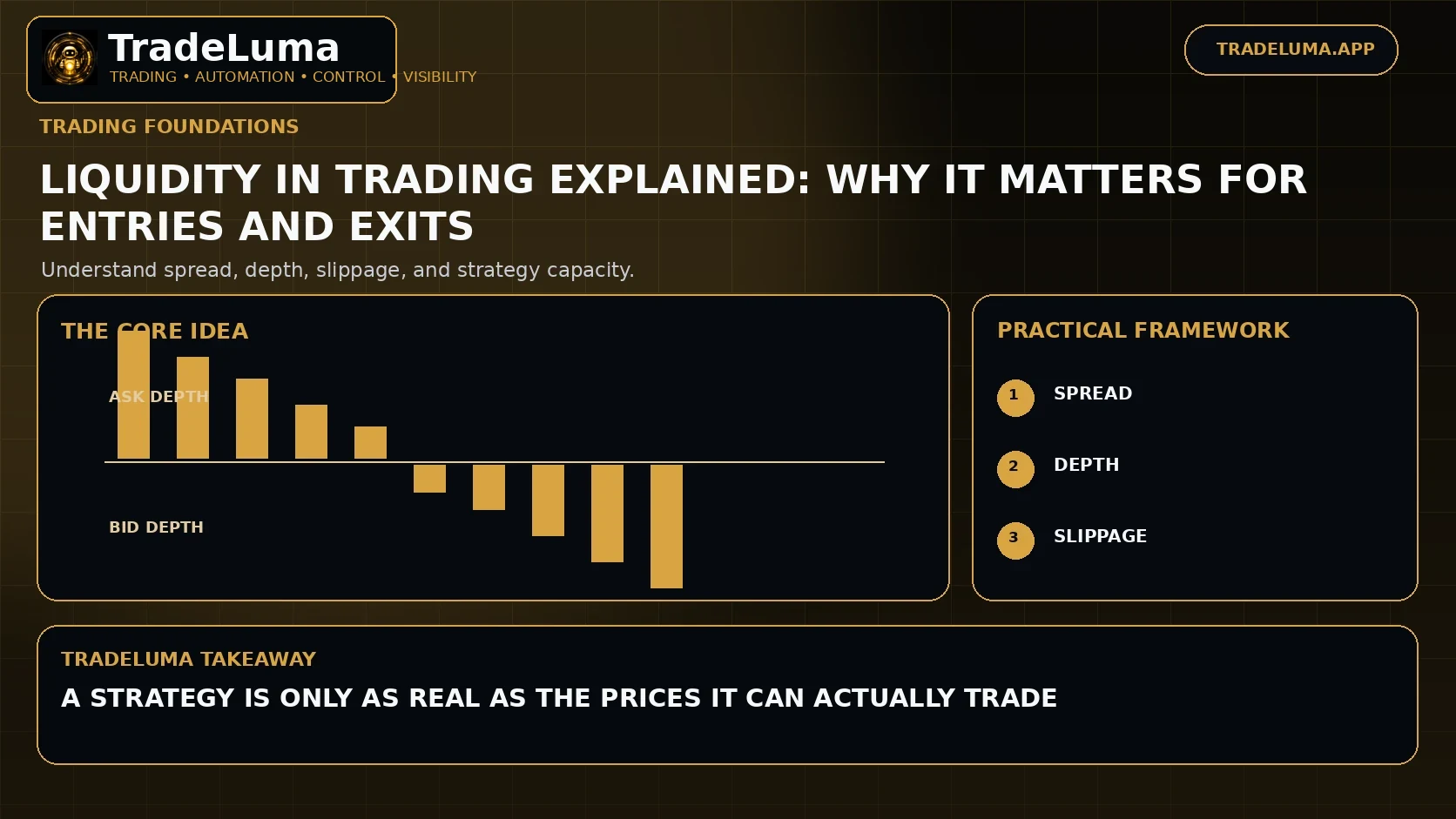
Liquidity describes how easily an asset can be bought or sold without causing a large price change. It is not just a measure of volume. A liquid market usually combines active participation, competitive bid-ask spreads, and enough resting or replenishing orders to absorb normal trade size. Liquidity directly affects fills, slippage, stop execution, and whether a backtested edge survives live trading.
What market liquidity means
A liquid market allows participants to trade a reasonable quantity quickly with limited price impact. Highly liquid instruments often have many buyers and sellers close to the current market price.
Illiquid markets may have wide gaps between available orders, so even a modest market order can move through several price levels.
Bid-ask spread
The bid is the highest visible price buyers are willing to pay and the ask is the lowest visible price sellers are offering. The difference is the spread, which is an immediate cost to traders who cross the market.
Tight spreads often indicate stronger competition and liquidity, while wide spreads can signal lower participation, greater uncertainty, or both.
Order-book depth
Depth describes how much quantity is available at different price levels. A market can show a tight top-of-book spread but still have limited depth just beyond the best bid and ask.
Larger orders may therefore experience slippage even when the displayed spread looks small. Depth also changes rapidly as orders are added, cancelled, or filled.
Volume versus liquidity
Volume measures how much traded during a period, while liquidity describes how easily the next trade can be executed. High volume often accompanies good liquidity, but a volatile event can generate huge volume while spreads widen and price impact increases.
For execution-sensitive strategies, spread and fill quality can be more informative than volume alone.
Why liquidity changes through the day
Many markets have predictable liquidity cycles. Participation can be strongest around major session opens and overlaps, weaker during quieter hours, and unstable near closes or scheduled announcements.
A strategy that performs well during a liquid window may deteriorate if run continuously through periods where spreads and slippage are materially worse.
Liquidity and order types
Market orders prioritise execution but consume available liquidity and can slip. Limit orders control the worst acceptable price but may not fill. Stop orders can become marketable precisely when liquidity is under stress.
Order choice should reflect the strategy's urgency, expected edge, and tolerance for missed fills versus price uncertainty.
Liquidity around news and stress
Before major releases, market makers and participants may reduce displayed size because the fair price is uncertain. Immediately after the release, price can jump across levels faster than orders can be replenished.
Backtests that assume smooth fills during these periods can materially understate live execution risk.
Strategy capacity
A strategy can be profitable at small size and degrade as order quantity grows. Larger orders may need multiple price levels, take longer to fill, or reveal enough demand to affect the market.
Capacity testing compares trade size with typical volume, depth, and realised slippage so the strategy does not assume unlimited scalability.
How to include liquidity in testing
Track spread, slippage, fill rate, partial fills, and time of day alongside P&L. Stress the strategy with worse execution assumptions and compare results across liquid and illiquid periods.
If a small increase in slippage removes the edge, execution quality is a core part of the strategy rather than a minor implementation detail.
Frequently asked questions
What is liquidity in trading?
Liquidity is the ability to buy or sell an asset quickly and in reasonable size without causing a large change in price.
Is high volume the same as high liquidity?
No. High volume often helps, but a market can trade heavy volume while spreads are wide and price impact is high, especially during volatile events.
Why does low liquidity increase slippage?
With fewer orders available near the current price, an executable order may need to trade through multiple price levels to complete.
When is liquidity usually worst?
It varies by market, but thin off-hours, session transitions, major news releases, and stressed conditions can all reduce available liquidity.
Continue learning
Related TradeLuma guides
Trading Foundations
Volatility in Trading Explained: How to Adapt When Markets Speed Up
8 Sept 2026 · 11 min read
Trading Foundations
Price Action Trading Guide: Market Structure, Momentum and Context
26 Aug 2026 · 12 min read
Trading Foundations
Multiple Timeframe Analysis: How to Align Trend, Setup and Entry
13 Sept 2026 · 11 min read
Build a controlled automation workflow with TradeLuma
Configure alerts, test in paper mode, apply execution controls, and follow broker outcomes from one workspace.