
Broker Connections
Automated trading bridge health: heartbeats, reconnects, and recovery
Learn how an automated trading bridge stays observable through heartbeats, broker-session checks, controlled reconnects, reconciliation, and safe recovery.
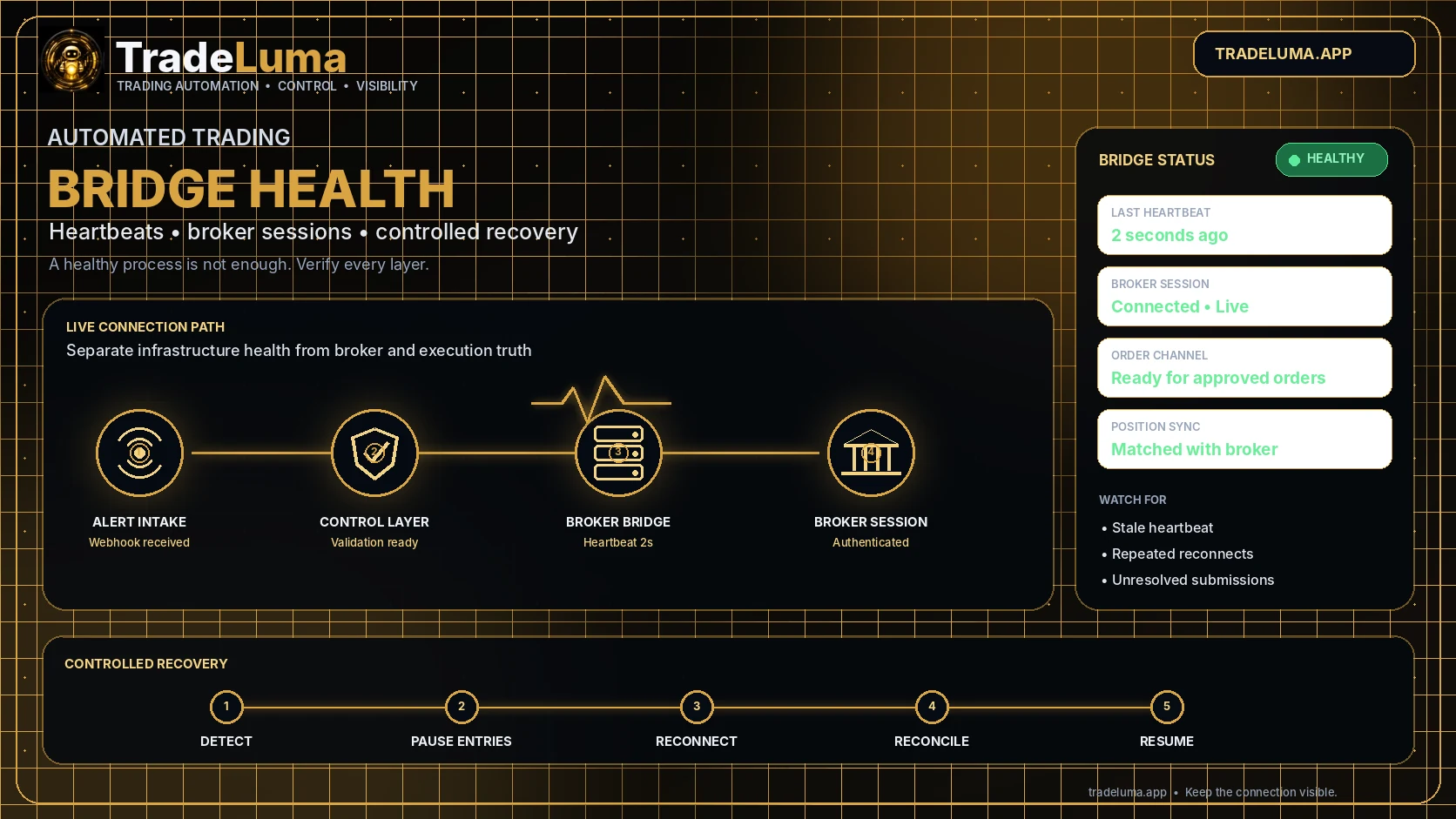
An automated trading bridge is the live connection layer that carries approved order instructions between a trading platform and a broker session. When it is healthy, it can appear almost invisible. When it becomes stale, disconnected, duplicated, or only partly recovered, the consequences can include delayed entries, unresolved exits, conflicting state, or false confidence that automation is still available. A dependable bridge therefore needs more than an online badge. It needs continuous evidence of life, clear session truth, controlled recovery, and reconciliation before normal execution resumes.
A running process is not the same as a healthy bridge
A bridge process can remain visible in an operating system while its broker socket is disconnected, its worker loop is stalled, its credentials have expired, or its account subscription is no longer receiving updates. A single green process indicator therefore proves very little about the full trading path.
Health should be divided into layers. Infrastructure health asks whether the service and host are running. Application health asks whether the bridge is processing work and publishing fresh state. Broker health asks whether the intended account session is authenticated and usable. Execution health asks whether orders can be acknowledged and tracked without unresolved state. Showing these layers separately prevents one healthy component from masking another that has failed.
Heartbeats turn silence into measurable evidence
A heartbeat is a small, periodic update that proves the bridge has recently completed part of its normal loop. It should include a timestamp, bridge identity, account scope, application version, and useful state such as connected, disconnected, paused, or action required. The monitoring service can then compare the heartbeat age with a defined freshness threshold.
The threshold should reflect the bridge design rather than an arbitrary number. A service that normally updates every few seconds may become stale after several missed intervals, while a lower-frequency process may need a wider allowance. Monitoring should distinguish a brief delay from a sustained outage so traders are not overwhelmed by alerts that resolve instantly.
Broker-session truth needs its own status
Broker connectivity can fail independently of the VPS or bridge application. Internet interruptions, broker maintenance, authentication prompts, session conflicts, account permissions, market-data issues, or another active login may leave the service alive but unable to trade normally.
A useful connection view should identify the broker account, paper or live mode, last successful broker interaction, session state, and any action required from the user. It should avoid describing a connection as live merely because the bridge process exists. For real orders and positions, the broker remains the authoritative source of truth.
Recovery should be a sequence, not a blind restart
Restarting a service can restore a failed connection, but it can also hide what happened immediately before the interruption. A controlled recovery sequence first records the incident, restricts new risk, checks whether any submission was left unresolved, and then reconnects using the correct account and environment.
After reconnection, the bridge should resubscribe to broker state, refresh working orders and positions, and verify that its local records still match the broker. Only then should it report that normal execution is available. Repeated restart loops should escalate as an action-required condition rather than continuing indefinitely.
Protect exits while new entries are paused
During uncertain connectivity, new entries and risk-reducing actions should not always be treated identically. A platform may pause instructions that add exposure while still allowing a verified close or cancellation path when the broker session is healthy enough to process it. The exact policy must be explicit and tested because an ambiguous half-connected state is dangerous.
Traders also need a direct broker fallback. No automation layer should be the only available way to inspect positions, cancel working orders, or reduce risk. The incident plan should state when to stop using the platform, when to move to the broker interface, and how the final account state will be reconciled afterward.
Operate the bridge like production infrastructure
A live bridge benefits from predictable startup behaviour, restricted access, automatic service recovery, version tracking, log retention, clock synchronisation, resource monitoring, and tested notifications. VPS changes, broker upgrades, certificate changes, and application releases should be introduced during controlled windows where possible.
Regular rehearsals are valuable. Stop the bridge in paper mode, interrupt the broker session, restart the host, create a stale-heartbeat condition, and confirm that the platform displays the correct state at every stage. A recovery process is trustworthy only after it has been practised before a real incident.
Frequently asked questions
What does a trading bridge heartbeat prove?
It proves that the bridge recently published an expected update. It does not by itself prove that the broker session is authenticated, that orders can be accepted, or that local positions match the broker.
Should an automated trading bridge restart itself?
Automatic restart can improve availability, but it should be bounded and observable. Repeated failures, unresolved orders, or authentication problems should trigger an action-required state rather than endless restarts.
When is a recovered bridge safe to resume?
After the correct account session is confirmed, working orders and positions are refreshed, unresolved submissions are investigated, local records are reconciled with the broker, and the execution controls report ready state.
Is a VPS required for trading automation?
Not every integration requires a user-managed VPS, but broker bridges that depend on a continuously running local application often benefit from a stable, secured host with reliable monitoring and restart procedures.
Continue learning
Related TradeLuma guides
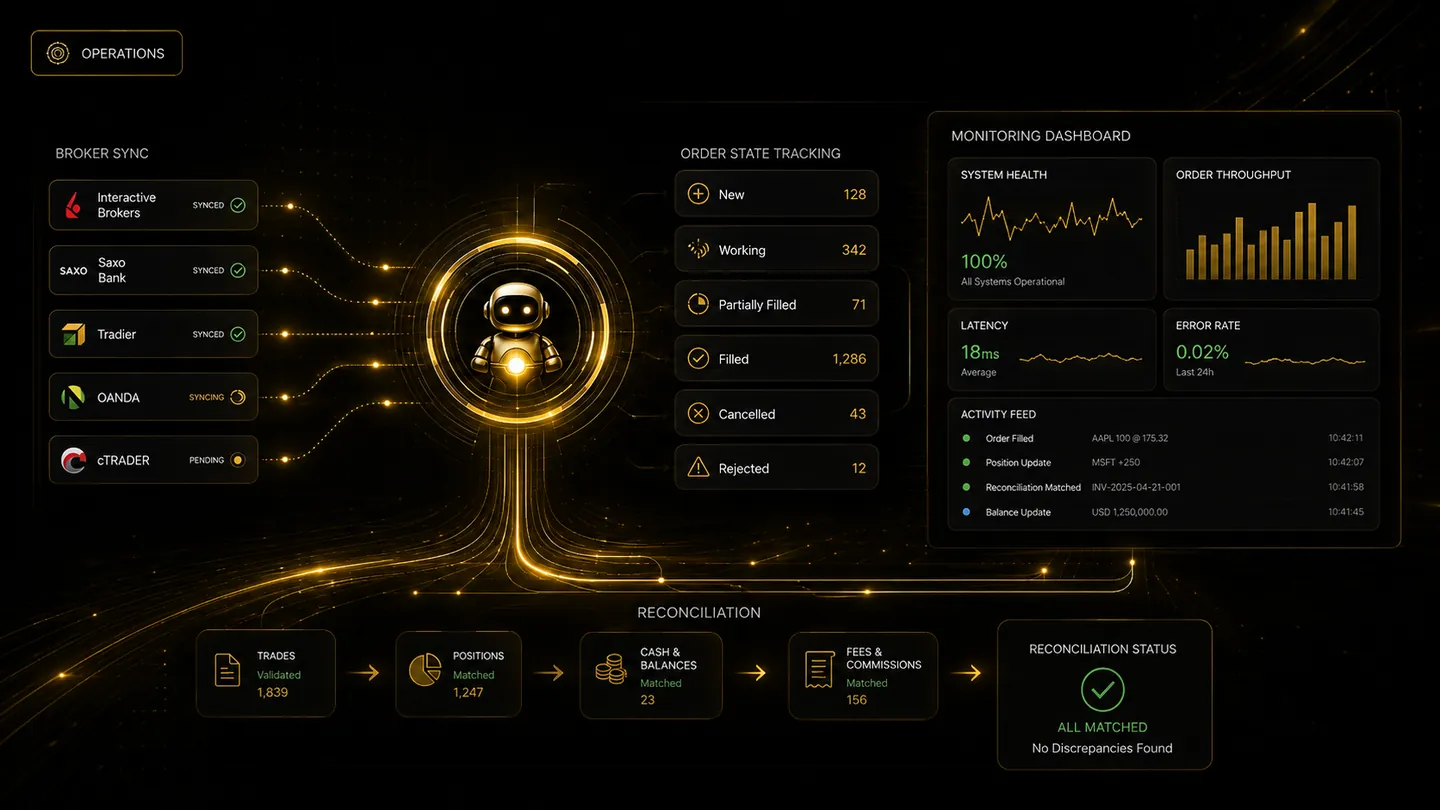
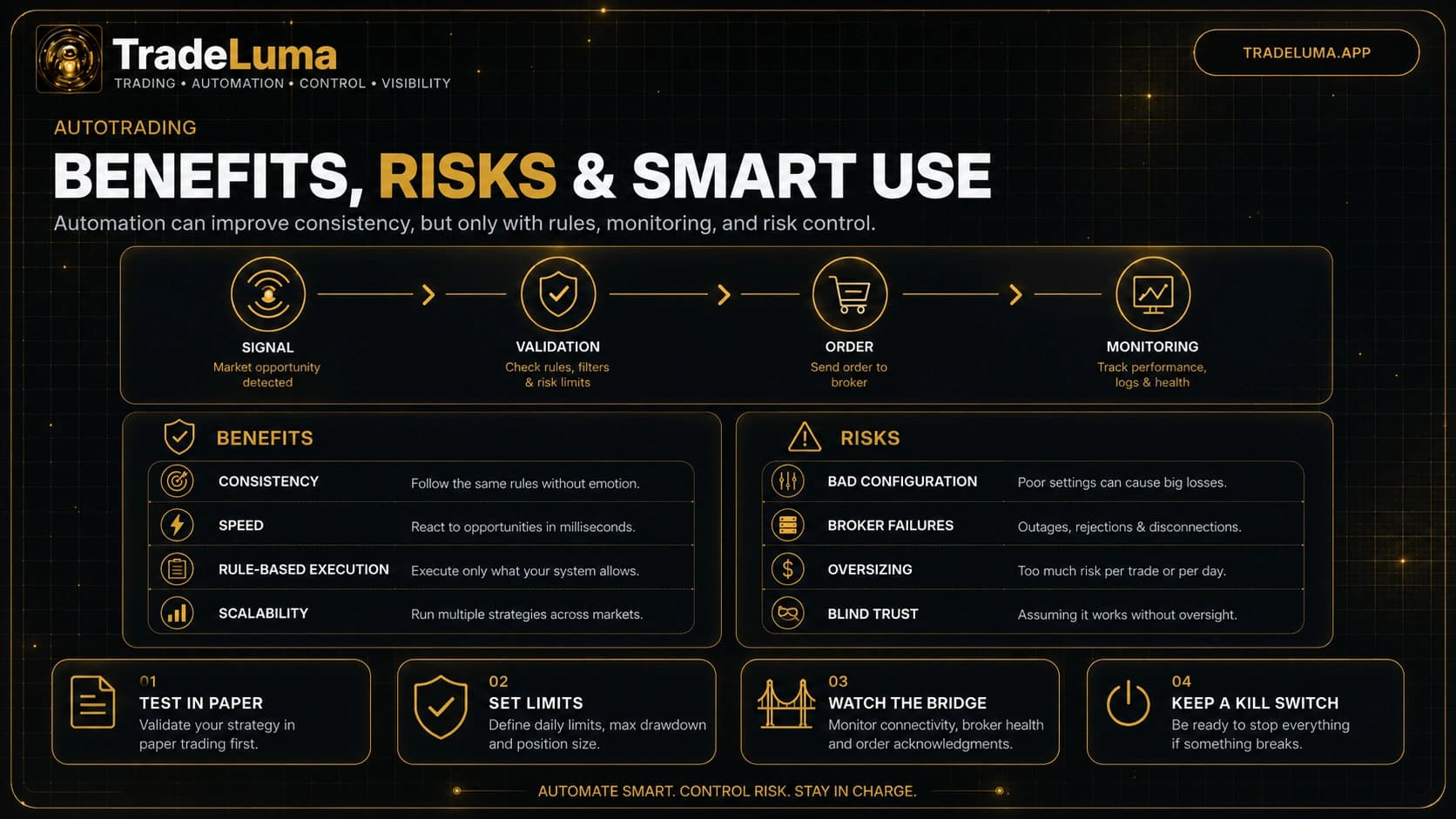
Build a controlled automation workflow with TradeLuma
Configure alerts, test in paper mode, apply execution controls, and follow broker outcomes from one workspace.