
Trading Strategies
Trend following trading strategy: how to trade with market direction
Learn how trend following strategies identify direction, enter pullbacks or breakouts, trail exits, manage whipsaws, and adapt risk to changing market conditions.
On this page+
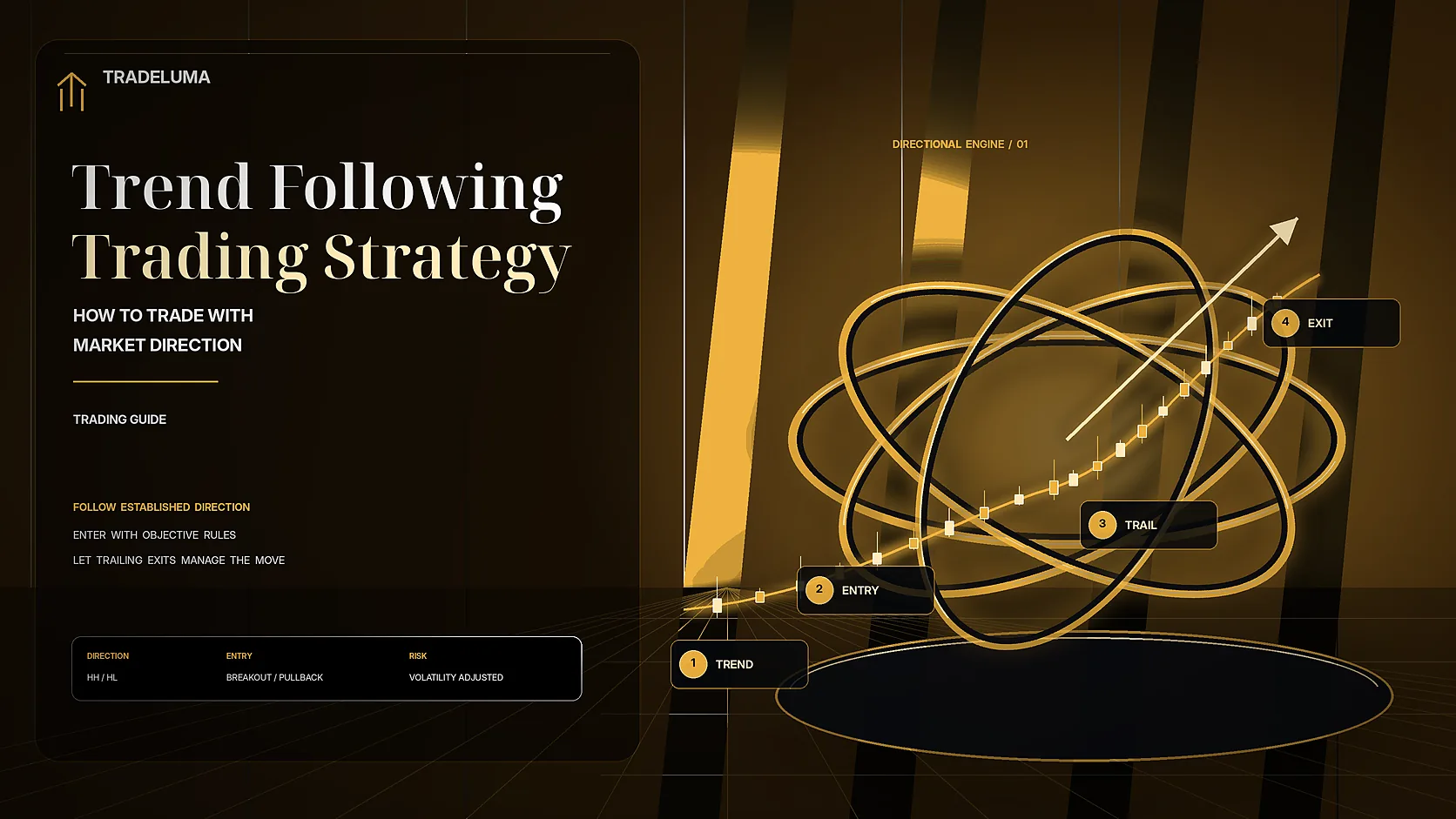
Trend following is built around a simple idea: once a market establishes directional movement, it may continue long enough for a rules-based strategy to participate. Trend followers do not need to predict the exact top or bottom. They usually wait for evidence that direction already exists, enter through a breakout or pullback rule, and stay with the position until the trend weakens or reverses. The cost of this approach is that sideways markets can produce repeated small losses before a sustained trend appears.
What trend following means
A trend-following strategy trades in the direction of established price movement. In an uptrend, the system looks for long opportunities; in a downtrend, it looks for short opportunities where the market and product allow them. The strategy usually avoids trying to call a reversal before there is evidence that direction has changed.
This creates a different mindset from prediction-based trading. The trader accepts entering after part of the move has already occurred in exchange for greater evidence that a directional condition exists.
How traders define a trend
Price structure is one approach: higher highs and higher lows can define an uptrend, while lower highs and lower lows can define a downtrend. Moving averages can also provide an objective filter, such as price remaining above a rising average or a faster average staying above a slower one.
Other systems use channel breakouts, directional indicators, or volatility-adjusted filters. The exact tool matters less than having a consistent definition that can be tested without hindsight.
Breakout entries versus pullback entries
Breakout trend entries join the market when price reaches a new high or low beyond recent structure. They prioritise momentum and confirmation. Pullback entries wait for a temporary move against the broader trend and try to enter at a better price if the trend resumes.
Breakouts can enter strong trends quickly but may suffer more failed signals. Pullbacks can improve reward-to-risk location but risk missing trends that accelerate without retracing. Some systems combine a trend filter with one specific entry type rather than switching subjectively between the two.
Why trend followers accept small losses
Markets spend meaningful periods moving sideways or reversing before a trend develops. During those periods, trend systems can enter, stop out, and enter again. These whipsaws are not necessarily evidence that the strategy is broken; they can be the cost of remaining ready for the next sustained move.
Because several small losses may occur before one large winner, position sizing must allow the strategy to survive a losing sequence. A trader who increases size after each failed signal can turn a normal strategy weakness into a serious account problem.
Using volatility in trend systems
Volatility affects both signal quality and risk. A fixed stop distance that works in calm conditions may be too tight when daily ranges expand. Many trend systems use average true range or another volatility measure to scale stops, trailing exits, or position size.
Volatility-adjusted sizing can also reduce exposure when markets become unusually fast. The purpose is not to remove risk but to keep account risk more consistent when the same instrument starts moving through larger ranges.
Trailing stops and letting winners run
Trend following often relies on asymmetric outcomes: many modest losses and a smaller number of large winners. Trailing stops are one way to stay in a profitable move while still defining an exit if the trend reverses. Examples include moving-average exits, channel exits, swing-point trails, and ATR-based stops.
Every trailing method gives back some open profit. A very tight trail protects gains quickly but can exit normal pullbacks. A wider trail captures more of a major trend but accepts larger reversals before the exit. That trade-off should be part of the backtest.
Trend filters across multiple timeframes
Some traders use a higher timeframe to define the broader trend and a lower timeframe to time entries. For example, the higher timeframe may need to be above a rising moving average before lower-timeframe pullbacks are considered. This can reduce trades that fight the dominant direction.
Multiple timeframes also create complexity. Signals can conflict, and changing the higher-timeframe filter can materially alter trade frequency. The rules should state exactly which timeframe controls direction and which timeframe controls entry.
Common trend-following mistakes
A common mistake is entering after an extended move with no plan for normal pullback risk. Another is abandoning the system after several whipsaws and then re-entering only after a large trend is already obvious. Trend following requires consistency because the largest winners are difficult to predict in advance.
Traders also damage trend systems by taking profits too quickly while allowing losses to exceed the intended stop. That reverses the payoff structure the strategy was designed to create.
How to evaluate a trend-following strategy
Test the system across trending and sideways periods, different volatility regimes, and enough trades to observe losing streaks. Review average win versus average loss, drawdown, time in market, and how much performance depends on a small number of exceptional trends.
A robust trend strategy should have rules that remain understandable outside the development sample. The goal is not to remove every losing trade but to capture directional movement with controlled downside when the trend fails to continue.
Frequently asked questions
What is a trend-following strategy?+
It is a rules-based approach that trades in the direction of established market movement and exits when that directional condition weakens or reverses.
Which indicators are used for trend following?+
Common tools include moving averages, price channels, swing structure, ATR-based filters, and directional indicators. A strategy does not need all of them; it needs a consistent rule set that can be tested.
Why do trend-following strategies get whipsawed?+
Sideways markets repeatedly create apparent directional moves that fail to continue. Trend systems accept some of these small losses in exchange for remaining available when a sustained trend develops.
Can trend following work on different markets?+
The concept can be applied to many liquid markets, but behaviour, costs, volatility, and contract or trading rules differ. Each implementation should be tested on the specific market and timeframe being traded.
Technical analysis
Continue with the topic hub.
Browse the related TradeLuma guides and build the topic from foundations through practical application.
Explore Technical analysis guides →Continue learning
Related guides.

Best Profitable Trading Strategies: 7 Approaches to Test
Compare seven widely used trading strategy styles, from trend following and breakouts to mean reversion, momentum, pullbacks, and pairs trading.

Mean reversion trading strategy: how pullbacks and range trades work
Learn how mean reversion trading works, how traders define a normal price zone, identify stretched moves, manage entries and stops, and avoid fighting strong trends.

Breakout trading strategy: entries, confirmation, stops, and false breakouts
Learn how breakout trading works, how traders identify consolidation and key levels, and how confirmation, stops, volume, and risk controls can reduce false-breakout mistakes.